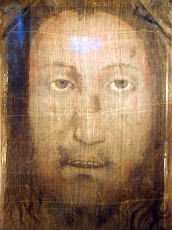
by Paul Badde, from Il Volto Santo di Manoppello the official publication of the Shrine of the Holy Face in Manoppello
"Perhaps it truly was John, the first who 'saw and believed', who previously had left to Peter the privilege of entering before him. John alone had been present at the burial to know that the 'sudarium had been placed on the face of Jesus'. Only an eyewitness of the burial would have been able to know such a detail. Perhaps he had observed how the Magdalen had placed the delicate veil of sea silk (marine byssus) on the Face of Jesus as a last tribute. Peter wasn't there. He wouldn't have known any of this. In any event, John would have immediately shown the veil to Peter in the opposite case. Because 'they hadn't in fact yet understood the Scriptures, that he would rise from the dead', continues John, using the plural. In any case, it had been a questions of mere seconds. But as for the rest of the account? Couldn't it be that all this could have happened differently? No, according to good sense, for whoever takes seriously the cloths and the texts of the Gospel and who has become familiar with the space of the sepulcher; and who still has enough fingers to add one plus one plus one plus one plus one equals five. Putting together all the components -- the eyewitness testimony of John, the space, the hour, the light and the cloths -- taking all these things together, adding as the first or the sixth component the Jewish reserve regarding the ritual impurity of tombs! --then the facts could not reasonably have gone any differently.
The conclusion is that Peter in the sepulcher must have lived an experience similar to that of Secondo Pia at Turin in 1898 when he withdrew the first photographic plates of the Shroud under the red light of the darkroom. Except that Peter's was an experience much more dramatic.
It is indispensable that there should have been a visible sign in the Sepulcher of the incedible event of the night of Easter, and this sign could not be the missing body of Jesus. That which Peter - or John - picked up from its 'special' position in the tomb, and held against the light, was the first testimony of that great event which was happening there. The little sudarium completes and explains the large sudarium. Together they are inserted in the Gospel as a puzzle is completed down to its every last piece.
As has been noted, on the Shroud, that is the large sudarium, one couldn't see anything at first in the narrow and dark chamber, where it was impossible for it to be unfolded. This brings us to the next step. Because not only can we but we must see how Peter and John hurriedly gathered up all these linens to bring them into the light. They had to bring them to a safe place. From that dark tomb nothing must be lost. Nothing should remain. Who knows what things the other cloths might be hiding? But all these are considerations which came forth later. Immediately they understood this: in that chamber death had lost its power. The deceased was no longer dead; those cloths were no longer impure.
The breaching of the presence of Christ into history began with a complete metamorphosis. If the Christ, already beginning with the dawn, had not shown his Face on the Sudarium, they would have left everything there. They were devout Jews. Burial cloths are not to be removed from empty tombs. According to the tradition of the Misnah, judaism is full of rigorous norms that declare the extreme impurity of all that is linked to the dead and their tombs, even after some time has passed. The Shroud, which just a little while later would have shown to the Church of Jerusalem the Passion of Christ in the Scriptures of an image, would not have been saved without the little sudarium on which the risen Christ had already shown his face. Mary Magdalen had left everything and had run to tell the Apostles. So would Peter and John also have done. They would have let everything stay there if the little fabric of light had not struck them. Then they would have simply gone outside in a hurry. But as I've said, the little Veil was there. The photo-image of the Sudarium forms the 'missing link' of the Paschal Vigil, in which is inserted the compelling logic which explains the unfolding of all the actions and the re-actions of those few moments.
Now they have taken the two sudaria with them together with the other cloths. This could have happened only in secret, in the early hours of the morning. And they didn't take them to the authorities but to Mary and the Apostles. 'Then the disciples returned home' writes John. Perhaps this refers to the cenacle on Mt. Sion where four days earlier they had celebrated the Passover with Jesus. Perhaps it was to a grotto-refuge in the garden of Gethsemane where they had found pilgrim lodging for the feast. But 'house' ,it clearly appears, in those days represented not only a habitation but the communion of the Apostles with Mary. It was to them, above all others, that they had brought the cloths that Easter morning. These cloths became, in the heart of the early church, the most precious treasure. Were they not perhaps the first pages of the joyful announcement of the Passion and Resurrection of Jesus Christ. Of course! Because of this it would be necessary to hide them right away and to keep secret not only their origin but even their very existence. Since these first documents of the Gospel of the early church were written on burial cloths, the most impure material of which the Jews were able to conceive. Their preservation would require a very intimate and secret place. Under no circumstances could the news get out. If the knowledge of these cloths amidst the Apostles had gotten out to Jerusalem -- and thus linked to the serious violations of the rules of purity -- the first Christians and also their first 'house' would not have survived the scandal. But John has not completely hidden the mystery. Eight verses following the recounting of the burial cloths he writes in his Gospel that already the evening of that first day of the week, when the disciples had locked the doors for fear of the Jews, Jesus entered with a greeting of peace in their midst,breathed on them and said: 'Receive the Holy Spirit' and showed them the wounds which -- in that hour-- had already been 'written' impressed, on the document of the Shroud. The 'fear of the Jews' would have easily induced the disciples to flee to Bethlehem, or to Gaza, or to Jordan, to Jericho or to the hills of Galilee, because they themselves were all jews. In all those distant places they would have all been safe. But their 'fear of the jews', which induced them, surprisingly, to lock the doors on that first Sunday evening, did not have any other reason than that of hiding and protecting the marvelous treasure which they were caring for. This was the so-called 'mystery' of early Christianity, by which, all of a sudden, that which up until then had been considered ritually impure would now be considered the purest relic. So that in this mystery was enclosed the images of light of these cloths, so closed that centuries would be required before the message that they contained would be able to go out from that secret place, and the splendid message of an image 'not made by human hands' would begin to spread everywhere in the Christian house, little by little, like a perfume of incense."
Monday, March 15, 2010


Friday, March 12, 2010
Videos by Father Laufer Which Explain the Story of the Holy Face of Manoppello Now Available in English
Father Josef Laufer of Germany has produced the following two videos on the Holy Face of Manoppello with the technical assistance of Michael Sauer. They have just become available in an English language translation. It is my voice reading the English narration that you will hear. Father Laufer's videos are a good summary of the current knowledge of the Holy Face. Plus you will see how Father Laufer has arranged that the Holy Face should be venerated in several beautiful Churches in the German countryside for which he is responsible. I encourage all to watch these well done videos and to share them with others.
http://www.youtube.com/watch?v=NeMySBuxBkM
http://www.youtube.com/watch?v=3ib_Ic_lOPw
http://www.youtube.com/watch?v=NeMySBuxBkM
http://www.youtube.com/watch?v=3ib_Ic_lOPw
Sunday, March 7, 2010
Scholars and Scientists to Discuss Images on Shroud of Turin, Veil of Manoppello, and Tilma of Guadalupe
A scholarly scientific conference entitled the International Workshop on the Scientific Approach to the Acheiropoietos Images will be held May 4,5, and 6th 2010 at the E.N.E.A scientific research center in Frascati, a beautiful and historic town in the hills above Rome. The website for the conference is http://www.acheiropoietos.info/ Among those giving papers or displaying poster exhibits are Heinrich Pfeiffer and Blandina Paschalis Schlomer of Germany; Andreas Resch of Austria, Giulio Fanti and Roberto Falcinelli of Italy; Z. Treppa, J.S. Jaworski, and K. Aszyk of Poland; and D. Scavone, D. Fulbright and J. Markwardt of the U.S.A. The conference will be conducted in English. According to the organizing committee the topics to be discussed are:
Images characteristics
Images formation hypotheses
Images dating
Images processing
Novel tools of analysis
Restoration and conservation issue
Comparison of different acheiropoietos images
Historical aspects
Forensic views
To see the abstracts of talks relating to the Veil of Manoppello see:
Frascati Acheiropoietos Workshop 2010 - ABSTRACTS - TALKS - MANOPPELLO VEIL
Of course the papers by Fr. Pfeiffer and the exhibits by Sr. Blandina will be very important and enlightening.
I was especially struck by the following article to be given at the conference which has to do with the phenonemon of the multiplicity of images which are seen on the Veil of Manoppello through photography:
The Appearance of the Changing Images on the Veil of Manoppello.
An examination of its implications for future scientific research through the discipline of photography by Zbigniew Treppa, Karolina Aszyk
Uniwersytet Gdanski, ul Bazynskiego 1a, 80-952 Gdansk
Summary
One aim of this research is to establish reasons why this Veil is so unique. I want to examine the message that it has for us. I have decided to concentrate on the semantic image. Semantics requires that we see the relationship between the language of words and the language of images. It would be impossible to read the message contained in the Shroud without the words contained in the Gospels. In the same way, it is impossible to find the meaning of the Veil without reference to the Gospels. In the case of the Veil, for a deeper understanding, it is necessary to analyse the structure of the material. All the more so, as the Veil allows us to enter into a field of exploration in a very unusual way and to start to find the secrets which have yet to be fully revealed.
I have been convinced that this is the way to gain knowledge of the Veil from the time when I was photographing it and had little expectation of being surprised. In a similar way to the Shroud, its meaning, which is hidden from the human eye, can be revealed with the aid of photography. I am a professional photographer and, when taking pictures of the Veil, I imagined I was producing a documentary file and nothing more. In the meantime, I analysed the pictures I had taken on a computer and reproduced them on a monitoring screen; there were marked differences in the photographs. The differences can be fully appreciated as the images were laid exactly in line with each other (the precision being outlined on the photos) and then the changes became apparent. The observations simply go unnoticed on casual inspection. These details are exposed when the Veil is examined under differing light conditions. The appearance of the changing images on the Veil impelled me to try to discover their true meaning.
The question has to be asked if these differences are not the capture of split-second moments in time that have been recorded on the Veil. Can we also put these recorded moments in a chronological order for a complete detailed version? I believe that it would be possible, with the aid of photography, to take a maximum number of photos and, after putting them into chronological order, to make an animated version of the whole scene.
From what I have observed, any critical mind can only want to seek an interpretation.
Images characteristics
Images formation hypotheses
Images dating
Images processing
Novel tools of analysis
Restoration and conservation issue
Comparison of different acheiropoietos images
Historical aspects
Forensic views
To see the abstracts of talks relating to the Veil of Manoppello see:
Frascati Acheiropoietos Workshop 2010 - ABSTRACTS - TALKS - MANOPPELLO VEIL
Of course the papers by Fr. Pfeiffer and the exhibits by Sr. Blandina will be very important and enlightening.
I was especially struck by the following article to be given at the conference which has to do with the phenonemon of the multiplicity of images which are seen on the Veil of Manoppello through photography:
The Appearance of the Changing Images on the Veil of Manoppello.
An examination of its implications for future scientific research through the discipline of photography by Zbigniew Treppa, Karolina Aszyk
Uniwersytet Gdanski, ul Bazynskiego 1a, 80-952 Gdansk
Summary
One aim of this research is to establish reasons why this Veil is so unique. I want to examine the message that it has for us. I have decided to concentrate on the semantic image. Semantics requires that we see the relationship between the language of words and the language of images. It would be impossible to read the message contained in the Shroud without the words contained in the Gospels. In the same way, it is impossible to find the meaning of the Veil without reference to the Gospels. In the case of the Veil, for a deeper understanding, it is necessary to analyse the structure of the material. All the more so, as the Veil allows us to enter into a field of exploration in a very unusual way and to start to find the secrets which have yet to be fully revealed.
I have been convinced that this is the way to gain knowledge of the Veil from the time when I was photographing it and had little expectation of being surprised. In a similar way to the Shroud, its meaning, which is hidden from the human eye, can be revealed with the aid of photography. I am a professional photographer and, when taking pictures of the Veil, I imagined I was producing a documentary file and nothing more. In the meantime, I analysed the pictures I had taken on a computer and reproduced them on a monitoring screen; there were marked differences in the photographs. The differences can be fully appreciated as the images were laid exactly in line with each other (the precision being outlined on the photos) and then the changes became apparent. The observations simply go unnoticed on casual inspection. These details are exposed when the Veil is examined under differing light conditions. The appearance of the changing images on the Veil impelled me to try to discover their true meaning.
The question has to be asked if these differences are not the capture of split-second moments in time that have been recorded on the Veil. Can we also put these recorded moments in a chronological order for a complete detailed version? I believe that it would be possible, with the aid of photography, to take a maximum number of photos and, after putting them into chronological order, to make an animated version of the whole scene.
From what I have observed, any critical mind can only want to seek an interpretation.
Saturday, March 6, 2010
Secondo Pia as Simon Peter, Part Six

by Paul Badde from Il Volto Santo the official publication of the Shrine of the Holy Face in Manoppello. This article is part of Paul Badde's new book Das Grabtuch Von Turin oder Das Geheimnis der heiligen Bilder which is soon to be published in Germany. I am looking forward to seeing it also published in English. I have heard that Prof. Badde's book on the Holy Face of Manoppello Das Gottliche Gesicht will soon be published in an English translation.
"Only three days prior Peter had said 'I don't know this man'. Some hours later he was forced to look and listen from far away. When Jesus was on the cross, covered with blood, he emitted a great cry and died. Certainly Peter remained even more disturbed when, suddenly, he saw the same Christ on the Veil which he held in his hands. Only now he recognized him, that Man. He recognized him right away. 'In your Light, O Lord, we see light' it had been recited in Israel for centuries in the Book of the Psalms. Did this verse now perhaps spring to his mind?
Or did he recall in that moment the words that Jesus had prophetically announced 'the Son of man will be put to death but after three days he will rise'. We don't know. But one thing we do know. Alongside the frightening emptiness of the burial cloths, in the tomb there was written this message contained in images: 'I am alive'. Jesus was no longer dead. The only thing corresponding to this image is not another image, no other icon nor any other painting. The only reality equivalent to that which Peter saw was the living man.
Everything was clear. Why didn't he now call out to John? It wasn't necessary. There were only two meters of distance between the two, one inside and the other outside the tomb. John became aware that Peter had remained shaken at his discovery. Then he also entered, he writes in his gospel and he said of himself 'he saw and believed'.
But he was also 'the disciple whom Jesus loved' as he willingly points out of himself. He was the disciple who later would take Mary, the Mother of Jesus into his house (and also Mary Magdalen as was written in many of the ancient sources) and who drank from the springs of the Mother as the source for his extraordinarily Marian gospel. The love of Christ for him and his love for Christ made him the first to understand the significance of the true image. Could it be that John, and not Peter was the first to raise the veil from the earth and to hold it against the light? Perhaps. 'The risen one is not seen as a piece of wood or stone is seen' wrote Joseph Ratzinger in 1985. 'he alone who sees is the one to whom He has revealed Himself. And He reveals Himself only to those who can be sent. He doesn't reveal Himself to curiosity, but to love."
Saturday, February 20, 2010
Secondo Pia as Simon Peter, Part Five
by Paul Badde, from the official publication of the Shrine of the Holy Face, Il Volto Santo di Manoppello, December 2009.
"At his feet the flickering light was concentrated on something of an indefinable quality, as the wind is able to capture the quavering of a burning bramble thicket in the bush. It had the appearance of golden bronze. If it had remained together with the other cloths on the stone slab, Peter would not have even seen nor felt it with his fingers, because it was very soft and delicate. Only with the light on the pavement was he able to become aware of it. It would not have been possible to notice it on the slab where no light had yet arrived. Because of the low entrance the tenuous rays of light were able to shine only on the pavement. On top of the stone slab the burial cloths remained in the darkness.
Only on the pavement had Peter been able to recognize something, and that which he saw was a fabric as delicate as a breath and so fine that Peter would not have even been aware of it had it remained lying flat on the ground. But it was rolled up, wound around itself. The greek word entetyligmenos which John used must have this meaning. An expression which thus clarifies at least one thing -- it wasn't flat. It was like a breath, but in some way was recognizable as an 'object', a 'material thing' which was captured in the dawn's early light. This is clear. Peter bowed down and picked it up. It was the precious fabric which had been placed on the face of Jesus, made from the finest silk from the sea. It was as light as the feather of an angel. When Peter picked it up he unrolled it and held it against the light coming from the entrance. How else could it be? He didn't direct it towards the darkness of the chamber, inside, but outside against the light. For it was a fabric of light. That reacted to the light.

That which Peter witnessed on that veil held in the direction of the morning light at that moment in the tomb suddenly made it as clear as the sun, no one had taken the Lord away from the tomb. Jesus was not stolen, taken away. Something totally new had happened in the world. That which Peter, in those hours of tenuous light on the first morning of Easter, had recognized on that transparent fabric, in the transparence against the light of the entrance, was an event that had never happened before. It was a veil 'not made by human hands' it would be said later. It was the True Image"
Friday, February 19, 2010
Secondo Pia as Simon Peter, Part Four
"Why then didn't Peter hurry outside to go with John to the Roman Governor? why then didn't he cry out 'they have taken away the Lord'. When didn't he immediately look for the other apostles to decide with them what to do, or to go to the Sanhedrin to complain with all the force he could muster, 'it's not possible! You first put to death our Teacher and afterwards take away in secret his body. He is a Jew like us. Doesn't he at least have the right to the peace of the dead? What other sacrilege do you still want to commit?' Was he too afraid to do this? Why didn't he run with John to Joseph of Arimathea and to Nicodemus who had placed Jesus in the tomb and had arranged for the great stone to be placed before the entrance. Why not? Because the thread of the story continues very differently from what the Madalen had said regarding her experience and observation. 'They have taken away the Lord from the tomb and we don't know where they have laid him'. Peter himself didn't show himself to be wiser or more prophetic than the Magadalen. There was no other possibility other than the fact that Jesus had been taken away. In what way? Perhaps by the Romans, perhaps by thieves or by who knows what other persons. But one thing was certain -- he was no longer there! He had simply vanished.
This is how the women interpreted what had happened and also Peter as well, but with one difference. He 'saw the wrappings unfolded and the sudarium that was placed around the head of Jesus', we read in the Gospel, 'but (the sudarium) was not with the wrappings, rather folded in a separate place'. Let's not forget that it was still very dark when Mary Magdalen arrived. The entrance to the tomb opened towards the east, towards the walls of the city. There the dawn rises very slowly. A weak morning light succeeds in penetrating through the opening of the rock in that hollow of small dimensions. This was the difference. Peter unexpectedly recognized something else in the dark on the pavement."
by Paul Badde
from the official publication of the Shrine of the Holy Face Il Volto Santo di Manoppello, Dec. 2009
This is how the women interpreted what had happened and also Peter as well, but with one difference. He 'saw the wrappings unfolded and the sudarium that was placed around the head of Jesus', we read in the Gospel, 'but (the sudarium) was not with the wrappings, rather folded in a separate place'. Let's not forget that it was still very dark when Mary Magdalen arrived. The entrance to the tomb opened towards the east, towards the walls of the city. There the dawn rises very slowly. A weak morning light succeeds in penetrating through the opening of the rock in that hollow of small dimensions. This was the difference. Peter unexpectedly recognized something else in the dark on the pavement."
by Paul Badde
from the official publication of the Shrine of the Holy Face Il Volto Santo di Manoppello, Dec. 2009
Friday, February 12, 2010
Secondo Pia as Simon Peter part three
continuing my translation of Paul Badde's article from the official publication of the shrine of the Holy Face of Manoppello Il Volto Santo Santo di Manoppello, December 2009
"It would be helpful to take a look at the road leading to the tomb of Christ, in company with Peter and John. Mary Magdalen had run in a hurry to them "early in the morning when it was still dark" and had alarmed them "they have taken away the Lord from the tomb and we don't know where they have laid him". Was this meeting perhaps at a refuge at the feet of the Mount of Olives or on Mount Sion? We don't know. To travel the road to and from Mt. Sion would have taken around a quarter of an hour, while to go to the Mount of Olives and then return would have required double that. And then the effort would have been tiring, uphill, towards the city and around the walls of the city. All this remains unspoken. Could the Magdalen have been able to see inside the tomb without any light? We don't know. In the darkness she had seen that the massive rock which served to close the entrance had been removed, rolled away, writes John who in the pre-dawn hours had hurried to the tomb together with Peter. Had it already begun to grow lighter? It's possible but at Jerusalem the dawning corrresponds to a rather brief period of time. "Then Peter and the other disciple left and headed for the tomb" it is nevertheless written in the Gospel. "They ran together but since the other disciple was younger, he arrived first. He bent down and saw the cloths laid out but did not enter into the tomb". John had to bend down. Still today we note how low the entrance was. The things which could been able to have been distinguished in this room, from the outside, could not have been many. But why then didn't he enter. Certainly partly due to the religious respect towards tombs which is held by every devout Jew. John had been under the cross. He knew that Jesus was truly dead. Respectful also was Simon Peter, and also no less devout. But he was certainly in a state of total confusion. Peter was beside himself from the moment two evenings before when he had betrayed three times the dearest person in his life, and this in the hour of his greatest suffering. Now he ran behind, but wanted to enter immediately into the burial chamber. No one could have been able to stop him. After the disturbing news from the Magadalen he had to enter, he had to verify what had happened. It wasn't much. He saw the cloths lying there, writes John, but without candles, without light, in the weak light of the fleeing night which would be able to penetrate through the narrow opening, we can think of this "seeing" without a doubt more as a touching and feeling. How could it be any different? The cloths were liturgically impure, as the rest of the tomb was. There it was fully dark, above all to the right, alongside the entrance above the stone slab where Jesus had been laid. Then Peter touched and "saw" the cloths and immediately understood, he is not here! There was no one there anymore. Again another time he felt the various cloths on the bed of stone. Jesus was not there any more. There was no doubt!"
"It would be helpful to take a look at the road leading to the tomb of Christ, in company with Peter and John. Mary Magdalen had run in a hurry to them "early in the morning when it was still dark" and had alarmed them "they have taken away the Lord from the tomb and we don't know where they have laid him". Was this meeting perhaps at a refuge at the feet of the Mount of Olives or on Mount Sion? We don't know. To travel the road to and from Mt. Sion would have taken around a quarter of an hour, while to go to the Mount of Olives and then return would have required double that. And then the effort would have been tiring, uphill, towards the city and around the walls of the city. All this remains unspoken. Could the Magdalen have been able to see inside the tomb without any light? We don't know. In the darkness she had seen that the massive rock which served to close the entrance had been removed, rolled away, writes John who in the pre-dawn hours had hurried to the tomb together with Peter. Had it already begun to grow lighter? It's possible but at Jerusalem the dawning corrresponds to a rather brief period of time. "Then Peter and the other disciple left and headed for the tomb" it is nevertheless written in the Gospel. "They ran together but since the other disciple was younger, he arrived first. He bent down and saw the cloths laid out but did not enter into the tomb". John had to bend down. Still today we note how low the entrance was. The things which could been able to have been distinguished in this room, from the outside, could not have been many. But why then didn't he enter. Certainly partly due to the religious respect towards tombs which is held by every devout Jew. John had been under the cross. He knew that Jesus was truly dead. Respectful also was Simon Peter, and also no less devout. But he was certainly in a state of total confusion. Peter was beside himself from the moment two evenings before when he had betrayed three times the dearest person in his life, and this in the hour of his greatest suffering. Now he ran behind, but wanted to enter immediately into the burial chamber. No one could have been able to stop him. After the disturbing news from the Magadalen he had to enter, he had to verify what had happened. It wasn't much. He saw the cloths lying there, writes John, but without candles, without light, in the weak light of the fleeing night which would be able to penetrate through the narrow opening, we can think of this "seeing" without a doubt more as a touching and feeling. How could it be any different? The cloths were liturgically impure, as the rest of the tomb was. There it was fully dark, above all to the right, alongside the entrance above the stone slab where Jesus had been laid. Then Peter touched and "saw" the cloths and immediately understood, he is not here! There was no one there anymore. Again another time he felt the various cloths on the bed of stone. Jesus was not there any more. There was no doubt!"
Subscribe to:
Posts (Atom)