Wednesday, August 7, 2024

Beautiful Video and Photos at Manoppello of the Holy Face on the Feast of the Transfiguration

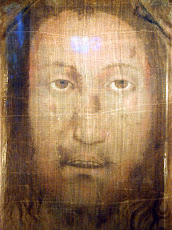
Every year there is a local celebration in Manoppello to honor the Holy Face on the feast of the Transfiguration. I am extremely grateful to Angelo Rytz for the tremendous video of the Feast of the Transfiguration and to Alexandra Prandell for the beautiful photos of the Holy Face.  Both the video and the photos capture well the joy which the Holy Face brings. 


Fr. Antonio Gentili, O.F.M., Cap., Rector of the Shrine of the Holy Face holding the monstrance of the Holy Face.  Notice in the photo below the fineness of the Veil which allows Fr. Antonio's face to be seen through the Veil.  


Sunday, August 4, 2024

Paul Badde's Talk for the Conference held at the Shrine of the Holy Face of Manoppello August 3, 2024.


Fr. Heinrich Pfeiffer, S.J. during the Omnis Terra Procession January 2017
 (Photo by Antonio Bini)


"THE MEDIUM IS THE MESSAGE!"

by Paul Badde

Some reflections on the 25th anniversary of the identification of the Holy Face with the Roman Veronica by Fr. Heinrich Pfeiffer S.J.

"The Jubilee of 2025 will probably be the Jubilee of the Holy Face", said Father Germano Franco di Pietro OFM Cap. in the magazine 'L'Arena' of Verona on November 22, 2000. How did the sober rector of the Basilica of the Holy Face in Manoppello come to this conclusion? What happened?

A year earlier, on May 31, 1999, the German professor and Jesuit priest Heinrich Pfeiffer had announced, in a press conference at the Foreign Press Office in Rome, on the initiative of Antonio Bini, the revolutionary hypothesis that the Holy Face of Manoppello was really the veil of the image that for centuries, until 1999, had been called "Veronica" in St. Peter's in the Vatican. The wealth of arguments in favor of his argument was convincing and overwhelming.

In a documentary about the event, however, I see today that 7 English, 18 German and 68 Italian newspapers reported on the press conference at the time, as well as a French magazine and two Spanish and two Polish newspapers. Five agencies, the world broadcaster BBC and television networks of Spain, Holland, Uruguay, Italy, Germany, Switzerland and Mexico also spoke about it.

But I also realize that none of the colleagues I knew went to Manoppello at the time to verify with their own eyes the bold hypothesis of Father Pfeiffer. I myself was still living in Munich in 1999 and in Jerusalem in 2000 and had heard nothing of the whole affair, even though I had to follow the press closely every day at the time.

The Vatican remained very cautious about the whole affair. It coldly rejected Father Pfeiffer's hypothesis in an essay by Dario Rezzi, canon of St. Peter's Basilica, in the magazine "30 Days" and granted a certain Roberto Falcinelli generous access to the relic of the Roman Veronica, only to have him spread the news in another essay in an anthology that the veil painted in Manoppello is the work of Albrecht Dürer. How did this come about and how should it be understood?

The reasons are fundamentally varied.

First, in 1999 the Roman Veronica had a 791-year history of well-documented veneration behind her, which began in 1208, when Pope Innocent first personally and publicly carried the veil from St. Peter's Basilica to the nearby Hospital of Santo Spirito in Sassia.

Secondly, on April 18, 1506, Pope Julius II laid the cornerstone of the new - current - St. Peter's Basilica in the Vatican right under the so-called Pillar of Veronica. This is one of the four pillars that support the dome of St. Peter's and was designed by the architect Bramante from the beginning as a security safe for the veil of Veronica. This veil of the "Sanctissimum Sudarium" with the "human face of God" (Benedict XVI) was in some way conceived as the foundation of the largest and most important church in Christianity.

Thirdly, however, a term coined by the great Catholic theorist and philosopher of communication Marshall McLuhan in 1964 comes to our aid, when in the first chapter of his book "Understanding Media, The Extensions of Man" he categorically stated: "The medium is the message".

What did he mean?

First, perhaps, this: packaging is what makes a gift a gift, my wife says!

Here are three examples:

I am almost certain that the Eucharistic monstrance originates from the frame that was once used to carry the Holy Face through Rome. In fact, how could one think of creating an elaborate frame for an image between two crystal discs that could be seen from two sides and that would show us an "image" of the treasured God? I just can't imagine that this idea was possible without the model with which the Holy Face was first carried around Rome. But unlike the original frame of the Holy Face, the monstrance needed an elaborate and precious halo of rays, each of which seemed to say above the small white host in the center: "Behold, it is the Lord!" THIS IS THE MEDIUM, which here is, so to speak, the message itself: it is the Lord!

The same goes for the entire Column of Veronica by architect Bramante in St. Peter's Basilica in the Vatican. You won't find a more precious safe anywhere in the world. Overall, this is a grand monstrance for the so-called Veil of Veronica! And that's not all: it also has its bells in the column and its liturgy for the time when the veil is displayed once a year.

And that's not all. Unlike the original frame of the Holy Face with two transparent crystal plates, which can still be admired today in the Treasury of St. Peter's, the Vatican's "Veronica" was suddenly presented to the faithful in this Veronica Column by Pope Urban VIII (1623 - 1644) through a completely different means (i.e. the medium). It was an extremely precious and heavy frame, which was to emphasize the immeasurable value of the relic with gold and silver and the most precious stones. It had only one flaw compared to the original old frame. It was no longer transparent, because suddenly the new relic was no longer transparent either. However, the whole mounting should make every pilgrim think: It is the Lord who shows himself here!

All this is perhaps surpassed only by the Cathedral of Orvieto, which makes the entire Umbrian city a unique monstrance among all the wonderful Italian cities. This basilica, with its wonderful chapel of the treasure, was built entirely for the corporal of nearby Bolsena, on which blood dripped in 1264 when a certain Father Peter of Prague doubted the presence of Christ in the host transformed during Holy Mass! Later and from then on the Cathedral of Orvieto and with it the entire city were built as a single MEDIUM for this corporal, as already mentioned, as a large monstrance.

Even so, the corporal originates from the liturgical cloths of the altar and was once called a sudarium. It is in fact the cloth that is separated from all the other cloths of the altar after coming into contact with the transformed host (that is, with Corpus Christi), just as the real sudarium came into contact with the face of the Lord on which it had been placed at the time of his burial.

And if we now compare this cathedral of Orvieto with the Basilica of the Holy Face of Manoppello, where the real Sudarium is venerated, we see something different, which we can also study in the magnificent church of San Camillo di Lellis in nearby Bucchianico. It is the oldest Baroque church in Abruzzo, which since its foundation has attracted pilgrims to venerate the saint, although he himself is not even buried here, but in Rome in the church of Santa Maria Maddalena, behind Piazza Navona. In Bucchianico, therefore, only this splendid "means" has remembered the saint for centuries, while in nearby Manoppello the human face of the God has been mostly hidden in the simple church of Saint Michael of the Capuchins and where even today these centuries of continuous and appropriate veneration of the most precious relic of Christianity are lacking!

But unlike all these examples, in Manoppello the medium is not the message. In the Holy Face, the message speaks to us as "the human face of God among men" even without the beautiful, freshly cleaned frame. Perhaps the prophetic Rector Germano was right in the year 2000 just a little wrong about the year, and that only the Holy Year 2050 will be the true jubilee of the Holy Face. Because this face in the Holy Sudarium shows not only the way and the life - but also the truth. But the truth is not in a hurry. The truth can certainly wait.


Friday, June 14, 2024

Veronica in Ugo da Carpi's Altarpiece. Similarities to the Holy Face


by Antonio Bini

A work of art can hold many surprises even after centuries. This is the case of the Altarpiece of the Sudarium of the Holy Face by Ugo dei Conti di Panico, known as Ugo da Carpi, commissioned by Pope Clement VII for the Jubilee of 1525, which shows Veronica unfurling the veil of the Holy Face between the apostles Peter and Paul.

The work was intended for the altar of the Holy Face, located in the lower part of the ciborium (freestanding edifice) of the ancient basilica, which in the upper part housed the Veronica, closed in a special chest, with a number of bolt locks controlled by the canons of St. Peter's, while the final key was in the hands of the pope. The ciborium is comprehensible in the illustration, shown below, by Jacopo Grimaldi, canon of St. Peter's, along with a map of the old basilica showing the location of the ciborium close to the Holy Door.


arrow points to the location of the Ciborium


Arrow points to the description of the Ciborium as the altar of the Holy Face and Sudarium 


Da Carpi's work appears destined to arouse new interest thanks to recent diagnostic analyses that have revealed the uniqueness of the work, confirming that it is not a painting, as noted in the margin by the author himself who wrote  "per Ugo da Carpi intaiatore fata senza penello", (by Ugo da Carpi engraver made without a paintbrush) but a masterpiece of engraving produced through multi-layered printing.


The work was at the center of an anecdote told by Giorgio Vasari, who refers to the conversation he had with Michelangelo:

"Ugo da Carpi, though a mediocre painter, was nevertheless, in other fancies, of the most acute genius. And since, as I have said, he was a painter, I will not be silent that he painted in oil without using a paintbrush, but with his fingers, and partly with his quirky instruments, an altarpiece that is in Rome at the altar of the Holy Face; which altarpiece, as I was one morning with Michelangelo to hear Mass at the said altar and seeing written upon it that Ugo da Carpi had made it without a paintbrush, I laughingly showed this inscription to Michelangelo, who also laughingly replied "It would have been better if he had used the paintbrush and done it in a better manner" (Giorgio Vasari, The Lives of the Most Excellent Architects,  Italian painters and sculptors).                                              

Both Vasari and Michelangelo expressed their critical judgment by dwelling on the artistic value of the work, not understanding the meaning of the artist's message, who evidently wanted to experiment with a mode of reproduction that would allow him to respect, in some way, the acheropite nature of the Holy Face, which Ugo da Carpi had certainly been able to see.

Vasari also speaks of the "Holy Face" and the episode he describes highlights the importance of that altar at the time, where only the work of Ugo da Carpi was visible.

This hypothesis regarding Ugo da Carpi's intention to respect the acheropite nature of the Holy Face had already been put forward by Giovanni Morello, even before recent scientific examinations, on the occasion of the display of the work in the exhibition The Face of Christ, inaugurated on December 9, 2000 at the Palazzo delle Esposizioni in Rome, which concluded the Great Jubilee of 2000.  For that exhibition Morello wrote that "the realization  cannot be connected to the mere whim or extravagance of the artist,  but rather to the very nature of the work, which was to reproduce the Veronica, an acheropite image, that is, not made by human hands" (cf. Il Volto di Cristo, Electa, Milan, 2000, p. 111). And Morello, at the time director of the Vatican museums, wrote with full knowledge of the facts.              

The panel was exhibited in Turin from June 16 to August 22, 2022, at the Medieval Court of Palazzo Madama and was exhibited again in Carpi, five hundred years after its creation, in Ugo's hometown.


The work, which has lost its original brightly colored quality, is considered by Pietro Zander, head of the Artistic Heritage section of the Fabrica of St. Peter's Basilica and curator of the two exhibitions, to be one of the most important works in St. Peter's.

I was able to visit the exhibition in Carpi and see the work up close, on display in the Museums of Palazzo dei Pio from February 24 to June 29, 2024. In the exhibition, several panels illustrate in detail the note written by Ugo da Carpi, to emphasize how the work was executed "without a paintbrush".

Fr. Heinrich Pfeiffer opined that Ugo da Carpi was inspired rather by the Mandilion, which at that time was preserved in the Church of San Silvestro, rather than by the Veronica (Holy Face), as it would have been "easier for him to imitate an icon than the image on the Veil which varies continuously and which presents itself with a different appearance according to the illumination and angle of the observer" (Il Volto Santo,  ed. Carsa, Pescara, 2000, p. 23).

These are certainly well-founded hypotheses, even if some details closely related to the face, examined a few centimeters from the Panel, such as the eyes, open, but with pupils of different sizes and the nose, which is swollen, suggest that the artist was inspired by the Holy Face.


Saturday, June 1, 2024

25 Years Since the Historic Press Conference in Rome of Fr. Heinrich Pfeiffer, S.J. Announcing that the Veronica is in Abruzzo


Fr. Germano di Pietro, O.F.M, Cap., Antonio Bini, Fr. Heinrich Pfeiffer, S.J.

May 31, 2024 marked the 25th anniversary of the Press Conference held in Rome by Fr. Heinrich Pfeiffer, S.J., distinguished professor of the history of Christian art at the Gregorian University of Rome which announced to  the world press the rediscovery of the Veronica in Abruzzo, at the shrine of the Holy Face in Manoppello.  https://holyfaceofmanoppello.blogspot.com/2019/07/twenty-years-ago-world-heard-that.html  

It is fitting at this time to remember the devoted work of Fr. Pfeiffer which established with great erudition the rediscovery of the Veronica and that the same cloth was also the "facecloth" (sudarium) that was on the face of Jesus in the tomb.

To that end I would like to post a Holy Face prayer card printed by Fr. Pfeiffer in the year 2000 which was provided to me by Antonio Bini, a close collaborator and friend of Fr. Pfeiffer.  The prayer card includes an inscription "to Antonio and the family" alongside a prayer to the Holy Face composed by Fr. Pfeiffer himself, along with a short history of the Holy Veil in Manoppello.  Fr. Pfeiffer's recounting of the history  of the Veil in Manoppello has now been superseded by more recent research showing that the Veil disappeared from Rome around the time of the Sack of Rome of 1527.  and that research on the whereabouts of the Veil from 1527 until 1608 is now ongoing


Text from the cover of the prayer card:

The Sacred Veil of the Shrine of the Holy Face of Manoppello

According to tradition it was brought to Manoppello in 1506 by a pilgrim who then vanished from sight.  Recent historical studies instead have reached the conclusion that it is the “Veronica”, smuggled out of Rome in 1608, sold in Manoppello in 1618, given to the Capuchin Fathers in 1638, and exposed for the veneration of the people in 1646.  It is a most subtle veil, with the dimensions of 17 x 24 centimeters.  The image of the face is seen identically from both sides, a characteristic that makes it an object unique in all the world.  It is perfectly superimposable over the face of the Shroud of Turin in such a way that it shows a single image.  Researched conducted with a high resolution 3D scanner has revealted the lack of color among the threads and within any of the threads.  


Inscription in Fr. Pfeiffer's handwriting:  To Antonio and the family best wishes for the celebrations of Christmas and New Year’s Day under the gaze of Jesus.

Fr. Heinrich Pfeiffer, S.J.


Prayer of Fr. Heinrich Pfeiffer, S.J.

"Et sudarium, quod fuerat super caput eius" (John 20:7)

"And the cloth (sudarium) which had covered his head"

The Lord wished to leave us his eternally imprinted Face so that everyone might remain steadfast

in love and in Love unite their own gaze with His, so that in the meeting of their gazes –

everyone might recognize the Divine Spirit, Light that illuminates the mind, and that they might

have Love in their heart.

O Mother of sorrows, Virtue shining and permeated with grace, impress this Face within me,

implore for me Purity, Beauty and Light. And as man doubts that the Lord has given us his face,

to remain among us and to let Love flow from our hearts, cast your gaze upon us, O Face of the

Father in the Son, and give us peace at last.


Also to pay tribute to Fr. Pfeiffer I would like to quote from a recent article entitled "The Church, Testing of Relics and the Holy Face"  written and posted on her very beautiful blog by Patricia Enk of New Orleans, an artist who is highly knowledgeable about the history and current state of devotion to the Holy Face throughout the Church. https://illuminadomine.com/2024/05/30/the-church-testing-of-relics-and-the-holy-face/

"The late, highly respected Heinrich Pfeiffer S.J. was an eminently qualified teacher of art history and Christian iconography at the Pontifical Gregorian University in Rome. He was also an expert “sindonologist.” Sindonology is the study of the Shroud of Turin, which is its own branch of science. In the course of his many years of research he traveled to the Shrine of the Holy Face in Manoppello. Upon seeing the Veil for himself, he immediately recognized it as the “proto-image” or original from which most icons, paintings, and other representations of “the Veronica” had been derived. The incredible “Veronica” of Manoppello was believed to be the veil that covered the Face of Jesus in the tomb. 

(Author Paul Badde has written much about this search for the “rediscovered face” in his books: The Face of God – the Rediscovery of the True Face of Jesus, The True Icon: From the Shroud of Turin to the Veil of Manoppello, and The Holy Veil of Manoppello: The Human Face of God.)

When, as a scholar, Fr. Pfeiffer joyfully and dutifully reported the fruits of his research, “all hell broke loose.” Instead of being met with rejoicing over the historic discovery of the “proto-image” of the Veronica–a miraculous image that corresponds to historic accounts and countless works of art in museums and churches around the world–Fr. Pfeiffer was roundly vilified by persons who, while accusing him of perpetrating fraud, also refused to look at his evidence. Any requests that Fr. Pfieffer or other scholars and researchers made to look into the authenticity of the relic veil held in the Vatican were declined by bureaucrats.

The indisputable abundance of centuries of art history, that even a child can see, points to the Veil of Manoppello as the original proto-image. But piles of comparisons are not enough to satisfy the outraged critics. Fr. Pfeiffer’s vast research that led him to Manoppello continues to be rejected out of hand, and ignored by those who refuse to look at the data. Unless the relic at the Vatican is examined, the controversy between the two relics of the Face of Jesus will remain at a stalemate, and continue to be a unhappy source of division in the Body of Christ. It was the cause of much suffering for Fr. Pfeiffer in his lifetime, but he was committed to speaking and writing about what he had discovered until he died in 2021."

May the upcoming Holy Year of 2025 bring Fr. Pfeiffer's vision of the Holy Face of Manoppello to the whole Church, through the diligent and loving work of each of us who are devoted to the Holy Face, but also through the honest and free investigation by the Vatican authorities of  this important matter utilizing the life's work of Fr. Pfeiffer and that of other reputable scholars and researchers.

Pope Benedict XVI, Fr. Heinrich Pfeiffer, S.J., Paul Badde and Sr. Blandina Schlömer
at the Shrine of the Holy Face of Manoppello on September 1, 2006


Photo by Alexandra Prandell


From the Sunday Times of London May 30, 1999 edition


Sunday, March 31, 2024

Christ is Risen, Alleluia!


Photo by Paul Badde

O God of Hosts Let Your Face Shine, and We Shall be Saved!

Psalm 80

Sunday, February 11, 2024

Live Streaming of the Holy Face of Manoppello

It is now possible to see the Holy Face of Manoppello Livestreaming on the YouTube channel of the Basilica.  What a blessing to see the Face of Jesus constantly! By scrolling through the previous moments of the Live Streaming anyone can see how the vision of the Holy Face changes over time depending on the light.  Thanks to the Capuchin Friars of the Basilica and all who have made this possible!


Friday, February 2, 2024

Feast of Omnis Terra at the Shrine of the Holy Face of Manoppello


Video filmed by Esther Dinh, provided to me through the courtesy of Paul Badde, of the Procession with the Holy Face following the Mass of Omnis Terra last Sunday January 28 at the Shrine of the Holy Face of Manoppello.  Archbishop Bruno Forte of the Diocese of Chieti-Vasto carries the monstrance of the Holy Face assisted by the Rector of the Shrine, Fr. Antonio Gentili.  A video of the complete Mass and procession including Archbishop Forte blessing the faithful with the Holy Face can be seen on the Facebook page of the Shrine https://www.facebook.com/watch/live/?ref=search&v=402624955616425 .  


At the conclusion of his homily Archbishop Forte recited the following prayer which he composed.  

PRAYER TO THE HOLY FACE 

Lord Jesus, Face of eternal Love, in this holy place, guardian of the veil upon which You reveal Yourself in the signs of suffering and let the infinite mercy of Your divine Heart shine through, grant us to live with ever new fidelity the journey of faith, charity and hope that you call us to walk together with you.


May your gaze fill us with the light that comes from the Father to illuminate our steps and lead us to the pastures of heaven, and pour into our hearts the Holy Spirit, the fragrance of your grace and the imprint of your beauty.


And Mary, who was the first to look upon your face and kiss it with the tenderness of a Mother, she who saw you close your eyes upon the arms of the Cross, contemplated you risen from the dead and now contemplates you in glory, help us to seek with ever new desire your Face as a King crucified for love, victorious over evil and death, to meet you in the embrace of your Church, to recognize you in your sacraments and to bear witness to you in the works and days of our lives.


We beseech You, answer our prayer and grant us what we ask of You in faith. You, who with God the Father live and reign in the unity of the Holy Spirit for ever and ever. Amen!

+ Bruno Forte
Archbishop of Chieti-Vasto