Friday, January 6, 2012

The Veronica is not in St. Peter's


by Antonio Bini

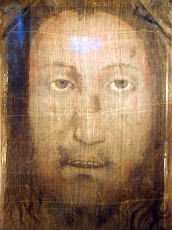
After almost five centuries the Vatican admits its disappearance in 1527. A circumstance which makes credible the hypothesis that it is identical to the Holy Face

On May 31, 1999 at a crowded press conference held in Rome at the foreign press association Fr. Heinrich Pfeiffer revealed the results of his study affirming that the Veronica and the Holy Face of Manoppello should be seen as one and the same. This news was reported by Italian and foreign television networks among their top stories for the day. Usually the coverage was linked to the classic stereotype of the mountainous Abruzzo region, so that Manoppello was described as a "forgotten village at the foot of the Maiella range".

Some of the journalists asked the Vatican for an opinion in this matter. The response was "total silence", said the correspondent for the Spanish television network Antenna 3's news program of May 31, 1999, as he broadcast with the facade of the Basilica of St. Peter's behind him.

The Catholic press and church leaders showed indifference and kept their distance, effectively isolating Father Pfeiffer, director of the Course on Cultural Patrimony for the Gregorian University, who is considered to be among the world's most authoritative scholars of Christian art. Some Italian scholars of the Shroud of Turin (sindonologists) didn't hesitate to show their annoyance at the news, and in some cases gave their opinion that at best the Holy Face could only be a copy of the Veronica.


Padre Germano di Pietro, OFM Cap., Antonio Bini and Father Heinrich Pfeiffer, S.J. on May 31, 1999 the day of the press conference

On the same occasion the results of Professor Donato Vittore's research were also presented. Professor Vittore, who teaches at the University of Bari, demonstrated by means of a high intensity scanner that there was no pigment on the cloth.

The problem was not so much the Holy Face itself, which had been at the center of a beloved and popular yet strictly local devotion centered in the mountains of Abruzzo, but rather the bringing up for discussion that the legendary Veronica was no longer to be found in Rome at St. Peter's Basilica.

Throughout the centuries the Veronica has been Christianity's most important relic. Coming from the East, it was venerated at St. Peter's from the eighth century, until it became the fundamental reason for pilgrimages to Rome, even prior to the first jubilee year proclaimed by Pope Boniface VIII in 1300.

Among the pilgrims coming to Rome to venerate it were Dante and Boccaccio.

After the 1500's a great silence fell over this prodigious image. But as the great Jubilee for the Holy Year of 2000 approached two important exhibitions were organized at Rome with the collaboration of the Vatican's Apostolic Library. Both exhibitions, the first on the history of the Pilgrimage to Rome in the Middle Ages (at the Palazzo Venezia) and the second on "The Face of Christ" (at the Palazzo delle Esposizioni) recalled to mind the historic role of the Veronica by means of documents, medals, etc. from a number of foreign museums. From the two exhibitions there emerged the clear distinction between the reproductions and engravings of the Veronica prior to the 1500's, which showed the image with eyes open, and the reproductions following which showed the image with eyes closed. In any case since the 1500's there continued to be a persistent silence regarding whether or not the relic was present at St.Peter's.

The arrival of the Jubilee Year of 2000 was marked also by an extraordinary production of books and articles which involved historians, experts on the Middle Ages, theologians, art historians, etc. At the end of 1999 one of the many books of a historical perspective published a photo of the cover of the "Opusculum del Grimaldi" preserved in the Vatican archives and which up until then had been unknown.

This document, dated 1618 (but which seems from every indication to have been changed from the original date)presents the image of the Veronica with open eyes and represents an important contribution compared to the overall confusion on the matter.

The importance of this image was at the center of my article entitled " La Veronica com'era" (The Veronica as it was) which I wrote for the pages of the Bollettino del Volto Santo (Bulletin of the Holy Face -- official publication of the Shrine of the Holy Face of Manoppello). There followed a further reflection on this by Padre Germano Di Pietro, then superior of the Shrine, which had the title "E' ancora in San Pietro la Veronica" (Is the Veronica still in St. Peter's?)

After the publication of these articles two Canons of St. Peter's came to Manoppello to advise Padre Germano to stop bringing up this issue.

When Pope Benedict XVI decided to go on pilgrimage to Manoppello his visit was announced and then denied for months. Contrary to the long advance notice which precedes the Pope's public appointments it was confirmed by the Vatican press office only around ten days before September 1, 2006. We know that the visit was strongly opposed by the Canons of St. Peter's, precisely for the significance that would be given to the event, with its implicit recognition of the thesis which had been advanced by Father Pfeiffer after years of research that the Holy Face is to be identified with the Veronica.

The visit was then described as a simple "private pilgrimage", a label which brought a smile to Pope Ratzinger himself at Manoppello.

In the meantime other scholars, especially from foreign countries, began to draw closer to the Holy Face. Paul Badde's book published in Germany in 2006 caused the weekly Der Spiegel to describe it as "a cultural thriller, full of suspense and intrigue, similar to Dan Brown"

Among the Italians the importance of Saverio Gaeta's study "L'enigma del Volto di Gesu'" (The Enigma of the Face of Jesus) published by Rizzoli in 2010 must be emphasized. Gaeta in his book, among other things, puts forth an interesting hypothesis concerning several important people linked to Abruzzo who were involved in the Sack of Rome in 1527.

His hypothesis is compatible with the arrival in Manoppello of the Holy Face, which according to the first document attesting to the presence of the relic in Abruzzo - the Relatione Historica (Historical Report) of Padre Donato da Bomba, came to the Abruzzi town "around the year 1506". The imprecise phrasing used by the Capuchin suggests using due caution, considering that the report wasn't published until 1640.

Bruno Forte, Archbishop of the diocese of Chieti-Vasto, in whose territory Manoppello falls, on many occasions has shown that he trusts the reliability of the studies which have so far been conducted concerning the Holy Face.

Pilgrims who arrive in Manoppello from the world over are not so much interested in this research, wanting above all to pray and to meditate before this mysterious image with its profound and human gaze which no work of art is able to render.

In April of 2011 an exhibit on the Holy Face opened in Lucca and another exhibit was held in September of the same year at Lourdes which was seen by over 150,000 people. The exhibit of Lourdes was strongly desired by Philippe Perrier, Bishop of the diocese of Lourdes-Tarbes who is very much devoted to the Holy Face.

But the year just completed is particularly significant because after almost five centuries the silence regarding the disappearance of the Veronica from St. Peter's came to an end. On December 6, 2011, with Christmas close at hand, L'Osservatore Romano welcomed an article by Paul Badde who on a number of occasions, in articles and in his book which so far has been translated into seven languages, had criticized the Vatican for their reticence. Badde was able to write for the first time in the press organ of the Holy See that the Veronica is for centuries in Manoppello, in as much as it disappeared during the so called Sack of Rome.

This follows a press release from Rome dated July 14, 2011 concerning the announcement of the exhibit entitled "L'uomo, il volto, il Mistero" (Man, Face, Mystery).

The last segment of the exhibition, inaugurated in August in San Marino, was dedicated to the "Holy Face". The surprise comes from the part of the press release where it affirms that the ancient relic of the Veronica "disappeared following the Sack of Rome of 1527".

In this brief phrase, there are two points to be gathered which are quite extraordinary.

This press release, ascribable to Professor Paolucci head of the Vatican Museums, is the first document which refers, even if only incidentally to the necessary information connected to the announcement of the exhibit, that the Veronica is no longer present in St. Peter's. It confirms an important series of hypothesis and doubts advanced by historians and other scholars, especially in recent years. But the press release offers a further element by indicating with precision that the disappearance of the Veil coincided with the Sack of Rome of 1527.

Professor Paolucci, with his authoritative stature as a former Minister for Cultural Patrimony in the Italian government, has finally been able to shed light on the doubts and uncertainty which have dragged on for far too long.

Regarding the Holy Face there will continue to be much discussion, but certainly it will no longer be able to exclude, a priori, the hypothesis that it is in fact the Veronica.

Wednesday, December 14, 2011

The True Icon by Paul Badde to be Published In March by Ignatius Press

After many years of study of the Shroud of Turin and the Holy Face of Manoppello Paul Badde has made a significant contribution to the understanding of both relics with a book already published in german which will now be available in english starting in March of 2012 from Ignatius Press of San Francisco. In my opinion it is no exaggeration to say that the english edition of this book, entitled the True Image, will mark the beginning of a new era and opportunity for scholars of the Shroud of Turin, as well as of the Holy Face of Manoppello.

See this announcement of the book by Ignatius press:

The True Icon - Paul Badde : Ignatius

Monday, November 28, 2011

The True Image -- Polar Star of the New Evangelization


Holy Face of Manoppello


Holy Face above the entrance to the Election Chapel, Frankfurt Cathedral


The True Image –
Polar star of the
new Evangelization


by Paul Badde


Facebook of heaven for the Word that became flesh.
A new Mount Tabor for a divided Christianity.
Reference point of return for the formerly Christian nations:

The human face of God


“Truth is a person“ – Nicolàs Gómez Dávila

At last month’s baptism of our latest granddaughter Josephine, we discovered a copy of the “true image” in Frankfurt Cathedral as I had never seen it before: Christ’s mild face, levitating in front of a transparent veil on which it lies as on a nimbus. I do not know who painted it, though for certain it was done by the hands of a master. The image sits within a six-fold lunette on the left side at the rear of the sanctuary of this venerable gothic cathedral above the door leading to the election chapel for the kings of the Germans' Holy Roman Empire. In 1345 Frankfurt on Main had been determined as the location for royal elections by the Golden Bull of Charles IV. The church had been completed shortly before this while the election chapel was only finished in 1425. This is also around the time when this image was affixed above the architrave, the door through which the “Roman kings” of the Germans along with the electors stepped into the cathedral right after their election, to present themselves to the people in order to sing the Te Deum together.

This door therefore occupies a key position in Europe’s history. The architects were well aware of this when they had the image of the Savior of the World, unknown to any other culture, painted precisely here. The fact that Christians do not just have one but the image of God in Christ, was and remains a unique feature of Christianity amongst the other religions. Only Christians have this. They know: God showed his face through Jesus. Additionally they believe that God left an image of this face which could not have been created by men. “The secret of a person is expressed in his face,” as Sister Columba wrote to me from a monastery in the orthodox world where this belief is maintained to the present day. “In the face of the one who lives in the midst of all as the Alpha and Omega, are – as Dante put it – also our faces engraved. Only if we wholly behold the face of him who is called I AM, will we be able to say – now within him: I AM.” This knowledge let blossom icon painting among the orthodox. The icon of icons, however, is the Vera Icon. Here he is painted in an incredibly modest manner so that the only one who recognizes it is the one who has seen the original before. The painter had surely seen it.

Copies of the original received the most exclusive and prominent places of honor in the eastern and western cathedrals. But in order to see the prototype one had to travel to Rome. Because for the “true image” itself only the most prominent place in the West could suffice: the tomb of St. Peter. It was no surprise that the largest church in the world was to be built for this original in 1506. Bramante erected a tower-like treasury for the true image right above the foundation stone of the new Basilica of St. Peter's.

This mysteriously beautiful yet ethereal veil arrived in Rome under Pope John VII in 706 during the age of Byzantine iconoclasm. It remained here for 820 years until 1527. During this time numerous copies were made, one more beautiful then the other, from the mosaic in the Zenon Chapel in Santa Prassede to the large depictions by Italian, German, French and Flemish masters.

The most fascinating factor for us in the origin and history of this true image is, however, that it disappeared during the “sack of Rome” in 1527, went missing for centuries but luckily did not remain lost. For it returned into history almost as silently as it had disappeared the moment Pope Benedict XVI – as the first pope after 479 years – got down on his knees on a hill behind Manoppello on the Adriatic in front of this most precious papal treasure of former times. It was the first pilgrimage of his pontificate within Italy of his own choice. No one was prepared for this rediscovery. Contrary to the case of the Shroud of Turin, which at the time when it was first photographed in 1898 had already been venerated for centuries in the West, the true image had been forgotten by us for centuries. No one had anticipated its reappearance. No one had expected it. Not a single researcher had it on his radar anymore – only a few shepherds and farmers and fishermen in Abruzzo, by whom it had been reverenced in a local shrine.

Unbelieving amazement therefore accompanied the rediscovery. Yet the finding was by far no Christian Troy. It is not an unearthed ruin, rather a living picture, as blazing and self-explanatory as it was on the first day, but actually even brighter, more revealing and surrounded by so much more light than ever before. It is incredibly easy to access on every day of the year and this access is free. Most uplifting of all is, however, that this legendary “true image” of the Church is no legend at all despite being described in this way even by extraordinary scholars such as Hans Belting. According to him, it could never have existed. If examples of the legendary kind would have been preserved, he wrote in his 2005 book “The real image”, they would have quickly “revealed themselves as fake”. But the authentic image is preserved here; and despite manifold attempts no one has yet been able to expose it as a fake. Here we have it in front of us.

The mother image of all Christ Icons, inexplicable, it is therefore no surprise that amazement and disbelieving skepticism have always accompanied this image – from Dante to Martin Luther. Because this isn’t just any image. It changes with every reflection of light, is painted by light and sometimes looks like photography. Yet there exists no objective photograph of it. Almost all photographs of this image show an unambiguity and one-dimensionality that in fact it doesn't have. It contains thousands of images, all of which are different – except for the merciful look in his eyes: “Would you like to become my friend?” It is the facebook of heaven.

It is impossible to count and explain all the names it has previously been called: Mandylion, Abgar-Image, Camuliana Veil, Sanctum Sudarium, Holy Face, Byssus Cloth, Veronica – but no name has captured its essence as has the term “true image”. Truth is the archimedic reference of its being. That is why we may best imagine this image in its wafer-thin, transparent fabric as a piece of material truth. Such a thing cannot exist, as everyone knows, because we commonly view the truth as a strictly philosophical term. Nonetheless, we are faced with a paradox. “Truth is a person,” Nicolàs Gómez Dávila says. That is how it is. Here he is. Jesus himself, on the other hand, remains silent when Pilate puts the question to him: What is truth? The true image is silent in a similar way. He only looks at us.

Generation Facebook and the following Christian generations may perhaps discover and recognize it as an almost cosmic memory chip of the merciful God, with innumerable gigabytes of unread information, which they will then begin to try to decode. In fact, it returned to us in history precisely at the dawn of the digital age. At the Iconic Turn! During the daunting return of images and hieroglyphs at the gates of our perception, it today reminds us as no other document does: We have an image of God! The word became flesh.

Nobody must therefore demand that this icon shall be elevated to become the polar star of evangelization. It is and will become so in any case, even without any publicity campaigns. Since Benedict XVI's visit, a massive migration movement from all parts of the world has begun to reach the true image on top of the Tarigni Hill behind Manoppello, as to a new Mount Tabor, and is unlikely to cease. The pope, who never tires of praising the “human face of God”, has led and initiated this movement with his pilgrimage. “During these times we will need to keep our gazed fixed upon Jesus Christ,” he said on October 11 during his announcement of the upcoming “Year of Faith”. The ecumenical procession leading the new-evangelization of formerly Christian nations, made up of people from all sides of a Christianity divided in so many ways, has long reached its destination here. By 2027, the 500th anniversary of the abduction and recovery of the veil from the Vatican, Manoppello will be unrecognizable. – “He looks like a sheep!” my wife frightenedly said when we stood in front of the true image of Christ for the first time. In the meantime, many thousands of people myself included recognize in this face the most beautiful being of all. But my wife was obviously right. Behold, the lamb of God!


26. November 2011

(thanks to Paul Badde and to his daughter Christina who translated the article from the original German)

Thursday, November 17, 2011

Puebla Conference on the Holy Face and the Madonna of Guadalupe


by Antonio Bini

Father Carmine Cucinelli, rector of the Shrine of the Holy Face of Manoppello, has been invited to participate in the Second Guadalupana Week which is being held from November 15 to 18, 2011 in the Mexican city of Puebla, capital of the region of the same name.

Father Carmine's conference -- awaited with great anticipation -- is scheduled for today, November 17, at the Popular Autonomous State University of Puebla (UPAEP).

Prior to leaving for Mexico Father Carmine emphasized that the year 2011 will be remembered for the significant activities which brought together the Holy Face with the Madonna of Lourdes and of Guadalupe, which are the most visited Marian shrines in the world.

The exhibit “L’image du Christ à travers le visage de la Vierge”, held at Lourdes from September 1 to October 2, 2011 -- at the request of the Bishop of the Diocese of Tarbes-Lourdes -- Monsignor Philippe Perrier -- was visited by thousands of people, and coincided with the time of the year in which is recorded the greatest number of pilgrims. The level of interest raised by the exposition is shown by the distribution of more than 100,000 leaflets prepared by the Capuchin Fathers in the various languages.

If the exhibit of Lourdes pertained to the relationship between the Holy Face and the Face of the Madonna in the variety of expressions of devotion and of faith which Lourdes and Manoppello share, the conference of Puebla -- which opens new perspectives for the spreading of the knowledge of the Holy Face of Manoppello (Santa Faz) in South America -- will concentrate on a comparison of studies on the acheropite ("not made by human hands) origin of the two images, in a historical, scientific and religious perspective.

Under this aspect, it should be remembered that the two images -- together with that of the Shroud of Turin -- were at the center of the International Workshop on the Scientific Approach to the Acheiropoietos Images – held at the Research Institute of Frascati from May 4 to 6, 2010.

http://arquidiocesisdepuebla.mx/
http://www.todopuebla.com/eventos/conferenciasantafazdemanopellosegundasemanaguadalupana

Tuesday, November 15, 2011

European and African Bishops to go Together as Pilgrims to the Holy Face in February 2012


In February of 2012, as part of the European and African Bishops symposium in Rome to prepare for the upcoming Synod of Bishops on the New Evangelization, there will be a pilgrimage of these Bishops to the Holy Face of Manoppello. May Our Lady bless and guide this holy and inspired effort.

Friday, October 28, 2011

The Holy Rosary and the Holy Face

One of the unique characteristics of the Holy Face of Manoppello is that the Face of Jesus can be seen bearing many, even seemingly infinite expressions. It can be said that in the variety of moments over time the Face of Jesus in Manoppello shows Himself to be sorrowful, joyful, glorious and luminous. As well it can be said the Face of Jesus in Manoppello has all these characteristics at one and the same time. Without doubt the Holy Face as a historical reality is a help to our praying the Holy Rosary, taking to heart Blessed Pope John Paul II's description of the Rosary as "the school of Mary where we are led to contemplate the beauty on the face of Christ, in union with Mary and to experience the depths of his love." (Apostolic Letter "The Rosary of the Virgin Mary, number 1)

thanks to Paul Badde for his beautiful photos and to Robert Feeney the author of "The Rosary, the John Paul II Method"


"To recite the Rosary is nothing other than to contemplate with Mary the face of Christ" Blessed Pope John Paul II


Monday, September 19, 2011

Youtube Course on Holy Face of Manoppello


A talented Italian artist, Raffaela Zardoni, has recently posted a beautifully illustrated course, entitled The Rediscovered Face, describing the history of the Holy Face of Manoppello from the first century until today.

http://www.youtube.com/playlist?list=PLF32FC9003C098D97

There are four segments totaling approximately 38 minutes. Originally available only in Italian, it has now thankfully been translated into English. This course is a great introduction to the wonderful image.