Thursday, December 19, 2013

The Pifferari of Abruzzo and their Christmas Traditions


They were called "pifferari": the bagpipers of Abruzzo and their centuries old traditions of Christmas

H. Payne, Shepherds from the Abruzzi (ca. 1850)


Anonymous Woodcut from the Second Half of the 19th Century published in the journal Roma, 1874 -- Pifferari play before an outdoor shrine of the Madonna

by Antonio Bini


On display as part of the current exhibition "The sound of bagpipes in the soul : d'Annunzio and the ancient sonority of the pastoral world" is the bagpipe which is part of the collection of objects in the small ethnographic museum connected to the Shrine of the Holy Face of Manoppello.

The exhibition, which will run from November 23 to January 26, 2014, is being held at the Museum of the Birthplace of Gabriele D' Annunzio in Pescara.

The bagpipe lent to the exhibition in Pescara was donated to the Shrine years ago by an anonymous elderly bagpiper, probably during his last Christmas traveling to the traditional novena. According to testimonies collected in the past, the pipers who came to the shrine during Christmas were given lodging for the night by the Capuchin friars.

Mario and Enrico Musichini, at the head of a company of pilgrims who are returning to their town of Castellafiume, in Abruzzo.

Until the nineteen sixties, a living nativity scene was held on January 6.

But the bagpipe was linked at one time not only to Christmas but also to the religious rites , and were present in the companies of pilgrims moving on foot towards the shrines.

The bagpipe is an ancient tradition in southern Italy and in particular in the Abruzzo region , where for centuries it has been linked to the pastoral world. The pipers, or better pifferari as they were called by the travelers of the Grand Tour, normally played the ancient instrument during the hours of watch over their flock, according to testimonies collected in Abruzzo also from American travelers , such as John Augustus C. Hare who met them near Sulmona (see Days near Rome , 1875) and Maud Howe who in 1898 records their presence in Roccaraso (see Roma Beata ).

But it was above all in Rome where the arrival of the pifferari for the Christmas novena took a particular religious relevance in the wake of an ancient tradition that was repeated until 1870, that is with the acquisition of the Papal States by the Kingdom of Italy. "The pipers never hurt anyone" protested the Romans.

To lament the loss of this tradition was also the American sculptor William Wetmore Story, in his book "Roba di Roma " in his later edition of 1870 (the first edition was published in 1862 in Boston and New York) .
There were reasons of public policy, related to the danger posed by banditry , to prevent the pipers' access to Rome. In Abruzzo this long tradition was to suffer the consequences of the collapse of the pastoral economy , which led many to emigrate from Abruzzo to the United States . Not surprisingly, the bagpipes which belonged to an immigrant from Abruzzo are on display in the Carnegie Museum of Art in Pittsburgh.

Stendhal, Dickens , Goethe, Berlioz, Lear , Gregorovius and many other known and less well-known protagonists of the Grand Tour in Italy frequently turned their attention to the pipers of Abruzzo, who with their repertoire in the past centuries inspired many musicians and composers ( Handel, Berlioz, Gounod , Corelli , etc. . ), whose pastoral compositions were largely influenced by the sonority of these singular wandering musicians .

St. Alphonsus Maria Liguori himself, author of the famous Christmas carol "Tu scendi dalle stelle" (known in English with various translations : "You come down from the stars" or "From Starry Skies Thou comest " , "From Starry Skies Descending ," " You Came a Star from Heaven ") adapted the music using pre-existing melodies played by shepherds from Abruzzo, as supported by several musicologists , including the Redemptorist Fr. Paolo Saturno , Professor of History at the Conservatory of Music of Salerno. Nevertheless it is certain that the text is by St. Alphonsus and that it was born as a prayer and was included in his "Christmas Novena".

It was definitely during his mission in Deliceto (1744-1746) , on the Mountains of Dauni in Puglia,
that the saintly Neapolitan musician came in close contact with the shepherds on the lowlands of Puglia . The spiritual care of the shepherds was in fact the goal of reopening the ancient shrine of Our Lady of Consolation near Deliceto . The first biographer of St. Alphonsus , his disciple Father Antonio Tannoja , wrote that St. Alphonsus "wept when he came to learn of the conditions of life of the shepherds , whom he wanted to assist at least on a spiritual level."


The pipers disappeared in silence at the beginning of the sixties, not only due to the inexorable decline of pastoral life , but also because of the steamroller of modernity and cultural assimilation.

In Italy it was especially Gabriele d'Annunzio , who had within him the reverence for the memories of his native land , viscerally attracted to the ancestral scenarios in the region, returning frequently with his soul to the ancient pastoral civilization, which he extolled in several works.

In recent years there has been a renewed interest in the recovery of the centuries-old tradition of pifferari by the Associazione Zampogne d'Abruzzo - http://www.zampognedabruzzo.it - whose members include a number of young people with musical training at the conservatory level.

“Tu scendi dalle stelle” performed by the band of the Associazione Zampogne d’Abruzzo

http://www.youtube.com/watch?v=m7AaNmjJ2c8

Quanno nascette ninno (text by S. Alfonso of “Tu scendi dalle stelle” in dialect)

http://www.youtube.com/watch?v=E4PHl2oD4mY

In my book , entitled "Li chiamavano pifferari : zampognari mito dell'Abruzzo " (ed. Menabo' , Ortona, 2013) , I reconstruct this extraordinary musical and cultural phenomenon.

Tuesday, December 17, 2013

Exhibit on Holy Face in New York City January 17 to 19, 2014


Following the very successful exhibit on the Holy Face which took place last August at the Meeting in Rimini there will be a similar exhibit entitled "The Face of Jesus: from that Gaze, the Human Person". This exhibit, organized by the same team which was responsible for the Rimini exhibit, will be held in New York City next month at the Manhattan Center as part of the annual cultural meeting "New York Encounter". See the website http://www.newyorkencounter.org/exhibits/2014/1/17/the-face-of-jesus-from-that-gaze-the-human-person for information on the meeting and exhibit, including the introduction to the exhibit on the Holy Face by Cardinal Sean O'Malley of Boston who will be in attendance at the gathering. This event in the cultural capital of America promises to be of immense importance for the spread of the knowledge of the Holy Face. An english translation of the catalog of the exhibit at Rimini has been prepared in time for the event in New York City.

Wednesday, November 27, 2013

Thank You Lord for Shining Your Face on Us


photos by Paul Badde

Collect for the Mass for Thanksgiving Day in the USA

Father all-powerful, your gifts of love are countless and your goodness infinite; as we come before you on Thanksgiving Day with gratitude for your kindness, open our hearts to have concern for every man, woman, and child, so that we may share your gifts in loving service. Through our Lord Jesus Christ, your Son, who lives and reigns with you in the unity of the Holy Spirit, one God, for ever and ever. Amen

Monday, November 18, 2013

In the Darkness of Our National Tragedy, An American Treasures a Final Human Touch of President Kennedy and Finds Light for the Journey in the Eucharistic Face of Jesus


This Friday November 22 marks the 50th anniversary of the assassination of President John F. Kennedy, so wickedly cut down in Dallas at the young age of 46 taking with him the hearts and hopes of so many, especially among the young. To remember and try to understand this shocking event in the history of America, John Darrouzet has written an article-memoir at http://catholicstand.com/president-john-kennedy-jesus-reflecting-face-face-encounters/. On that November day in 1963 Mr. Darrouzet's family, holding a banner asking the President to "stop and shake their hands", stood along the route of the motorcade of President Kennedy as it made it's way to downtown Dallas. When the president did to their delight order the motorcade to stop and waved to them to come over, they became the last Americans to have the opportunity to receive the human touch of the youthful president so beloved especially to Catholics in America. The article concludes with a stirring encouragement and testimony by Mr. Darrouzet to the love of the Eucharistic Face of Jesus so powerfully symbolized and made present by the Holy Face of Manoppello.

Wednesday, November 13, 2013

My Witness to the Holy Face 2002 to 2008

Witness to the Holy Face
by Raymond Frost


This article originally appeared in 2008 in the official journal of the Shrine of the Holy Face. It relates my experience of the Holy Face of Manoppello up until that time. The story of my efforts since 2008 to promote the knowledge of the Holy Face is to be found in the totality of the blog itself.

During the summer of 2002, I read in the Italian journal Cristianita’ Francesco Barbesino's review of the book by Father Heinrich Pfeiffer, S.J. , Il Volto Santo di Manoppello. I was amazed because I had never heard of the story of this image according to Pfeiffer connected to Veronica and the resurrected Jesus. It was for me a story much more than interesting, it was something that I had to look into and get to the bottom of the matter.

I looked for further news on the internet and in the library of the University of San Francisco. I spoke with colleagues about this subject. There was little enough in English to find, and not even very much in Italian. There was the website of the Capuchin Fathers of Manoppello and some articles that spoke of Father Pfeiffer, nothing else. No colleague had ever heard of the Holy Face.

I decided to translate the review of Barbesino and spread it among friends and colleagues. I sent the translation, through the internet, to the editors of Cristianita' who included it on their website. It was a first step for me. Unfortunately there were not many people, including friends or colleagues who believed or wanted to appear to believe in the case of Father Pfeiffer.

I sent an e-mail to Father Germano di Pietro, the guardian of the shrine of the Holy Face of Manoppello, with a copy of the translation and quite soon there arrived at my house a copy of the book by Father Pfeiffer and Father Germano’s own pamphlet on the Holy Face. After reading both I translated some parts of each. The desire to visit Manoppello grew in me, but it was not possible for the moment.

In September of 2004 there appeared in the American magazine Inside the Vatican the first article of Paul Badde with some wonderful photographs of the Holy Face of Manoppello. These photographs aroused in me an even greater desire to know the history of the Holy Face and share the story with others. With the help of Father James Blaettler, S.J. assistant pastor of the Jesuit church of St. Ignatius where I am the sacristan, I made copies of the photographs of the Holy Face and I began to disseminate them among friends, colleagues and relatives. I bought quite a number of copies of the copy of the journal in which the article by Badde appeared, also to disseminate them.

Every now and then I looked on the internet for news about the Holy Face. I found an article in the Messenger of St. Anthony written by Renzo Allegri in which he spoke of the Holy Face with journalist and author Saverio Gaeta. I sent an e-mail to Gaeta, who answered me right away.

In this period the book by Paul Badde appeared, but unfortunately I do not know German. I wanted to immediately know if it was possible to print an English translation, but at that moment I could not make contact with the author. A few months later I received the book in Italian by Saverio Gaeta on the Holy Face. I read the book during the summer of 2006. My wish was that as soon as possible the books of Badde and Gaeta would be published in English.

In late summer of 2006, after the visit of the Holy Father Benedict XVI to the Shrine of the Holy Face, I spoke of the Holy Face more at length with the pastor of Saint Ignatius, Father Charles Gagan, SJ, showing him photographs of Holy Face and the visit of the Holy Father to Manoppello. He encouraged me to persevere in the pursuit of my study of the Holy Face and gave me permission to mount a copy of the Holy Face in the sacristy of the church and speak and disseminate images of the Holy Face among the parishioners.

In recent years more and more I wanted to visit the Shrine of the Holy Face. Finally in 2007 the chance came. I wrote to Father Carmine Cucinelli, the guardian, and Saverio Gaeta with the news of the visit. Both encouraged me. In November I arrived in Rome to meet Saverio in his office and spoke about the Holy Face. He invited me to dinner at his house with his wife and son, a beautiful moment.

With his help I arrived in Manoppello and met Father Carmine and Sister Blandina. I thank Father Carmine warmly because I spoke at length several times with him during my three-day visit to Manoppello and he patiently answered all my questions. At the end of my stay in Manoppello he gave me quite a number of leaflets and prayer cards of the Holy Face in English. I also thank Sister Blandina for her generosity with me because I could listen to her
experience of the Holy Face closely.


I was enchanted by my visit to the Shrine, beginning with the beauty of nature in the surrounding countryside. The interior of the church impressed me very much. It seems that everything about it is very well done. The Holy Face was much more impressive than I thought it would be before my visit to the shrine. Seeing the Face close to me was a very intense experience of prayer. I can only compare this experience to the adoration of the Blessed Sacrament. I was touched very deeply by the changes and the fluidity of the image of Jesus – the colors, its transparency, and especially from the wounds on the face of Jesus that seemed to me almost phosphorescent at times.


Many many thanks to the citizens of Manoppello and to the Capuchin friars for the help which they gave me during the visit. The Shrine of the Holy Face is a great gift for the Church and for the world. I hope that many people can mount the steps of the shrine to see and speak with their Divine Redeemer and friend Jesus.

At the beginning of 2008, it came to my mind to start a blog on the internet regarding the Holy Face. I began with the posting of the Holy Father's prayer to seek the Face of Jesus. I informed Father Carmine and I received his blessing. After several weeks I received an e-mail from Paul Badde with photographs. In recent months we have continued to correspond and he has helped me a lot to know more about the Holy Face.

With the blog I would like to help those who speak English to know about the Holy Face, through articles, photographs and testimonials. I would also like to emphasize that the Holy Face is a great source of prayer, spirituality and Christian inspiration that would give everyone a new experience and knowledge of the life, death and resurrection of Jesus. I believe that the knowledge of the Holy Face gives people an intimate knowledge of Jesus and that everyone has the right to this knowledge.

Until now I have received comments on the blog and e-mails from Catholics, Anglicans and Orthodox from Europe, America and New Zealand. They have many questions. Some scientists do not want to take seriously the arguments in favor of the Holy Face. First, they want to have "evidence". But many other simple people, as well as from the educated class, are truly fascinated by the story of the Holy Face.

Recently I received permission to prepare an exhibition of photographs of the Holy Face in a parish of the Archdiocese of San Francisco. I hope that this exhibition can make visits in other parishes of the archdiocese, and beyond, in the future.

Tuesday, November 12, 2013

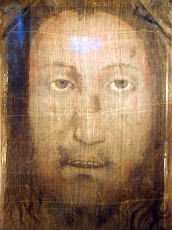
Man of Sorrows Watches Over Us

Juliusz Maszloch from Poland has produced a very interesting Youtube video on the Holy Face http://www.youtube.com/watch?v=dQGRP77f1QA using color enhancement software in order to help better visualize the precious blood of Jesus -- what He suffered for our sake. Juliusz also has an english language website on the Holy Face of Manoppello which is well worth visiting.http://manoppello.eu/eng/http://manoppello.eu/eng/

Friday, October 4, 2013

A Conversation Between Our Lady and Francis in Assisi

I remember all the faces of my son -- joyful, sorrowful, glorious, luminous. Will you reveal them to everyone around the world, especially in every hill top town, so that peace might reign in their hearts. Yes, Mother. Photos (except for the Shroud of Turin) by Paul Badde