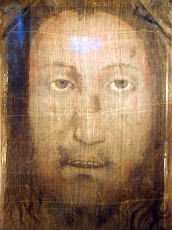
A grand map on the internet of the representations of the Veronica. Plans also for an exhibit on "The Rediscovered Face"
by Antonio Bini
A unique initiative, significant for the Year of Faith being celebrated from October 2012 to November 2013, was launched some months ago by Raffaella Zardoni, an illustrator from Milan, who came to learn about the Holy Face of Manoppello in 2010 during the exhibition of the Holy Shroud in Turin.
Her personal experience of the Holy Face of Manoppello and the hypothesis of the identification of the extraordinary image with the Veronica has brought her to imagine the creation of an exhibit which will be the fruit of a very wide searching out of the representations of the Veronica made during the years 1200 to 1600. The exhibit will be on display during next year's Meeting (August 18-24, 2013) the annual gathering held each year in Rimini.
At this time it is interesting to note that Zardoni has been progressively expanding her archive of images which come from throughout the world and are to be seen on her blog
http://raffandcompany.wordpress.com/category/veronica/
The ambitious objective of realizing a kind of planetary map -- called in fact Veronica Route -- has been taking shape in a surprising way with the power offered for collaborative effort by the internet's social media network. As I am writing there are a total of around 600 images which have been gathered between Veronica Route and Veronica Book, with the initial nucleus taken from the book by the scholar Karl Pearson (Die Fronica, 1887)
The project aims to demonstrate the immense diffusion of these images which permits the rediscovery of how much the Roman Veronica was known and venerated in the past, a subject -- writes Zardoni -- which although it has been almost entirely ignored by the field of art history has had and continues to have significant spiritual, cultural and historical meaning in addition to its artistic importance.
closeup of a portion of a fresco by Tiberio da Assisi showing pilgrims with the Veronica badge on their caps in Assisi listening to St. Francis
fresco by Tiberio da Assisi in the church of Santa Maria degli Angeli in Assisi
It is appropriate for us to recall the reasons for the silence which lasted for centuries regarding this image, reasons laid out by Saverio Gaeta in his book L'Enigma del Volto di Gesu' (The Enigma of the Face of Jesus) published by Rizzoli in 2010.
The oblivion into which the Veronica had fallen for almost five centuries was brought to an end by the exhibit "Romei e Giubilei: il pellegrinaggio medievale a Roma 350-1350" (Pilgrims to Rome and Jubilees: the medieval pilgrimage to Rome 350 to 1350) held at the Palazzo Venezia in Rome just prior to the opening of the Jubilee of the year 2000. Central to the exhibit were documents and objects coming primarily from foreign museums, which testified to the large numbers of pilgrims which came to Rome to venerate the Veronica, even prior to the proclamation of the first Jubilee in the year 1300. By a singular coincidence the important exposition took place less than five months time following the international news reporting on the studies of Fr. Heinrich Pfeiffer regarding the possible identification of the Holy Face with the Veronica.
As mentioned above, the research for Veronica Route has attracted the interest and involvement of a number of people. Among these, according to Zardoni, are an englishwoman who has documented a number of images of medieval pilgrimages, other persons from Finland who have sent photos of gold rings carrying the symbol of the Veronica and functioned as signs which rich pilgrims brought back to their country to demonstrate their penitential trip to Rome. Also a number of students have used part of their own free time to search out reproductions of the Veronica, the legendary sudarium upon which was impressed the face of Jesus.
This research will make a contribution to documenting and supporting the discussion which has been underway for some time on the Christian roots of Europe. The gathering together of these images will permit above all the verification of the correspondence between them and the Holy Face of Manoppello itself.
For Raffaella Zardoni the Year of Faith represents an occasion to make known the Veil of Manoppello, defined as the "Rediscovered Face", in the historic context of the Holy Years and of the pilgrimages to Rome. "The Rediscovered Face" will also be the title of the exhibit being prepared for Rimini in August, 2013.
Collaborating in this project are a number of experts from various disciplines, among whom are Emanuele Colombo, history of Church art; Giovanna Parravicini, researcher from the Fondazione Russia Cristiana, Paolo Martinetti, OFM, Cap, from the Pontifical University Antonianum in Rome; Paul Badde, journalist and historian; Daniele Gomarasca, college dean, Silvana Tassetto, professor of art history, Cristina Terzaghi, history of contemporary art at Universita Roma Tre.
Also by means of this article we intend to encourage the opportunity to participate in this research without borders, which seems to be taking its cue from the prophetic words written by John Paul II for the third millenium in his apostolic letter "Novo Millennio Ineunte" by means of which at the end of the Grand Jubilee of the Year 2000, in recalling the historic foundation of the figure of Christ, the Pope invited the faithful to retake their ordinary path "with their eyes fixed more than ever on the face of the Lord". An invitation which was taken up above all by his successor, Benedict XVI, pilgrim to Manoppello on September 1, 2006.
To collaborate in the research
Anyone who has information about reproductions of the Veronica (Saint Veronica and Holy Face) is invited to send the relevant references to the e-mail address below, after checking to see if the image is already present on the websitehttp://raffandcompany.wordpress.com/category/veronica/. Thanks in advance to all who desire to collaborate in the research by visiting museums, art collections, churches, sacristies, wayside shrines, etc. sending a photo and noting the artist, where possible, as well as the location and the time period of the work to raffaella.zardoni@mac.com
Monday, December 17, 2012
Friday, May 18, 2012
Knowing and Celebrating the Face of the Lord
I am happy to share a very fine article written by the Australian journalist Paul MacLeod reviewing Paul Badde's recently published book "The True Icon". I do so in honor of the upcoming feast this Sunday of the Holy Face celebrated in Manoppello with a joyful, prayerful procession from the Shrine of the Holy Face to the church of San Nicola inside the walls of the historic fortified town. The Holy Face will then remain overnight in
San Nicola before being taken on Monday morning in procession through all the streets of the town and back to the Shrine.
(the first two photos above are by the editor of the blog, the third photo above, and the one below are by Paul Badde)
Two witnesses – and a tiny lock of hair
By Paul MacLeod
A tiny lock of hair is a vital piece of evidence in an investigation of the circumstances of the Resurrection, validating one of the “signs” Pope Benedict XVI spoke of in his address to the world on Easter Sunday.
The Pope quoted the ancient Easter hymn, Victimae Paschali Laudes, which addresses to Mary Magdalen the question: “What did you see?” It has her reply: “the angelic witnesses, the sudarium and the gravecloths.”
These the Pope described as “signs”.
Research by the German historian and journalist Paul Badde in recent years has established the identity of the sudarium and the gravecloths, which still exist, and are indeed signs, just as a sacrament is a physical sign of a spiritual truth.
The German theologian, Klaus Berger, a friend of the Pope, has said of Badde: “Nobody has ever dared to go deeper into the Holy Sepulchre than Paul Badde.”
The term “sudarium” has long been taken to refer to the Shroud of Turin, but it is only one of the “gravecloths” (othonia in Greek, which means “wrappings”). Another is the bloodied cloth preserved at Oviedo, in Spain, and another a headband, kept in Cahors, in southern France.
Badde has now established that the “sudarium” is, in fact, what is known as the Veil of Manoppello, which has an image of Jesus’ face, alive and with His eyes wide open.
The Shroud and the Veil present us with two witnesses to the reality of the Resurrection, the two witnesses required by Jewish law. One shows us Christ dead and the other Christ alive.
The Shroud, of course, bears an image of the whole body of Jesus, bloodied and wounded, majestic in death – a large four-metre long linen sheet, but dim in its outlines and detail. The Veil, on the other hand, is a delicate, transparent piece of expensive material, measuring just 28cm by 17cm, in which the face of Jesus seems to float in light, even to store light
The Shroud came to world attention at the end of the 19th century, when the Italian photographer, Secondo Pia, famously produced a positive image, greatly clarifying the detail and leading to years of study, tests and speculation.
Now the Veil has come to world attention – almost as though these physical signs have been reserved for an unbelieving age.
Badde describes them as “the first pages of the Gospel”, written during the very night of the Resurrection, not by man’s hands though, and written in images rather than words – and what could be more appropriate for our digital age in which we increasingly communicate by images?
None of the written gospels attempt any description of what Jesus looked like. They did not need to, as the Church treasured these cloths from the tomb.
They were found there by Peter and John on the morning of the Resurrection, and, as John relates, one was rolled up by itself, away from the others. This was undoubtedly the Veil, which was a piece of most expensive material, known as byssos, woven from the fibres of sea mussels, and used as a face covering in death for dignitaries such as the High Priest.
In the darkness of the tomb, the image on the Shroud would not have been evident, but if Peter held the Veil up to the earliest light of the day from the entrance, his shock would have been much greater than that of Secondo Pia.
Peter obviously took the cloths back to the city with him, and as articles that had touched a corpse, they were ritually unclean in Jewish law, and would have brought down the wrath of the Jewish authorities on the new community. Hence, Badde suggests, the Apostles kept the doors locked to preserve these treasures. Had they been shown and displayed or discovered in those early days, neither these items would have survived, nor the community of the first followers of Christ around Mary and the Apostles.
As the Church spread, they found their way first to Edessa, then to Constantinople and, during the Crusades, to Europe, and were referred to by a variety of names. But both images are of the same person. Computer technology has now shown that the features of Christ on both are an exact match.
What is of great significance is that the Veil was first publicly displayed in Rome in 1208, and up to that time, icons and paintings of Christ bear a close resemblance to the features on the Veil – even to a tiny lock of hair on the forehead. Why would an artist put that there if he was not copying the Veil?
The Veil, known then as “the Veronica”, was later housed in a pillar of the rebuilt St Peter’s Basilica, but disappeared during the Sack of Rome in 1506, although the broken frame which had held it is still in the treasury of St Peter’s.
This cloth turned up in 1508 in the little town of Manoppello, in the Italian province of Abruzzo, and is now housed in a reliquary above the altar of the Capuchin monastery there, visible to all who visit. The shrine is known as the Volto Santo, or Holy Face.
Meanwhile the Shroud turned up in France and was first publicly displayed in Lirey in 1356. From then on it gained increasing attention, while the Veil faded into obscurity. That is, until 1977 when the Capuchin custodian of the Manoppello shrine, Fr Domenico da Cese, took a large photograph of it to a Eucharistic Congress in nearby Pescara, and the world began to take notice. He died in an accident the next year in Turin, which he had visited to see the Shroud for the first time - and there are now moves for his beatification.
In 1968, Fr Domenico opened the doors of the shrine one morning to find Padre Pio kneeling in prayer before the image – as the very last example of Padre Pio’s power of bilocation. At the time, Padre Pio was gravely ill in his cell in the Capuchin friary at San Giovanni Rotondo, more than 200 kilometres away, and was to die that night.
Pope Benedict XVI visited the Manoppello shrine in 2006 as one of the first acts of his pontificate, and has since increasingly referred to the face of Jesus as the human face of God, culminating in his Urbi et Orbi address this last Easter Sunday.
The new second Eucharistic Prayer of the Mass now asks God to welcome the departed “into the light of Your face”, rather than “presence”, as in the old version, and it has been suggested that the altar cloth and chalice veil at Mass have their origins in the Shroud and the Veil.
In Psalm 24 we read: “Such is the generation of those who seek Him, seek the face of the God of Jacob”. This is the deepest longing of the human heart – to see the face of Him in whose image we are made.
Paul Badde tells the story of his investigation into the link between the Shroud and the Veil in his book “The True Icon”, published by Ignatius Press.
Wednesday, May 16, 2012
Video of Holy Face of Manoppello
On the recent Good Friday the Italian television network RAI transmitted a segment on the Holy Face of Manoppello on their religious program "A Sua Immagine". The segment, which begins at the 27th minute of the program, beautifully captures the mysterious features of the Holy Face and is narrated by Antonio Bini, expert on the Holy Face of Manoppello, editor of the Volto Santo di Manoppello which is published by the Shrine of the Holy Face. The video also includes footage of Fr. Carmine Cucinelli, OFM, Cap., Rector of the Shrine, carrying the monstrance containing the Holy Face, as well as his thoughts on the importance of the Holy Face.
Below is the link to the video
Video Rai.TV - A Sua Immagine - Le ultime ore di Gesù
Below is the link to the video
Video Rai.TV - A Sua Immagine - Le ultime ore di Gesù
Wednesday, April 25, 2012
Signs of Hope, Signs of Resurrection
EasterVideo
On Easter Sunday Pope Benedict, speaking from the dramatic loggia of St. Peter's Basilica, gave a beautiful meditation on the Risen Lord basing much of his talk on the Easter Sequence: Victimae Paschali Laudes which speaks of "sudarium et vestes". This phrase to my mind is a clear reference to the sudarium now in Manoppello and the shroud now in Turin, as well as to the other grave cloths of Jesus now present in various other parts of Europe. This video shows the complete Easter morning ceremony with Pope Benedict speaking from the loggia. You can click on the english audio for the translation of his Italian address. These signs of hope, which are signs of resurrection are still with us
.
Friday, April 6, 2012
The Living Image
The most investigated cloth in history | Video | Fox News
Click on the link above to see a portion of Paul Badde's interview today, Good Friday, on Fox News regarding the Holy Shroud and especially the Veil of Manoppello. Very fascinating, hopefully more of the interview will be available.
Thursday, March 29, 2012
The Shroud, the Veil, Jerusalem at the Start
In Paul Badde's essential book: The True Icon: from the Shroud of Turin to the Veil of Manoppello, each chapter has a unique importance in responding to various questions regarding the burial cloths of Jesus. For me the most important is entitled "The 'Missing Link' of Easter Night". Three years ago much of this chapter was published in Il Volto Santo the official publication of the Shrine of the Holy Face of Manoppello in an article with the title "St. Peter as Secondo Pia". I translated this article and published it on my blog in seven installments. At this time close to Holy Week I would like to refer to this article with the hope that it might be an enticement to read Paul Badde's whole book. I especially encourage experts on the Shroud, who have dedicated their lives to this holy relic, to read what Paul Badde has to say about the Veil and Shroud in Jerusalem at the start, and then to read his entire book. No one to my knowledge has given a better description of the tomb of Jesus and the burial cloths which were found by Peter and John.
Here is the conclusion of Paul Badde's article which can be found on this blog in entirety in seven installments, the first dated January 28, 2010 and the last March 15, 2010.
"Perhaps it truly was John, the first who 'saw and believed', who previously had left to Peter the privilege of entering before him. John alone had been present at the burial to know that the 'sudarium had been placed on the face of Jesus'. Only an eyewitness of the burial would have been able to know such a detail. Perhaps he had observed how the Magdalen had placed the delicate veil of sea silk (marine byssus) on the Face of Jesus as a last tribute. Peter wasn't there. He wouldn't have known any of this. In any event, John would have immediately shown the veil to Peter in the opposite case. Because 'they hadn't in fact yet understood the Scriptures, that he would rise from the dead', continues John, using the plural. In any case, it had been a questions of mere seconds. But as for the rest of the account? Couldn't it be that all this could have happened differently? No, according to good sense, for whoever takes seriously the cloths and the texts of the Gospel and who has become familiar with the space of the sepulcher; and who still has enough fingers to add one plus one plus one plus one plus one equals five. Putting together all the components -- the eyewitness testimony of John, the space, the hour, the light and the cloths -- taking all these things together, adding as the first or the sixth component the Jewish reserve regarding the ritual impurity of tombs! --then the facts could not reasonably have gone any differently.
The conclusion is that Peter in the sepulcher must have lived an experience similar to that of Secondo Pia at Turin in 1898 when he withdrew the first photographic plates of the Shroud under the red light of the darkroom. Except that Peter's was an experience much more dramatic.
It is indispensable that there should have been a visible sign in the Sepulcher of the incedible event of the night of Easter, and this sign could not be the missing body of Jesus. That which Peter - or John - picked up from its 'special' position in the tomb, and held against the light, was the first testimony of that great event which was happening there. The little sudarium completes and explains the large sudarium. Together they are inserted in the Gospel as a puzzle is completed down to its every last piece.
fresco in Pinerolo, Italy site of the first public display of the Holy Shroud in Italy
As has been noted, on the Shroud, that is the large sudarium, one couldn't see anything at first in the narrow and dark chamber, where it was impossible for it to be unfolded. This brings us to the next step. Because not only can we but we must see how Peter and John hurriedly gathered up all these linens to bring them into the light. They had to bring them to a safe place. From that dark tomb nothing must be lost. Nothing should remain. Who knows what things the other cloths might be hiding? But all these are considerations which came forth later. Immediately they understood this: in that chamber death had lost its power. The deceased was no longer dead; those cloths were no longer impure.
The breaching of the presence of Christ into history began with a complete metamorphosis. If the Christ, already beginning with the dawn, had not shown his Face on the Sudarium, they would have left everything there. They were devout Jews. Burial cloths are not to be removed from empty tombs. According to the tradition of the Misnah, judaism is full of rigorous norms that declare the extreme impurity of all that is linked to the dead and their tombs, even after some time has passed. The Shroud, which just a little while later would have shown to the Church of Jerusalem the Passion of Christ in the Scriptures of an image, would not have been saved without the little sudarium on which the risen Christ had already shown his face. Mary Magdalen had left everything and had run to tell the Apostles. So would Peter and John also have done. They would have let everything stay there if the little fabric of light had not struck them. Then they would have simply gone outside in a hurry. But as I've said, the little Veil was there. The photo-image of the Sudarium forms the 'missing link' of the Paschal Vigil, in which is inserted the compelling logic which explains the unfolding of all the actions and the re-actions of those few moments.
Now they have taken the two sudaria with them together with the other cloths. This could have happened only in secret, in the early hours of the morning. And they didn't take them to the authorities but to Mary and the Apostles. 'Then the disciples returned home' writes John. Perhaps this refers to the cenacle on Mt. Sion where four days earlier they had celebrated the Passover with Jesus. Perhaps it was to a grotto-refuge in the garden of Gethsemane where they had found pilgrim lodging for the feast. But 'house' ,it clearly appears, in those days represented not only a habitation but the communion of the Apostles with Mary. It was to them, above all others, that they had brought the cloths that Easter morning. These cloths became, in the heart of the early church, the most precious treasure. Were they not perhaps the first pages of the joyful announcement of the Passion and Resurrection of Jesus Christ. Of course! Because of this it would be necessary to hide them right away and to keep secret not only their origin but even their very existence. Since these first documents of the Gospel of the early church were written on burial cloths, the most impure material of which the Jews were able to conceive. Their preservation would require a very intimate and secret place. Under no circumstances could the news get out. If the knowledge of these cloths amidst the Apostles had gotten out to Jerusalem -- and thus linked to the serious violations of the rules of purity -- the first Christians and also their first 'house' would not have survived the scandal. But John has not completely hidden the mystery. Eight verses following the recounting of the burial cloths he writes in his Gospel that already the evening of that first day of the week, when the disciples had locked the doors for fear of the Jews, Jesus entered with a greeting of peace in their midst,breathed on them and said: 'Receive the Holy Spirit' and showed them the wounds which -- in that hour-- had already been 'written' impressed, on the document of the Shroud. The 'fear of the Jews' would have easily induced the disciples to flee to Bethlehem, or to Gaza, or to Jordan, to Jericho or to the hills of Galilee, because they themselves were all jews. In all those distant places they would have all been safe. But their 'fear of the jews', which induced them, surprisingly, to lock the doors on that first Sunday evening, did not have any other reason than that of hiding and protecting the marvelous treasure which they were caring for. This was the so-called 'mystery' of early Christianity, by which, all of a sudden, that which up until then had been considered ritually impure would now be considered the purest relic. So that in this mystery was enclosed the images of light of these cloths, so closed that centuries would be required before the message that they contained would be able to go out from that secret place, and the splendid message of an image 'not made by human hands' would begin to spread everywhere in the Christian house, little by little, like a perfume of incense."
Here is the conclusion of Paul Badde's article which can be found on this blog in entirety in seven installments, the first dated January 28, 2010 and the last March 15, 2010.
"Perhaps it truly was John, the first who 'saw and believed', who previously had left to Peter the privilege of entering before him. John alone had been present at the burial to know that the 'sudarium had been placed on the face of Jesus'. Only an eyewitness of the burial would have been able to know such a detail. Perhaps he had observed how the Magdalen had placed the delicate veil of sea silk (marine byssus) on the Face of Jesus as a last tribute. Peter wasn't there. He wouldn't have known any of this. In any event, John would have immediately shown the veil to Peter in the opposite case. Because 'they hadn't in fact yet understood the Scriptures, that he would rise from the dead', continues John, using the plural. In any case, it had been a questions of mere seconds. But as for the rest of the account? Couldn't it be that all this could have happened differently? No, according to good sense, for whoever takes seriously the cloths and the texts of the Gospel and who has become familiar with the space of the sepulcher; and who still has enough fingers to add one plus one plus one plus one plus one equals five. Putting together all the components -- the eyewitness testimony of John, the space, the hour, the light and the cloths -- taking all these things together, adding as the first or the sixth component the Jewish reserve regarding the ritual impurity of tombs! --then the facts could not reasonably have gone any differently.
The conclusion is that Peter in the sepulcher must have lived an experience similar to that of Secondo Pia at Turin in 1898 when he withdrew the first photographic plates of the Shroud under the red light of the darkroom. Except that Peter's was an experience much more dramatic.
It is indispensable that there should have been a visible sign in the Sepulcher of the incedible event of the night of Easter, and this sign could not be the missing body of Jesus. That which Peter - or John - picked up from its 'special' position in the tomb, and held against the light, was the first testimony of that great event which was happening there. The little sudarium completes and explains the large sudarium. Together they are inserted in the Gospel as a puzzle is completed down to its every last piece.
fresco in Pinerolo, Italy site of the first public display of the Holy Shroud in Italy
As has been noted, on the Shroud, that is the large sudarium, one couldn't see anything at first in the narrow and dark chamber, where it was impossible for it to be unfolded. This brings us to the next step. Because not only can we but we must see how Peter and John hurriedly gathered up all these linens to bring them into the light. They had to bring them to a safe place. From that dark tomb nothing must be lost. Nothing should remain. Who knows what things the other cloths might be hiding? But all these are considerations which came forth later. Immediately they understood this: in that chamber death had lost its power. The deceased was no longer dead; those cloths were no longer impure.
The breaching of the presence of Christ into history began with a complete metamorphosis. If the Christ, already beginning with the dawn, had not shown his Face on the Sudarium, they would have left everything there. They were devout Jews. Burial cloths are not to be removed from empty tombs. According to the tradition of the Misnah, judaism is full of rigorous norms that declare the extreme impurity of all that is linked to the dead and their tombs, even after some time has passed. The Shroud, which just a little while later would have shown to the Church of Jerusalem the Passion of Christ in the Scriptures of an image, would not have been saved without the little sudarium on which the risen Christ had already shown his face. Mary Magdalen had left everything and had run to tell the Apostles. So would Peter and John also have done. They would have let everything stay there if the little fabric of light had not struck them. Then they would have simply gone outside in a hurry. But as I've said, the little Veil was there. The photo-image of the Sudarium forms the 'missing link' of the Paschal Vigil, in which is inserted the compelling logic which explains the unfolding of all the actions and the re-actions of those few moments.
Now they have taken the two sudaria with them together with the other cloths. This could have happened only in secret, in the early hours of the morning. And they didn't take them to the authorities but to Mary and the Apostles. 'Then the disciples returned home' writes John. Perhaps this refers to the cenacle on Mt. Sion where four days earlier they had celebrated the Passover with Jesus. Perhaps it was to a grotto-refuge in the garden of Gethsemane where they had found pilgrim lodging for the feast. But 'house' ,it clearly appears, in those days represented not only a habitation but the communion of the Apostles with Mary. It was to them, above all others, that they had brought the cloths that Easter morning. These cloths became, in the heart of the early church, the most precious treasure. Were they not perhaps the first pages of the joyful announcement of the Passion and Resurrection of Jesus Christ. Of course! Because of this it would be necessary to hide them right away and to keep secret not only their origin but even their very existence. Since these first documents of the Gospel of the early church were written on burial cloths, the most impure material of which the Jews were able to conceive. Their preservation would require a very intimate and secret place. Under no circumstances could the news get out. If the knowledge of these cloths amidst the Apostles had gotten out to Jerusalem -- and thus linked to the serious violations of the rules of purity -- the first Christians and also their first 'house' would not have survived the scandal. But John has not completely hidden the mystery. Eight verses following the recounting of the burial cloths he writes in his Gospel that already the evening of that first day of the week, when the disciples had locked the doors for fear of the Jews, Jesus entered with a greeting of peace in their midst,breathed on them and said: 'Receive the Holy Spirit' and showed them the wounds which -- in that hour-- had already been 'written' impressed, on the document of the Shroud. The 'fear of the Jews' would have easily induced the disciples to flee to Bethlehem, or to Gaza, or to Jordan, to Jericho or to the hills of Galilee, because they themselves were all jews. In all those distant places they would have all been safe. But their 'fear of the jews', which induced them, surprisingly, to lock the doors on that first Sunday evening, did not have any other reason than that of hiding and protecting the marvelous treasure which they were caring for. This was the so-called 'mystery' of early Christianity, by which, all of a sudden, that which up until then had been considered ritually impure would now be considered the purest relic. So that in this mystery was enclosed the images of light of these cloths, so closed that centuries would be required before the message that they contained would be able to go out from that secret place, and the splendid message of an image 'not made by human hands' would begin to spread everywhere in the Christian house, little by little, like a perfume of incense."
Thursday, March 15, 2012
Letter of Archbishop Bruno Forte to the European and African Bishops on Pilgrimage to the Holy Face of Manoppello
The concluding act of the Symposium of European and African Bishops held in Rome in February of this year was a pilgrimage to the Holy Face of Manoppello. Archbishop Bruno Forte of the Archdiocese of Chieti-Vasto, in whose diocese Manoppello is found, accompanied the Bishops to the Shrine and wrote the letter posted above, which he entrusted to each bishop. The following lines are my english translation of his important letter. Thanks to Antonio Bini for providing me with the copy of the Archbishop's letter and to Paul Badde for the photos of the blessed day
Archbishop Bruno Forte together with African and European Bishops After the Celebration of the Holy Eucharist at the Basilica Shrine of the Holy Face of Manoppello
African and European Bishops during the Holy Eucharist at the Basilica Shrine of the Holy Face of Manoppello
Archbishop Bruno Forte
To the European and African Bishops Pilgrims to the Basilica Shrine of the Holy Face of Manoppello
Dear Brothers and Friends,
I welcome you with joy to the Archdiocese entrusted to my Episcopal service and in particular to the Basilica of the Holy Face which had the honor and the gift of the visit of the Holy Father Benedict XVI on September 1, 2006.
The studies of recent years -- conducted by researchers such as Fr. Heinrich Pfeiffer, S.J., Sr. Blandina Paschalis Schlomer, Andreas Resch, Paul Badde, Saverio Gaeta -- offer various arguments to respond affirmatively and with sufficient moral certainty to two questions which are raised by the Holy Face of Manoppello: Is the Veil cared for in this place the Veronica which was venerated in the Vatican Basilica in Rome, which then went missing (from the 16th century)and was substituted by a painted copy which today is completely faded? Is this the precious relic -- the sudarium-- placed on the face of the dead Christ in the tomb which was attested to in the Gospel of John (20:6-7), and then was present in Cappadocia, in Camulia, prior to being sent to safety in Rome at the beginning of the eighth century to elude the iconoclasts?
If these two affirmative replies given by the scholars should be found to be definitively established, the Holy Face of Manoppello would have to be considered the most holy relic of Christianity, such as it was venerated in the Middle Ages (cf. for example what Dante says in Canto XXXI of Il Paradiso, or Petrarch in Sonnet XVI of Il Canzoniere). Two elements appear ever more secure: the fact that the features and shape of the Holy Face kept in the Shrine in Abruzzo are those of the canon which inspired the Eastern (and other) iconography from the very first centuries; and the perfect match which results when the image is placed over the Face of the Shroud kept in Turin.
With his visit the Holy Father Pope Benedict XVI naturally has not taken in any way a position on the historical question, which is up to scholars to deepen and definitively clarify. The intense prayer of the Pope before the image, as well as his words, express what he himself has written on the memorial parchment he left at the Shrine: "May the Lord help you to know ever more His face and thus to see the Father! In communion of prayer in the common research of His Face -- Pope Benedict XVI". It is what I too wish to repeat to you, keeping in my prayer all of you, your churches and those who are entrusted to your care. Thanks for being here!
+Bruno Forte
Archbishop of Chieti-Vasto
February 12, 2012
Subscribe to:
Posts (Atom)