Monday, June 23, 2008

Vatican Newspaper Reviews Book by Hans Belting on the True Face of Christ


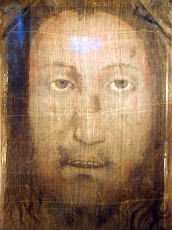
In the edition of June 22, the Vatican newspaper L'Osservatore Romano published a review signed by Damiano Pomi of a book by the distinguished scholar of art history Hans Belting entitled Il Vero Volto di Cristo "the true face of Christ" (Turin 2008, Bollati Boringhieri, 256 pages). As far as I know this book has not appeared yet in English. If someone knows differently I would appreciate being corrected. Belting is one of a group of art historians who must be known by anyone seeking to deepen their knowledge of the history of images. His work Likeness and Presence: A History of the Image before the Era of Art (Chicago 1994) is fundamental. What follows is my English translation of Pomi's review of Belting's Italian language book, the photos above are by Paul Badde.

Another part of (Belting's) text, dedicated to the representation of the body as a theme of faith, is centered on the image of the Veronica - vera icona (true icon) - paradigm of the artistic definition of the face of Jesus for a number of centuries. Beyond recounting the historical events of which the famous relic was the protagonist, an interesting perspective is delineated for the research according to which, starting exactly from the evanescent image visible on the cloth conserved in the Vatican basilica, there proceeded to be defined a new perception of the face of Christ. In the image, that tradition held was miraculously formed by the contact of the cloth with the face of Jesus, one is already able to foretaste, in a certain sense, that which could only be fully experienced after death: the vision of the face of Jesus.


This idea, widely diffused from the time of the middle ages, is testified to also in literature, in particular in the work of Dante Alighieri. In the work of his youth, Vita Nova, "new life", the celebrated Tuscan poet, writing of the pilgrims that were passing through Florence on their way to Rome to venerate the Veronica, compares them to Beatrice his prematurely deceased beloved. The pilgrims, upon arrival in Rome, would see that which his beloved was already able to gloriously contemplate: she could fix her gaze upon the One of whose true likeness the earth was in possession.


The presence of the relic in the heart of Christianity has given life to an iconography that has rendered even more vivid and real the face of Jesus: the artists that reproduced the cloth were called to furnish a recognizable expression to the indistinct features on it. A work not very easy, whether to satisfy the commissioning of the works of art, or to adequately represent a mystery never fully able to be decodified. Evocative in this vein, is the painting by Francisco de Zurbaran, preserved in the Prado of Madrid, in which a painter, holding his brush and palette, is in devout recollection before the Crucifix. Prior to placing his hands to the work, he seems to be questioning himself on how best to constitute that which is present to his eyes: the death of a man on the cross or the highest manifestation of the love of God. Will his work succeed in communicating this apparent contradiction?


The troubled history of the Roman Veronica, beginning with the sack of Rome at the hands of German lancers in May of 1527, has meant that the icon would be received less as an image and instead be largely received as a relic. The reproductions which followed the sack of Rome would usually present the holy face with closed eyes, while previously they were open: a living face which observed and not only was observed, in an exchange of looks which conferred on the one who examined closely a strong emotional impact. Through that which was held to be the true face of Christ, the person felt personally called and encouraged to redefine even his relation with himself and the reality surrounding him, inasmuch as, by means of the image, the mystery of God, in part, had been unveiled for him.

Sunday, June 8, 2008

Textile Expert Interviewed Regarding Shroud of Turin

This is an interesting source of information regarding some of the problems which put in serious doubt the carbon 14 testing done on the Shroud of Turin. http://www.swissinfo.ch/eng/front/Sacred_relic_still_shrouded_in_mystery.html?siteSect=105&sid=8909646&cKey=1206968176000&ty=st

Sunday, June 1, 2008

Sr. Blandina Paschalis Schlomer


Sr. Blandina speaking to German pilgrims at the Shrine of the Holy Face in Manoppello


Sr. Blandina greeting Pope Benedict on the occasion of his visit to the Shrine of the Holy Face in Manoppello on September 1, 2006.


Sr. Blandina, a Trappistine sister from the Abbey of Maria Frieden near the city of Cologne in Germany, was the first to discover, in the 1970's, the fact that the Holy Face of Manoppello is able to be perfectly superimposed on the Face of the Holy Shroud. Today Sr. Blandina lives in Manoppello and dedicates herself to continuing study on the Holy Face of Manoppello. She is also a writer of icons, as well as a guide for the pilgrims who come to the Shrine of the Holy Face. It was Sr. Blandina who brought Fr. Pfeiffer, S.J. to the knowledge of the Holy Face.

Saturday, May 31, 2008

Prayer of Pope Benedict XVI Composed on September 1, 2007, the First Anniversary of his Visit to the Shrine of the Holy Face of Manoppello


In honor of this last day of May, the month of Mary, Feast of the Visitation of Mary to her cousin Elizabeth, and traditionally,the Feast of the Immaculate Heart of Mary, here is an excerpt of Pope Benedict XVI's prayer to the Holy Face of Jesus which ends with an invocation of the Blessed Virgin Mary.

"Mary, Mother of the Holy Face, help us have 'innocent hands and a pure heart', hands illumined with the truth of love and hearts enraptured by divine beauty, that transformed by the encounter with Christ, we may give ourselves to the poor and the suffering whose faces reflect the hidden presence of your Son Jesus, who lives and reigns forever. Amen!"

Wednesday, May 28, 2008

A Beautiful Montage of Photographs from the Feast of the Holy Face of Manoppello by Antonio Teseo

Antonio Teseo, one of the most perceptive and spiritual minded commentators on the Holy Face of Manoppello has posted a series of photographs showing the recent pilgrimage (May 17, 18, 19) from the Shrine to the parish church of San Nicola. See this on Youtube http://www.youtube.com/watch?v=OJZC0nE2JcY.

Thursday, May 22, 2008

Fr. Heinrich Pfeiffer, S.J. Teaches about Holy Face of Manoppello

In 2000 Fr. Heinrich Pfeiffer, S.J., Professor at the Pontifical Gregorian University in Rome edited a book entitled Il Volto Santo di Manoppello(The Holy Face of Manoppello), published by Carsa Edizioni in Pescara. On page 13 Father Pfeiffer writes,

"Is the Veil of Veronica found in Rome or in Manoppello? That's what many are asking after having known the Holy Face in the shrine near the little city in Abruzzo. By now its accepted almost everywhere that no trace of an image is found on that piece of cloth which is still venerated today in the basilica of St. Peter's in Rome. On the other hand there have already been attempts to remove the 6th station from the Way of the Cross in as much as modern theologians don't believe any more in the existence of a woman with the name of Veronica who would have given her veil to Christ in order to wipe his bloody face during the ascent to Calvary.

In Rome this saint was never depicted prior to the painting by Ugo da Carpi in 1525, a painting intended to be located in the place where the relic of the Holy Face was shown to the crowds of pilgrims, that relic which was simply called (the) Veronica. Here it was the relic and not the saint that was called Veronica, a name which means "true icon". Only around 100 years after Ugo da Carpi's painting was there created a second representation of Saint Veronica, the colossal statue sculpted by Mochi for the pillar where the so-called relic is kept, (the fabric) on which no one is able to recognize any more the features of Christ.

But in Manoppello there is found a very fine Veil with the most vivid and expressive image of Jesus in all the world. No one knows how to explain the process by which the image has been formed on the Veil. The research conducted in part by a German Trappistine Sister, Blandina Paschalis Schlomer, and in part by myself, has determined four things:
1. The face on the Veil (of Manoppello) is able to be perfectly superimposed on the face of the Shroud (of Turin), and this on a scale of one to one.

2. The Veil with its face is none other than the Roman Veronica believed to be lost.

3. The face on the Veil of Manoppello is, together with the Shroud, the most important model for the depictions of Christ in the Christian East and West.

4. The Veil with the face of Christ could not have already arrived in Manoppello by 1506, but rather a little more than 100 years later."

Saturday, May 17, 2008

May is the Month of Mary, Mother of the Holy Face

From Ecco tua Madre!, un Mese con Maria (Behold your Mother!, a month with Mary) by Stefano De Fiores, Citta' Nuova, Rome, 2007, p. 122.

"Let's be guided by Mary, example and teacher of contemplation, because her heart is a jewelery case which contains the mysteries of Christ and a mirror in which is reflected the multiform images of his face."