Wednesday, February 22, 2012

The Symposium Of European and African Bishops Concludes at Manoppello

The Symposium Of European and African Bishops Concludes at Manoppello

by Antonio Bini; photos by Antonio Bini and Paul Badde


Bishops on the Via Crucis leading to the Shrine of the Holy Face


Pescara - With a pilgrimage to the Shrine of the Holy Face the second Symposium of the Episcopal Conferences of Africa and Madagascar (SECAM) and the Council of Episcopal Conferences of Europe (CCEE)has drawn to a close.
"Evangelization today: communion and pastoral cooperation between Africa and Europe" was the theme of the Symposium which began on February 13, 2012 in Rome at the Pontifical Athenaeum Regina Apostolorum in Rome, with discourses by Cardinals Polycarp Pengo and Angelo Bagnasco, Chairman of the Symposium of Episcopal Conferences of Africa and Madagascar (SECAM) and Vice-President of the Council of European Episcopal Conferences (CCEE)respectively.


The days of study and discussion were intended to understand and reflect on the pressing problems of the Church on the two continents, in a climate of friendship that will be useful for better cooperation on issues of peace, immigration, religious freedom and combating prostitution. For the Hungarian Cardinal Peter Erdo, "European and African bishops want to face together the challenge of the new evangelization, living in a more intense way our brotherhood in mission. A collaboration that is based on mutual exchanges. While in the past many missionaries left Europe to go to Africa, now we are seeing an opposite movement, with priests, nuns and lay religious coming to Europe from Africa. We discovered many common concerns and we are committed to working together in the field of pastoral care, health, education, and social problems. Moreover, our continent needs an injection of ecclesial vitality and this vitality can come from the young Churches of Africa."


Along the same line, the Senegalese Cardinal Theodore-Adrien Sarr, who stated "The African immigrants will help Europe to discover for the future new youthfulness and freshness in the faith. Future exchanges between the bishops will address issues such as education, the fight against poverty, health, training of leadership teams, the dialogue between religions, the arms trade, human trafficking, external debt and the exploitation by the mining companies."


This path of commitment to communion and solidarity of people coming from so many different worlds comes from belonging to the same Church, united in Christ.


This is the deeper meaning to be found in the final pilgrimage to Manoppello.


It is the Pope himself who, the day before, while meeting with the bishops attending the Symposium who did not hide the complexity of the challenges facing the Church today, starting with that of religious indifference. Recalling the moral authority and credibility that must support them in their pastoral efforts, Benedict XVI said that the gaze of faith fixed on Jesus opens the mind and heart to the First Truth which is God. Benedict XVI sought to further strengthen this thought emphasizing that "a bishop must be in love with Christ."


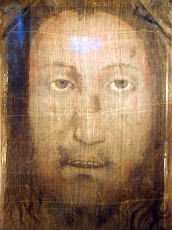
The Shrine of the Holy Face was framed with an unusual amount of pure white snow which however did not prevent the Bishops from climbing Tarigni hill, walking along the Via Crucis. At each station the reflections were led by a different bishop. Arriving in the Basilica, Archbishop Bruno Forte of Chieti-Vasto, prior to the solemn celebration of Mass, welcomed his brother bishops from Europe and Africa and spoke regarding the extraordinary image of the Holy Face in Italian, English and French. Referring to studies of P. Heinrich Pfeiffer, Sr. Blandina Paschalis Schlomer, Andrew Resch, Paul Badde and Saverio Gaeta he said that one can "respond positively and with sufficient moral certainty to two questions put by the Holy Face: Is this the Veil of Veronica once venerated in St. Peter's? And 'Is this the precious relic of the sudarium laid in the tomb on the face of the dead Christ, as attested by the Gospel of John (20, 6-7)?" These reflections were also been drawn up in a letter From Archbishop Forte personally delivered to the bishops present.


These assessments are important, which also take into account, perhaps, that the Vatican last summer in a press release for the first time admitted (after 484 years), the disappearance of Veronica during the sack of Rome in 1527. The meeting was an opportunity to meditate and pray before the Holy Face, described in detail by the German writer and journalist Paul Badde. Many bishops did not hide their emotion. A feeling that has united distant worlds, from that of the bishop of Iceland to that of South Africa. At the end of the celebration Archbishop Charles Gabriel Palmer-Buckle of Ghana, expressing gratitude for the welcome they had received, asked Bruno Forte on behalf of all, that each time he returned to the Basilica of the Holy Face he might remember in his prayers the European and African bishops.


When I asked the same Archbishop Palmer-Buckle, who was part of the core group organizing the Symposium, what was the meaning which he and the other bishops would attribute to the pilgrimage to the Holy Face, he reflected deeply before replying that the impetus which comes from having known the Holy Face is to "proclaim the true Christ, a living Christ." The Archbishop Bruno Forte, to whom I had asked what impressions he had received from the participants, confirmed to me that "all were deeply affected by the pilgrimage to Manoppello".


Also present at the gathering was Petra-Maria Steiner, who in recent years has dedicated herself to studies on the Holy Face, and who is engaged in a constant effort of promotion of the Holy Face in the German speaking countries. Lastly there should be noted the greeting of the President of the Polish Bishops' Conference Jozef Michalik to Immaculata and Caterina, young nuns who arrived from Poland a few months ago and are now serving in Manoppello.


BISHOPS WHO TOOK PART IN THE PILGRIMAGE TO MANOPPELLO

EUROPE: Jozef Michalik, chairman of the Episcopal Conference of Poland; Ludwig Swartz, archbishop of Linz, Austria; François Garnier, Archbishop of Cambrai, France, Gerard de Foix, Archbishop of Lille, France; Senkiv Taras, Greek-Catholic church Bishop of Ukraine, Lucjan Avgustini, Albania, Duarte De Cunha, Portugal, Zef Gashi, Montenegro, Petru Gherghe, Romania, Pierre Bürcher, Iceland; Vjekoslav Huzjak, Croatia; Everard De Jong, Netherlands;

AFRICA: Buti Joseph Tlhagale, Archbishop of Johannesburg, South Africa, Jean Gabriel Djarra, Mali; Touabli Youlo Alexis, Ivory Coast, Jude Thaddeus Ruwa'ichi, Tanzania, Jean-Noël Diouf, Senegal, Denis Komivi Amuzu-Dzakpah, Togo; Gabriel Justice Anokye, Ghana; Maragde Mbonyintege, Rwanda, Frank Nubuasah, Botswana, Emmanuel Obbo, Uganda; Louis Portella Mbuyu, Congo, Benjamin Ramaroson, Madagascar, Joachim Tarounga, Chad, Charles Kasonde, Zambia, Gabriel Charles Palmer-Buckle, Ghana.


unosemper@libero.it

Friday, February 17, 2012

Pilgrims to the Holy Face of Manoppello -- Bishops Representing European and African Bishops Conferences

A historic day at Manoppello -- dozens of Bishops from the African and European continents together honor the Holy Face and seek help for their duties as successors to the apostles in the 21st century. Thanks to Paul Badde for this photo.

Thursday, February 16, 2012

Video on Youtube of the Feast of the Holy Face in May 2011

Antonio Teseo has alerted me regarding a wonderful video which he and Giuseppe Marcantonio have produced and is now available on Youtube of the Feast of the Holy Face in May 2011. The video is "dedicated to the Italians in other countries outside Italy, especially in Canada, the United States, Argentina, Belgium, France, Luxemburg,and Switzerland who with their assistance contribute to making the festival of May unique in the world." This video is very special and has many scenes of the procession to and from the Shrine, which enable the viewer to hear the music, see the streets of Manoppello, as well as the arrival of the Holy Face at the church of San Nicola and the return of the Holy Face to its case above the altar in the Shrine by Fr. Carmine, rector of the Shrine. Many scenes are very moving for me as my wife and I were there in Manoppello for these events and participated in the processions. Thanks Antonio. To see the video, click on the following link Festa del Volto Santo di Manoppello dedicata agli italiani all'estero - YouTube

Monday, February 13, 2012

European and African Bishops to travel to Manoppello to Entrust New Evangelization to the Holy Face

On Friday February 17 the European and African Bishops participating in a symposium in Rome on the New Evangelization will travel on pilgrimage to the Shrine of the Holy Face of Manoppello. Archbishop Bruno Forte of the archdiocese of Chieti-Vasto will accompany the Bishops. These bishops, around 50 in number, representatives of the Bishops Conferences of Europe and the Bishops Conferences of Africa and Madagascar will represent all the bishops of Europe and Africa in entrusting the New Evangelization to the Holy Face. Read this article on the Bishops' Symposium which includes news of the pilgrimage Fides Service - AFRICA - On February 13 the Second Symposium of the European and African Bishops opens in Rome

Saturday, February 11, 2012

Seeing and Understanding the Shroud of Turin and the Holy Face of Manoppello


Paul Badde's book "The True Icon -- From the Shroud of Turin to the Veil of Manoppello" is now available from Ignatius Press. This book is an artistic achievement being both scholarly and accessible to the public at large. Wonderfully illustrated with dozens of photos taken by the author himself, the book will open up the sacred images "not made by human hands" to a wider audience throughout the english speaking world. Experts on the Holy Shroud as well as theologians will benefit from this masterpiece of journalism which "throws open the doors (and windows) to Christ" who reveals himself even in our day in a marvelous way by means of images. To order see The True Icon - Paul Badde : Ignatius
For more information about the book see
Press Release

Wednesday, February 1, 2012

Salve Sancta Facies - Hail Holy Face


a hymn by Pope Innocent III from the year 1216


Salve sancta facies nostri redemptoris,
in qua nitet species divini splendoris
Impressa panniculo nivea candoris,
dataque Veronice signum ob amoris


Hail holy face of our redeemer on which shines the appearance of divine splendor
Impressed upon a little cloth of snowy radiance and given to Veronica as a standard of love.


Salve, decus seculi, speculum sanctorum
Quod videre cupiunt Spiritus coelorum.
Nos ab omni macula purga vitiorum,
Atque nos consortio lunge beatorum


Hail beauty of the ages, mirror of the saints, which the Spirits of the heavens desire to see.
Cleanse us from every stain of sin and guide us to the fellowship of the blessed.


Salve nostra gloria in hac vita dura,
Labili ac fragili, cito transitura.
Nos perduc ad Patriam, o felix figura,
Ad videndam faciem que est Christi pura.


Hail our glory amidst this hard life, so fragile and unstable, quickly passing away.
Point us, o happy figure, to the heavenly homeland to see the face that is Christ indeed.


Salve o sudarium, nobile iocale
Et nostrum solatium et memoriale
Eius qui corpusculum assumpsit mortale
Nostrum verum gaudium et bonum finale!


Hail, o sudarium, noble encased jewel, both our solace and the memorial of him who assumed a little mortal body – our true joy and ultimate good!


Friday, January 6, 2012

The Veronica is not in St. Peter's


by Antonio Bini

After almost five centuries the Vatican admits its disappearance in 1527. A circumstance which makes credible the hypothesis that it is identical to the Holy Face

On May 31, 1999 at a crowded press conference held in Rome at the foreign press association Fr. Heinrich Pfeiffer revealed the results of his study affirming that the Veronica and the Holy Face of Manoppello should be seen as one and the same. This news was reported by Italian and foreign television networks among their top stories for the day. Usually the coverage was linked to the classic stereotype of the mountainous Abruzzo region, so that Manoppello was described as a "forgotten village at the foot of the Maiella range".

Some of the journalists asked the Vatican for an opinion in this matter. The response was "total silence", said the correspondent for the Spanish television network Antenna 3's news program of May 31, 1999, as he broadcast with the facade of the Basilica of St. Peter's behind him.

The Catholic press and church leaders showed indifference and kept their distance, effectively isolating Father Pfeiffer, director of the Course on Cultural Patrimony for the Gregorian University, who is considered to be among the world's most authoritative scholars of Christian art. Some Italian scholars of the Shroud of Turin (sindonologists) didn't hesitate to show their annoyance at the news, and in some cases gave their opinion that at best the Holy Face could only be a copy of the Veronica.


Padre Germano di Pietro, OFM Cap., Antonio Bini and Father Heinrich Pfeiffer, S.J. on May 31, 1999 the day of the press conference

On the same occasion the results of Professor Donato Vittore's research were also presented. Professor Vittore, who teaches at the University of Bari, demonstrated by means of a high intensity scanner that there was no pigment on the cloth.

The problem was not so much the Holy Face itself, which had been at the center of a beloved and popular yet strictly local devotion centered in the mountains of Abruzzo, but rather the bringing up for discussion that the legendary Veronica was no longer to be found in Rome at St. Peter's Basilica.

Throughout the centuries the Veronica has been Christianity's most important relic. Coming from the East, it was venerated at St. Peter's from the eighth century, until it became the fundamental reason for pilgrimages to Rome, even prior to the first jubilee year proclaimed by Pope Boniface VIII in 1300.

Among the pilgrims coming to Rome to venerate it were Dante and Boccaccio.

After the 1500's a great silence fell over this prodigious image. But as the great Jubilee for the Holy Year of 2000 approached two important exhibitions were organized at Rome with the collaboration of the Vatican's Apostolic Library. Both exhibitions, the first on the history of the Pilgrimage to Rome in the Middle Ages (at the Palazzo Venezia) and the second on "The Face of Christ" (at the Palazzo delle Esposizioni) recalled to mind the historic role of the Veronica by means of documents, medals, etc. from a number of foreign museums. From the two exhibitions there emerged the clear distinction between the reproductions and engravings of the Veronica prior to the 1500's, which showed the image with eyes open, and the reproductions following which showed the image with eyes closed. In any case since the 1500's there continued to be a persistent silence regarding whether or not the relic was present at St.Peter's.

The arrival of the Jubilee Year of 2000 was marked also by an extraordinary production of books and articles which involved historians, experts on the Middle Ages, theologians, art historians, etc. At the end of 1999 one of the many books of a historical perspective published a photo of the cover of the "Opusculum del Grimaldi" preserved in the Vatican archives and which up until then had been unknown.

This document, dated 1618 (but which seems from every indication to have been changed from the original date)presents the image of the Veronica with open eyes and represents an important contribution compared to the overall confusion on the matter.

The importance of this image was at the center of my article entitled " La Veronica com'era" (The Veronica as it was) which I wrote for the pages of the Bollettino del Volto Santo (Bulletin of the Holy Face -- official publication of the Shrine of the Holy Face of Manoppello). There followed a further reflection on this by Padre Germano Di Pietro, then superior of the Shrine, which had the title "E' ancora in San Pietro la Veronica" (Is the Veronica still in St. Peter's?)

After the publication of these articles two Canons of St. Peter's came to Manoppello to advise Padre Germano to stop bringing up this issue.

When Pope Benedict XVI decided to go on pilgrimage to Manoppello his visit was announced and then denied for months. Contrary to the long advance notice which precedes the Pope's public appointments it was confirmed by the Vatican press office only around ten days before September 1, 2006. We know that the visit was strongly opposed by the Canons of St. Peter's, precisely for the significance that would be given to the event, with its implicit recognition of the thesis which had been advanced by Father Pfeiffer after years of research that the Holy Face is to be identified with the Veronica.

The visit was then described as a simple "private pilgrimage", a label which brought a smile to Pope Ratzinger himself at Manoppello.

In the meantime other scholars, especially from foreign countries, began to draw closer to the Holy Face. Paul Badde's book published in Germany in 2006 caused the weekly Der Spiegel to describe it as "a cultural thriller, full of suspense and intrigue, similar to Dan Brown"

Among the Italians the importance of Saverio Gaeta's study "L'enigma del Volto di Gesu'" (The Enigma of the Face of Jesus) published by Rizzoli in 2010 must be emphasized. Gaeta in his book, among other things, puts forth an interesting hypothesis concerning several important people linked to Abruzzo who were involved in the Sack of Rome in 1527.

His hypothesis is compatible with the arrival in Manoppello of the Holy Face, which according to the first document attesting to the presence of the relic in Abruzzo - the Relatione Historica (Historical Report) of Padre Donato da Bomba, came to the Abruzzi town "around the year 1506". The imprecise phrasing used by the Capuchin suggests using due caution, considering that the report wasn't published until 1640.

Bruno Forte, Archbishop of the diocese of Chieti-Vasto, in whose territory Manoppello falls, on many occasions has shown that he trusts the reliability of the studies which have so far been conducted concerning the Holy Face.

Pilgrims who arrive in Manoppello from the world over are not so much interested in this research, wanting above all to pray and to meditate before this mysterious image with its profound and human gaze which no work of art is able to render.

In April of 2011 an exhibit on the Holy Face opened in Lucca and another exhibit was held in September of the same year at Lourdes which was seen by over 150,000 people. The exhibit of Lourdes was strongly desired by Philippe Perrier, Bishop of the diocese of Lourdes-Tarbes who is very much devoted to the Holy Face.

But the year just completed is particularly significant because after almost five centuries the silence regarding the disappearance of the Veronica from St. Peter's came to an end. On December 6, 2011, with Christmas close at hand, L'Osservatore Romano welcomed an article by Paul Badde who on a number of occasions, in articles and in his book which so far has been translated into seven languages, had criticized the Vatican for their reticence. Badde was able to write for the first time in the press organ of the Holy See that the Veronica is for centuries in Manoppello, in as much as it disappeared during the so called Sack of Rome.

This follows a press release from Rome dated July 14, 2011 concerning the announcement of the exhibit entitled "L'uomo, il volto, il Mistero" (Man, Face, Mystery).

The last segment of the exhibition, inaugurated in August in San Marino, was dedicated to the "Holy Face". The surprise comes from the part of the press release where it affirms that the ancient relic of the Veronica "disappeared following the Sack of Rome of 1527".

In this brief phrase, there are two points to be gathered which are quite extraordinary.

This press release, ascribable to Professor Paolucci head of the Vatican Museums, is the first document which refers, even if only incidentally to the necessary information connected to the announcement of the exhibit, that the Veronica is no longer present in St. Peter's. It confirms an important series of hypothesis and doubts advanced by historians and other scholars, especially in recent years. But the press release offers a further element by indicating with precision that the disappearance of the Veil coincided with the Sack of Rome of 1527.

Professor Paolucci, with his authoritative stature as a former Minister for Cultural Patrimony in the Italian government, has finally been able to shed light on the doubts and uncertainty which have dragged on for far too long.

Regarding the Holy Face there will continue to be much discussion, but certainly it will no longer be able to exclude, a priori, the hypothesis that it is in fact the Veronica.