Friday, January 31, 2014
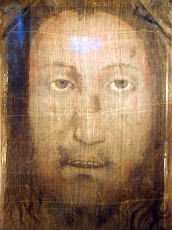
More Photos on Holy Face of Manoppello from Alan Holdren at Catholic News Agency
See the Facebook page of Catholic News Agency for additional photos from Manoppello https://www.facebook.com/media/set/?set=a.10151795757276486.1073741859.25126781485&type=1


Monday, January 27, 2014
American Catholic Media Turns its Attention to the Holy Face of Manoppello

In these days the attention of the American Catholic media has been attracted to the Holy Face of Manoppello. Alan Holdren, after a visit to the Shrine of the Holy Face has written an article with photos for the Denver, Colorado based Catholic News Agency. http://www.catholicnewsagency.com/news/manoppellos-holy-face-shrine-sees-uptick-in-us-interest/. A series of articles on the Holy Face is planned by the journalist.
EWTN (Eternal Word Television Network) based in Birmingham, Alabama but with a worldwide audience will be reporting in the near future on the Holy Face of Manoppello. Their camera crew was recently on location in Manoppello to do some filming, among their guides were author Paul Badde and the Rector of the Shrine of the Holy Face, Fr. Carmine Cucinelli, O.F.M., Cap. seen in the photo below observing the Holy Face in the open air outside the Basilica.

A more thorough informing of the American Catholic public about the Holy Face of Manoppello is in progress.


.jpg)


photos courtesy of Alan Holdren
Thursday, January 23, 2014
On Dr. Martin Luther King, Jr. Weekend America's Home of Liberty Discovers the Holy Face of Manoppello
by Paola Frachessaphoto by Nicholas Erickson
photo by Brenda Abdelmesih
In the context of the New York Encounter, the yearly cultural event organized by the catholic movement Communion and Liberation, visitors from all over the States have attended the guided tour to the exhibit "the Face of Jesus: from that gaze, the human face is born".
The exhibit, dedicated to the tradition of the acheiropoeita, the images of Christ not painted by human hands, focused on the "Holy Face of Manoppello", the precious relic that has been held since 1660 in the Capuchin monastery of the town of Manoppello in Abruzzo, Italy.
The exhibit documents how the desire to see the Face of God has been present in the life of the Church throughout the centuries and is still the object of modern man's profound nostalgia.
All the guides were volunteers that had been trained by the Italian curator of the exhibit, Ms. Raffaella Zardoni.
About a thousand people visited the exhibit; among the guests his Excellency Mons. Carlo Maria Vigano', Apostolic Nuncio to the United States of America and to the Organization of American States.
The Mayor of the town of Manoppello, Mr. Gennaro Matarazzo came to New York expressly for the event. He was present for the entire weekend, and was warmly welcomed by the visitors. "I will never stress enough the importance of this exhibit for all of us who are visiting it and, if I am allowed to say it, for the whole Church and believers. I keep receiving text messages from the citizens of Manoppello, asking how the exhibit is being welcomed in New York". Mr. Matarazzo said.
photo of organizers of New York Encounter and at the center Mr. Gennaro Matarazzo, Mayor of Manoppello this photo and two photos immediately preceding by Raffaella Zardoni
“Several things about the presentation on the Face of Jesus exhibit, and particularly the Veil of Manoppello, really moved me”, Mr. Henry Artis, Painter, said after viewing the exhibit. “First, that at a certain point in history the desire to see the “face” of Christ stopped. I am really intrigued by this because it indicates that something changed, a something that was greater than the sack of Rome.
Second, that we, in a time of extreme individualism in which “faces” merge into a faceless mass would once again be prompted by the gesture of Pope Benedict XVI to turn toward a particular “face”, the face of the one we love.
photo by Paul Badde
Third, the fact that Christ would even have the desire to leave an imprint of his face on Veronica’s veil makes the question “Why?” immediately arise.
Fourth, that like Juan Diego's tilma, Christ’s portrait is left on a surface that does not hold paint and with unknown pigments.
Fifth, the fact that Christ wants “to see” and “be seen” points to the fact that his humanity is so truly human. This, I believe, is vitally important because the desire to “be seen”, to be acknowledged, by the person I love is one of two deeply rooted needs that I have, and the second is that I want to see the one seeing me in order to see what kind of gaze it is. Because the look in the eyes of the one I love looking at me tells me everything.
photo by Paul Badde
And that leads me to my sixth point. When I looked at the eyes of Christ on the Veil of Manoppello they showed an ocean of paradoxical emotions that are hard to describe and that no artist was able to catch. I saw in the eyes a certainty and a pleading, a love and a begging for love, a willingness and a regret…in short, I saw the gaze of a real man begging for my gaze, a gaze full of His love.
I am really thankful that the exhibit was put on and that I was able to see it during the New York Encounter”.


Tuesday, January 14, 2014
Procession with the Veronica

The following english translation is that of an article which appeared in the July 2013 edition of Il Volto Santo di Manoppello, the official publication of the Shrine of the Holy Face of Manoppello
The true founder of the cult of the Veronica was Pope Innocent III (1198-1216), under whose pontificate there took place the conquest of Constantinople by the Crusaders. It is due to him that the Veronica was transformed into a universal symbol of the Church, unlike the image of the Savior in the Sancta Sanctorum sketched by St. Luke and painted by the angels, whose veneration remained a phenomenon limited to Rome and towns in the region of Lazio. In 1208 the Pope instituted a procession with the Veronica, which traveled from St. Peter's to the Santo Spirito Hospital which Innocent had founded. In addition, the Pope transferred the status of "station church" assigned to the second Sunday after Epiphany from the church of Sant'Eustachio to that of the church of Santa Maria in Sassia, situated close to the Santo Spirito Hospital. As explained by the Bull and the preaching of Pope Innocent upon its institution, the procession was intended to be a liturgical commemoration of the Wedding of Cana in the course of the festivity of Epiphany. On that occasion donations were made to the poor and the pontiff preached each year on works of charity (which according to the exegesis were symbolized by the stone water jars of Cana). Although there is included also an image of Mary, the Wedding of Cana was accomplished between the image of Christ and the observer, a salvific anticipation of that marriage between the human soul and the heavenly grace that will take place at the end of time. Pope Innocent established that, during the celebration of the feast the image of Christ should be exposed in an exquisite capsa (case)of gold and silver decorated with precious stones. The transmission of salvation happened through the remission of sins provided for through taking part in the procession. In 1216, a year of great difficulty for Innocent, the following miracle was verified: the face of Christ on the cloth turned upside down so that the beard was shown on top and the forehead down below. As related by the english historian Matthew Paris, monk of St. Alban's, in his chronica maiora of 1240, we also learn that, following this event, the pope composed an elegant prayer that provided to whoever recited it an indulgence of ten days. This text speaks of the sudarium of Veronica which God had left to mankind as a memento (equal to a reminder)and alludes at the same time to the face to face encounter with Christ at the end of time. The Veronica thus was considered on the one hand retrospectively, in as much a testimony of the earthly events of Christ, on the other hand in a future perspective as a guarantee and anticipation of the intimate vision of God (the visio beatifica)
Friday, January 10, 2014
New York Encounters the Holy Face
based on a flyer for the exhibit on the Holy Face
http://www.newyorkencounter.org/exhibits/2014/1/17/the-face-of-jesus-from-that-gaze-the-human-person
January 17-19, 2014 | Manhattan Center | 311 West 34th Street | New York City
New York Encounter is an annual three-day public cultural festival in New York City, organized by members of the Catholic movement Communion and Liberation and by the Crossroads Cultural Center
(646) 571-2341 | info@newyorkencounter.org
THE FACE OF JESUS: FROM THAT GAZE, THE HUMAN PERSON IS BORN

The exhibit is open to the public and free of charge New York Encounter invites you to a weekend of public discussions, exhibits, presentations, and live performances exploring the nature of the person and the flourishing of that person in belonging to a people. Our hope is that New York Encounter itself can give witness to the life of a people whose heart has been reawakened by an encounter with a human presence.
The exhibit retraces the events of the most ancient portraits of Christ, called acheiropoietos (i.e., not made by human hands) and, in particular, of the Veil of Manoppello, Italy, visited in 2006 by Pope Benedict XVI during his first papal trip.
Recent studies have re-opened the question of whether this veil, because of its unique
features, might be the one used by Veronica to wipe Jesus' face on His way to Calvary. The exhibit will document how the desire to see the Face of God, which characterizes the Old Testament, has been present in the life of the Church throughout the centuries and is still the object of modern man's profound nostalgia.
Guided Tours of the Exhibit
Friday, January 17: 8:00 PM | 9:15 PM
Saturday, January 18: 10:00 AM | 11:15 AM | 12:30 PM | 1:45 PM | 3:00 PM | 4:15 PM | 5:30 PM | 6:45 PM
Sunday, January 19: 11:00 AM | 12:15 PM | 1:30 PM | 2:45 PM | 4:00 PM | 6:00 PM |
7:15 PM | 8:30 PM
http://www.newyorkencounter.org/exhibits/2014/1/17/the-face-of-jesus-from-that-gaze-the-human-person
January 17-19, 2014 | Manhattan Center | 311 West 34th Street | New York City
New York Encounter is an annual three-day public cultural festival in New York City, organized by members of the Catholic movement Communion and Liberation and by the Crossroads Cultural Center
(646) 571-2341 | info@newyorkencounter.org
THE FACE OF JESUS: FROM THAT GAZE, THE HUMAN PERSON IS BORN

The exhibit is open to the public and free of charge New York Encounter invites you to a weekend of public discussions, exhibits, presentations, and live performances exploring the nature of the person and the flourishing of that person in belonging to a people. Our hope is that New York Encounter itself can give witness to the life of a people whose heart has been reawakened by an encounter with a human presence.
The exhibit retraces the events of the most ancient portraits of Christ, called acheiropoietos (i.e., not made by human hands) and, in particular, of the Veil of Manoppello, Italy, visited in 2006 by Pope Benedict XVI during his first papal trip.
Recent studies have re-opened the question of whether this veil, because of its unique
features, might be the one used by Veronica to wipe Jesus' face on His way to Calvary. The exhibit will document how the desire to see the Face of God, which characterizes the Old Testament, has been present in the life of the Church throughout the centuries and is still the object of modern man's profound nostalgia.
Guided Tours of the Exhibit
Friday, January 17: 8:00 PM | 9:15 PM
Saturday, January 18: 10:00 AM | 11:15 AM | 12:30 PM | 1:45 PM | 3:00 PM | 4:15 PM | 5:30 PM | 6:45 PM
Sunday, January 19: 11:00 AM | 12:15 PM | 1:30 PM | 2:45 PM | 4:00 PM | 6:00 PM |
7:15 PM | 8:30 PM
Thursday, December 19, 2013
The Pifferari of Abruzzo and their Christmas Traditions
They were called "pifferari": the bagpipers of Abruzzo and their centuries old traditions of Christmas

H. Payne, Shepherds from the Abruzzi (ca. 1850)

Anonymous Woodcut from the Second Half of the 19th Century published in the journal Roma, 1874 -- Pifferari play before an outdoor shrine of the Madonna
by Antonio Bini
On display as part of the current exhibition "The sound of bagpipes in the soul : d'Annunzio and the ancient sonority of the pastoral world" is the bagpipe which is part of the collection of objects in the small ethnographic museum connected to the Shrine of the Holy Face of Manoppello.

The exhibition, which will run from November 23 to January 26, 2014, is being held at the Museum of the Birthplace of Gabriele D' Annunzio in Pescara.
The bagpipe lent to the exhibition in Pescara was donated to the Shrine years ago by an anonymous elderly bagpiper, probably during his last Christmas traveling to the traditional novena. According to testimonies collected in the past, the pipers who came to the shrine during Christmas were given lodging for the night by the Capuchin friars.

Mario and Enrico Musichini, at the head of a company of pilgrims who are returning to their town of Castellafiume, in Abruzzo.
Until the nineteen sixties, a living nativity scene was held on January 6.
But the bagpipe was linked at one time not only to Christmas but also to the religious rites , and were present in the companies of pilgrims moving on foot towards the shrines.
The bagpipe is an ancient tradition in southern Italy and in particular in the Abruzzo region , where for centuries it has been linked to the pastoral world. The pipers, or better pifferari as they were called by the travelers of the Grand Tour, normally played the ancient instrument during the hours of watch over their flock, according to testimonies collected in Abruzzo also from American travelers , such as John Augustus C. Hare who met them near Sulmona (see Days near Rome , 1875) and Maud Howe who in 1898 records their presence in Roccaraso (see Roma Beata ).
But it was above all in Rome where the arrival of the pifferari for the Christmas novena took a particular religious relevance in the wake of an ancient tradition that was repeated until 1870, that is with the acquisition of the Papal States by the Kingdom of Italy. "The pipers never hurt anyone" protested the Romans.
To lament the loss of this tradition was also the American sculptor William Wetmore Story, in his book "Roba di Roma " in his later edition of 1870 (the first edition was published in 1862 in Boston and New York) .
There were reasons of public policy, related to the danger posed by banditry , to prevent the pipers' access to Rome. In Abruzzo this long tradition was to suffer the consequences of the collapse of the pastoral economy , which led many to emigrate from Abruzzo to the United States . Not surprisingly, the bagpipes which belonged to an immigrant from Abruzzo are on display in the Carnegie Museum of Art in Pittsburgh.
Stendhal, Dickens , Goethe, Berlioz, Lear , Gregorovius and many other known and less well-known protagonists of the Grand Tour in Italy frequently turned their attention to the pipers of Abruzzo, who with their repertoire in the past centuries inspired many musicians and composers ( Handel, Berlioz, Gounod , Corelli , etc. . ), whose pastoral compositions were largely influenced by the sonority of these singular wandering musicians .
St. Alphonsus Maria Liguori himself, author of the famous Christmas carol "Tu scendi dalle stelle" (known in English with various translations : "You come down from the stars" or "From Starry Skies Thou comest " , "From Starry Skies Descending ," " You Came a Star from Heaven ") adapted the music using pre-existing melodies played by shepherds from Abruzzo, as supported by several musicologists , including the Redemptorist Fr. Paolo Saturno , Professor of History at the Conservatory of Music of Salerno. Nevertheless it is certain that the text is by St. Alphonsus and that it was born as a prayer and was included in his "Christmas Novena".
It was definitely during his mission in Deliceto (1744-1746) , on the Mountains of Dauni in Puglia,
that the saintly Neapolitan musician came in close contact with the shepherds on the lowlands of Puglia . The spiritual care of the shepherds was in fact the goal of reopening the ancient shrine of Our Lady of Consolation near Deliceto . The first biographer of St. Alphonsus , his disciple Father Antonio Tannoja , wrote that St. Alphonsus "wept when he came to learn of the conditions of life of the shepherds , whom he wanted to assist at least on a spiritual level."

The pipers disappeared in silence at the beginning of the sixties, not only due to the inexorable decline of pastoral life , but also because of the steamroller of modernity and cultural assimilation.
In Italy it was especially Gabriele d'Annunzio , who had within him the reverence for the memories of his native land , viscerally attracted to the ancestral scenarios in the region, returning frequently with his soul to the ancient pastoral civilization, which he extolled in several works.
In recent years there has been a renewed interest in the recovery of the centuries-old tradition of pifferari by the Associazione Zampogne d'Abruzzo - http://www.zampognedabruzzo.it - whose members include a number of young people with musical training at the conservatory level.
“Tu scendi dalle stelle” performed by the band of the Associazione Zampogne d’Abruzzo
http://www.youtube.com/watch?v=m7AaNmjJ2c8
Quanno nascette ninno (text by S. Alfonso of “Tu scendi dalle stelle” in dialect)
http://www.youtube.com/watch?v=E4PHl2oD4mY
In my book , entitled "Li chiamavano pifferari : zampognari mito dell'Abruzzo " (ed. Menabo' , Ortona, 2013) , I reconstruct this extraordinary musical and cultural phenomenon.
Tuesday, December 17, 2013
Exhibit on Holy Face in New York City January 17 to 19, 2014

Following the very successful exhibit on the Holy Face which took place last August at the Meeting in Rimini there will be a similar exhibit entitled "The Face of Jesus: from that Gaze, the Human Person". This exhibit, organized by the same team which was responsible for the Rimini exhibit, will be held in New York City next month at the Manhattan Center as part of the annual cultural meeting "New York Encounter". See the website http://www.newyorkencounter.org/exhibits/2014/1/17/the-face-of-jesus-from-that-gaze-the-human-person for information on the meeting and exhibit, including the introduction to the exhibit on the Holy Face by Cardinal Sean O'Malley of Boston who will be in attendance at the gathering. This event in the cultural capital of America promises to be of immense importance for the spread of the knowledge of the Holy Face. An english translation of the catalog of the exhibit at Rimini has been prepared in time for the event in New York City.
Subscribe to:
Posts (Atom)