Tuesday, June 30, 2009

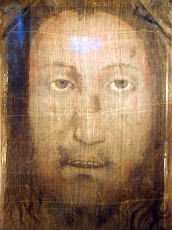
A View of the Veronica along with an Angelic Hand


Each year in Manoppello on the third Sunday of May there takes place a procession from the Capuchin Shrine of the Holy Face, about a kilometer outside the walls of the old commune of Manoppello, to the church of San Nicola, where tradition holds that in 1506 an angelic personage handed over the Holy Face to a citizen of Manoppello. It was in 1506 that Pope Julius II laid the cornerstone for the Veronica pillar which is also the cornerstone of the whole edifice of the present St. Peter's Basilica. Coincidentally it was also in 1506 that the same pontiff gave permission for the establishment of a feast of the Holy Shroud of Turin on May 4 each year, with its own proper Mass and Office.

Here is a photo of the Veronica now present in Manoppello as it arrives at the Church of San Nicola with a small tribute of a single rose petal perched near the cross above the Veronica. During the festive procession,and especially once the Veronica arrives inside the commune's walls, the people of the commune toss an abundance of rose petals to honor the Holy Face of Jesus.

Next year in 2010 this procession will take place on May 16 toward the end of the announced Exposition of the Holy Shroud in Turin which will be from April 10 to May 23. However it is not necessary to wait until that time to see the Holy Face. One may go there at any time the Shrine of the Holy Face is open, which is every day. And hopefully you will have the good fortune to meet a modern day angelic personage, Sr. Blandina,who will explain for you the most blessed Face which is the true image of the Lord. It is through her hands, one of which is actually seen helping to make visible the Face of Jesus in the second photo above, that the Holy Face has now passed from Manoppello to the world.

Monday, June 29, 2009

Sad But Also Necessary Views of the Actual Condition of the Veronica of St. Peter's Basilica


I have thought about whether to post these photos for a long time. First, they are not very good quality. Second they reveal something not very pretty. Yet in posting them I wish to make an appeal to authorities at St. Peter's, as well as to experts on the Shroud that they might put aside personal preferences and their own uninformed opinions to take a fresh look at the Holy Face of Manoppello and let the truth be known.

The photos do not reveal anything new. Already in 1907 Monsignor Wilpert after examining the Veronica in St. Peter's stated that no image at all could be seen on the cloth. More recently, in March 2005, the German journalist Paul Badde was allowed to see the Veronica in St. Peter's from up close, and as he describes the relic in his book soon to be published in english, "one cannot recognize there any signs of an image or painting, nothing at all". How long must this truth be ignored?

Homage to the Holy Spirit


The above photo was taken by Georg Bickl of Germany. It shows a most amazing fresco from the city of Pinerolo in Piedmont not far from the city of Turin. The fresco, which is on the outside of a building at the intersection of Via Germano Sommeiller and Via Archibugeri di San Georgio close to the Church of the Sacred Heart depicts in a most singular way the connection between the Shroud of Turin and the Sudarium (Veronica-Holy Face of Manoppello). It is a fact of history that the first exposition of the Shroud of Turin in Italy took place exactly in Pinerolo in the year 1478. In those years the House of Savoy kept the Shroud in their capital of Chambery in France but they always took the Shroud with them wherever they traveled, The Duchess Jolanda, who had taken over as head of the House upon the death of her husband Blessed Amedeo, spent a good part of 1478, the last year of her life, in Pinerolo and wished that it be exposed there. It was not until the late 1500's, after the Savoy had established their capital in Turin, that the Shroud would remain in Turin. In the region of Piedmont there are over 100 paintings depicting the Shroud of Turin, although this particular painting may be the only one in Piedmont, or anywhere else for that matter, which links the Shroud with the Sudarium.

O Mary, Mother, Teacher and Queen of All Apostles, enlighten the hearts of all peoples to seek the face of your son Jesus Christ. You know him better than anyone could ever hope to know him. In your mind and spirit you longed to see him in your womb before he was born. You comforted and consoled him and nurtured him throughout his life, even to his more awful suffering and death. Be with us O Mary on our journey to be with Jesus, to live for Jesus, to live in Jesus. Amen.

Wednesday, June 24, 2009

Fervent Prayers For and With the Youth of Iran


I say that we all have a duty to remember and pray for the innocent men and women of Iran who have been killed in horrific ways, who are being killed at this moment and for those, especially the women, who are being threatened with death solely because they are for justice, truth, goodness and beauty.

Psalm 10

Why, O Lord, do you stand far off? Why do you hide yourself in times of trouble? In arrogance the wicked persecute the poor -- let them be caught in the schemes they have devised...

Their mouths are filled with cursing and deceit and oppression; under their tongues are mischief and iniquity. They sit in ambush in the villages; in hiding places they murder the innocent.

Their eyes steathily watch for the helpless; they lurk in secret like a lion in its covert; they lurk that they may seize the poor; they seize the poor and drag them off in their net.

They stoop, they crouch, and the helpless fall by their might. They think in their heart, "God has forgotten, he has hidden his face, he will never see it."

Rise up, O Lord; O God, lift up your hand, do not forget the oppressed. Why do the wicked renounce God, and say in their hearts, "You will not call us to account"?

But you do see! Indeed you note trouble and grief, that you may take it into your hands; the helpless commit themselves to you; you have been the helper of the orphan.

Break the arm of the wicked and evildoers; seek out their wickedness until you find none. The Lord is king forever and ever; the nations shall perish from his land.

O Lord, you will hear the desire of the meek; you will strengthen their heart, you will incline your ear to do justice for the orphan and the oppressed, so that those from earth may strike terror no more."

Wednesday, June 17, 2009

Heaven's Window, Heaven's Mirror, Heaven's Image, Heaven's Throne


Psalm 33:13-22 "From Heaven the Lord looks down; he sees all mankind. From his fixed throne he beholds all who dwell on the earth, He who fashioned the heart of each, he who knows all their works. A king is not saved by a mighty army, nor is a warrior delivered by great strength. Useless is the horse for safety; great though its strength, it cannot provide escape. But see, the eyes of the Lord are upon those who fear him, upon those who hope for his kindness. To deliver them from death and preserve them in spite of famine. Our soul waits for the Lord, who is our help and our shield, for in him our hearts rejoice; in his holy name we trust. May your kindness, O Lord, be upon us who have put our hope in you."

Sunday, June 7, 2009

Original Icon of the Holy Eucharist and the Holy Trinity


It seems that the Latin Church's tradition of the Exposition of the Most Blessed Sacrament, making use of a double sided monstrance with glass lunette, dates from no earlier than the arrival in Rome of the image of the Veronica (Holy Face of Manoppello). And according to Paul Badde it was because of the tremendous devotion given to the Veronica in Rome that the traditional Procession on the feast of Corpus Christi was initiated and spread throughout the Latin (Western) Catholic Church.

It also seems that this Holy Face of Manoppello is a reflection of the mystery of the Holy Trinity, Jesus united with His Father and the Holy Spirit in a spiralling of processions.

Saturday, May 23, 2009

Not Painted by Human Hands


Fr. Carmine Cucinelli greeting Pope Benedict VI during his visit to Manoppello on Sept. 1, 2006


Fr. Heinrich Pfeiffer, Sr. Blandina Schloemer, and citizens of Manoppello standing before the Holy Face of Manoppello during one of the expositions of the Holy Face in the Church of San Nicola in Manoppello during the Feast of the Holy Face.

Natural Colors on the Holy Face, the Work of an Artist?

Father Heinrich Pfeiffer, S.J., Professor at the Pontifical Gregorian University in Rome, interviewed by Father Carmine Cucinelli, O.F.M., Cap., Rector of the Shrine of the Holy Face of Manoppello:


A discussion with Fr. Heinrich Pfeiffer on the recent hypothesis put forth by the photographer Roberto Falcinelli, according to whom the precious veil is possibly a work of art made in the 16th century which many believed had been lost.

Fr. Cucinelli: There are many theories that affirm that the Holy Face is a painting. Recently Roberto Falcinelli, a photographer and expert on the Shroud, has affirmed that we are dealing with a painting of the 1500’s by the great German painter Albert Durer or even Raphael, what do you think of this?

Fr. Pfeiffer: I know the basis which allows Falcinelli to say this. But he is mistaken. He is neither the first nor will he be the last to say these things. Already the Jesuit Father Bulst, a famous expert on the Shroud from Germany, with whom I have worked, has affirmed a statement of this type. Actually I was the very one to have pointed out to him the reference to Vasari in his “Life of Raphael”. There it says that the German painter would have sent to the Urbanite (Raphael) a self-portrait, painted on both sides of a cloth so subtle that it was not possible to see that it was a painting. So in reply there are five things that should be highlighted: First we could say that we would be very proud if we possessed a heretofore unknown original of the great artist of Nuremberg. Second unfortunately it does not correspond to the characteristics of the face of the artist. Third he must have copied the Shroud of Turin. Fourth the phenomenon of the oscillation of colors is seen on the Holy Face. Fifth it is not possible to paint on fabric made of marine byssus.

Fr. Cucinelli: Can you explain these points in a detailed and understandable way? In particular why can’t it be a painting?

Fr. Pfeiffer: Again we say that the Holy Face can in no way be a painting. And for a number of reasons. First, even if one could paint with the greatest perfection on both sides of a cloth, there would never be the total transparency as in the Holy Face of Manoppello. The only painting of this type that I know of is a Byzantine work of art made around the year 1000 which shows St. Vitale equally on both sides of a silk fabric. This work is found in the treasury of the Cathedral in Trieste. Second. As Sr. Blandina Pascalis Schlomer has shown that the Holy Face is able to be perfectly superimposed over the Shroud of Turin, the presumed painter, let’s say Albert Durrer, would first have had to place his cloth over the Shroud and copy onto it exactly the characteristics of the negative. One must realize that the Shroud can only be seen from a distance of at least one and half meters. So one can’t ever copy all the details that correspond element by element. In fact until now no one has ever been able to make a perfect copy of the Shroud with purely artistic means. Our presumed painter would have had to turn the cloth over and paint the other side with the same perfection. One can clearly see that this procedure was not possible for any artist, still less for one in the first or second decade of the 1500’s. Third: If one begins to look at the Face and then moves to the right or left, at a certain point one sees that the lips are pink and then this blush disappears and the lips become brown. If one shines a light diagonally from behind only a light brown can be seen in various tones, the red disappears completely. If a light shines from the front, there comes forth a more intense brown and also the red of the wounds from the crown of thorns on the temple is seen. If all this artificial illumination is taken away the colors vanish and there comes forth on the figure a light grey. All these changes can best be observed with the light of the day during the open air solemn procession in May.

Fr. Cucinelli: How can the changing colors be explained? If they are colors, as they appear to the eye to be, of what kind are they?

Fr. Pfeiffer: Such oscillation of colors is only found in nature itself.

Fr. Cucinelli: Can you give some examples of natural coloration that changes?

Fr. Pfeiffer: Yes, in the fish in the Caribbean Sea or in the butterflies in tropical zones, that oscillate, according to the angle of view, between blue and grey. So one must understand that in reality, in nature colors don’t exist, but rather when an object is struck by the white light, it absorbs a part of the light and reflects the complementary light, for example, it absorbs the green and reflects the red. The phenomenon of oscillation is such that as the surface of the object has various angles which are able to be seen, these reflect one or another of the colors at a different time. Therefore the threads of the fabric of the Holy Face must change either on the surface of the threads or inside them in order to permit the same phenomenon. No artist with any technique, whether known or still to be discovered, can change a fabric in this way in order to permit this phenomenon. In other words, one must distinguish the fabric from the image. The very fine fabric is a human work, the image that can be seen on it, is not. This image behaves as a phenomenon that is found in nature. This insperable combination between human work (fabric) and natural phenomenon (image) we can only call by the word “miracle”, a miracle that will last as long as the fabric does not decompose. There is still another reason that excludes any kind of painting. A fabric so fine, which is identified as marine byssus by Chiara Vigo, the only known weaver of this material, can be found only in ancient times. But marine byssus can only be “tinted”, for example through a purple dye, but one can not “paint” anything on it. The salt remaining between the threads sooner of later will cause any color to fall from the threads.

Fr. Cucinelli: It is said that if the color comes from watercolor, then there would not be residue or pigment left between the threads. What if the colors were watercolor?

Fr. Pfeiffer: It doesn’t make any difference. By definition any painting technique consists of a material applied over a support, in this case a fabric. Whether such material might be between the threads or over the threads, it has yet to be found. I have not studied the fabric with a microscope but I have gone millimeter by millimeter with a lens that magnifies ten times and I have not found traces of such residue. If one might find something one could only speak of a strip of paint applied afterwards to highlight some pre-existing detail of the image.

Fr. Cucinelli: Falcinelli says that Vasari has perhaps confused the work of Raphael with a supposed self-portrait of Durrer and that this work of the Urbinate would be the Holy Face. Do we find ourselves on a totally mistaken trail?

Fr. Pfeiffer: The same difficulty remains whether it were to be the work of Durrer or the work of Raphael. The Holy Face of Manoppello corresponds much better to the thousands of paintings of Christ in both the West and the East then it does with the work of Raphael. However it is possible that there is a certain relationship between Raphael and the Roman Veronica. When Raphael, towards the end of his life, painted his Transfiguration of Christ, he certainly used the Veronica as a model for the characteristics of the face of Christ. There is a possibility, or we might say a suspicion, he even had the famous relic in his studio, by special permission of Pope Leo X. Perhaps to throw the curious off the track he made up the story that it was a self-portrait by the famous Durrer. However on this matter we can say nothing for certain. The only thing we can say is that the characteristics of the painting described by Vasari, whether in the life of Raphael, or in that of Giulio Romano, are not sufficient to identify this very fine painting with the Holy Face of Manoppello. The human mind, it seems to me, has today a great difficulty in admitting a miraculous event. So, contrary to any real possibility, one prefers to attribute the Shroud of Turin to the genius of Leonardo da Vinci, and now the Veil of Manoppello to that of Raphael, only because one does not want to confess that God has intervened in the creation of both images.