Wednesday, April 25, 2012

Signs of Hope, Signs of Resurrection


EasterVideo

On Easter Sunday Pope Benedict, speaking from the dramatic loggia of St. Peter's Basilica, gave a beautiful meditation on the Risen Lord basing much of his talk on the Easter Sequence: Victimae Paschali Laudes which speaks of "sudarium et vestes". This phrase to my mind is a clear reference to the sudarium now in Manoppello and the shroud now in Turin, as well as to the other grave cloths of Jesus now present in various other parts of Europe. This video shows the complete Easter morning ceremony with Pope Benedict speaking from the loggia. You can click on the english audio for the translation of his Italian address. These signs of hope, which are signs of resurrection are still with us


.

Friday, April 6, 2012

The Living Image

The most investigated cloth in history | Video | Fox News


Click on the link above to see a portion of Paul Badde's interview today, Good Friday, on Fox News regarding the Holy Shroud and especially the Veil of Manoppello.   Very fascinating, hopefully more of the interview will be available.

Thursday, March 29, 2012

The Shroud, the Veil, Jerusalem at the Start

In Paul Badde's essential book: The True Icon: from the Shroud of Turin to the Veil of Manoppello, each chapter has a unique importance in responding to various questions regarding the burial cloths of Jesus. For me the most important is entitled "The 'Missing Link' of Easter Night". Three years ago much of this chapter was published in Il Volto Santo the official publication of the Shrine of the Holy Face of Manoppello in an article with the title "St. Peter as Secondo Pia". I translated this article and published it on my blog in seven installments. At this time close to Holy Week I would like to refer to this article with the hope that it might be an enticement to read Paul Badde's whole book. I especially encourage experts on the Shroud, who have dedicated their lives to this holy relic, to read what Paul Badde has to say about the Veil and Shroud in Jerusalem at the start, and then to read his entire book. No one to my knowledge has given a better description of the tomb of Jesus and the burial cloths which were found by Peter and John.


Here is the conclusion of Paul Badde's article which can be found on this blog in entirety in seven installments, the first dated January 28, 2010 and the last March 15, 2010.

"Perhaps it truly was John, the first who 'saw and believed', who previously had left to Peter the privilege of entering before him. John alone had been present at the burial to know that the 'sudarium had been placed on the face of Jesus'. Only an eyewitness of the burial would have been able to know such a detail. Perhaps he had observed how the Magdalen had placed the delicate veil of sea silk (marine byssus) on the Face of Jesus as a last tribute. Peter wasn't there. He wouldn't have known any of this. In any event, John would have immediately shown the veil to Peter in the opposite case. Because 'they hadn't in fact yet understood the Scriptures, that he would rise from the dead', continues John, using the plural. In any case, it had been a questions of mere seconds. But as for the rest of the account? Couldn't it be that all this could have happened differently? No, according to good sense, for whoever takes seriously the cloths and the texts of the Gospel and who has become familiar with the space of the sepulcher; and who still has enough fingers to add one plus one plus one plus one plus one equals five. Putting together all the components -- the eyewitness testimony of John, the space, the hour, the light and the cloths -- taking all these things together, adding as the first or the sixth component the Jewish reserve regarding the ritual impurity of tombs! --then the facts could not reasonably have gone any differently.

The conclusion is that Peter in the sepulcher must have lived an experience similar to that of Secondo Pia at Turin in 1898 when he withdrew the first photographic plates of the Shroud under the red light of the darkroom. Except that Peter's was an experience much more dramatic.

It is indispensable that there should have been a visible sign in the Sepulcher of the incedible event of the night of Easter, and this sign could not be the missing body of Jesus. That which Peter - or John - picked up from its 'special' position in the tomb, and held against the light, was the first testimony of that great event which was happening there. The little sudarium completes and explains the large sudarium. Together they are inserted in the Gospel as a puzzle is completed down to its every last piece.


fresco in Pinerolo, Italy site of the first public display of the Holy Shroud in Italy


As has been noted, on the Shroud, that is the large sudarium, one couldn't see anything at first in the narrow and dark chamber, where it was impossible for it to be unfolded. This brings us to the next step. Because not only can we but we must see how Peter and John hurriedly gathered up all these linens to bring them into the light. They had to bring them to a safe place. From that dark tomb nothing must be lost. Nothing should remain. Who knows what things the other cloths might be hiding? But all these are considerations which came forth later. Immediately they understood this: in that chamber death had lost its power. The deceased was no longer dead; those cloths were no longer impure.

The breaching of the presence of Christ into history began with a complete metamorphosis. If the Christ, already beginning with the dawn, had not shown his Face on the Sudarium, they would have left everything there. They were devout Jews. Burial cloths are not to be removed from empty tombs. According to the tradition of the Misnah, judaism is full of rigorous norms that declare the extreme impurity of all that is linked to the dead and their tombs, even after some time has passed. The Shroud, which just a little while later would have shown to the Church of Jerusalem the Passion of Christ in the Scriptures of an image, would not have been saved without the little sudarium on which the risen Christ had already shown his face. Mary Magdalen had left everything and had run to tell the Apostles. So would Peter and John also have done. They would have let everything stay there if the little fabric of light had not struck them. Then they would have simply gone outside in a hurry. But as I've said, the little Veil was there. The photo-image of the Sudarium forms the 'missing link' of the Paschal Vigil, in which is inserted the compelling logic which explains the unfolding of all the actions and the re-actions of those few moments.

Now they have taken the two sudaria with them together with the other cloths. This could have happened only in secret, in the early hours of the morning. And they didn't take them to the authorities but to Mary and the Apostles. 'Then the disciples returned home' writes John. Perhaps this refers to the cenacle on Mt. Sion where four days earlier they had celebrated the Passover with Jesus. Perhaps it was to a grotto-refuge in the garden of Gethsemane where they had found pilgrim lodging for the feast. But 'house' ,it clearly appears, in those days represented not only a habitation but the communion of the Apostles with Mary. It was to them, above all others, that they had brought the cloths that Easter morning. These cloths became, in the heart of the early church, the most precious treasure. Were they not perhaps the first pages of the joyful announcement of the Passion and Resurrection of Jesus Christ. Of course! Because of this it would be necessary to hide them right away and to keep secret not only their origin but even their very existence. Since these first documents of the Gospel of the early church were written on burial cloths, the most impure material of which the Jews were able to conceive. Their preservation would require a very intimate and secret place. Under no circumstances could the news get out. If the knowledge of these cloths amidst the Apostles had gotten out to Jerusalem -- and thus linked to the serious violations of the rules of purity -- the first Christians and also their first 'house' would not have survived the scandal. But John has not completely hidden the mystery. Eight verses following the recounting of the burial cloths he writes in his Gospel that already the evening of that first day of the week, when the disciples had locked the doors for fear of the Jews, Jesus entered with a greeting of peace in their midst,breathed on them and said: 'Receive the Holy Spirit' and showed them the wounds which -- in that hour-- had already been 'written' impressed, on the document of the Shroud. The 'fear of the Jews' would have easily induced the disciples to flee to Bethlehem, or to Gaza, or to Jordan, to Jericho or to the hills of Galilee, because they themselves were all jews. In all those distant places they would have all been safe. But their 'fear of the jews', which induced them, surprisingly, to lock the doors on that first Sunday evening, did not have any other reason than that of hiding and protecting the marvelous treasure which they were caring for. This was the so-called 'mystery' of early Christianity, by which, all of a sudden, that which up until then had been considered ritually impure would now be considered the purest relic. So that in this mystery was enclosed the images of light of these cloths, so closed that centuries would be required before the message that they contained would be able to go out from that secret place, and the splendid message of an image 'not made by human hands' would begin to spread everywhere in the Christian house, little by little, like a perfume of incense."

Thursday, March 15, 2012

Letter of Archbishop Bruno Forte to the European and African Bishops on Pilgrimage to the Holy Face of Manoppello


The concluding act of the Symposium of European and African Bishops held in Rome in February of this year was a pilgrimage to the Holy Face of Manoppello. Archbishop Bruno Forte of the Archdiocese of Chieti-Vasto, in whose diocese Manoppello is found, accompanied the Bishops to the Shrine and wrote the letter posted above, which he entrusted to each bishop. The following lines are my english translation of his important letter. Thanks to Antonio Bini for providing me with the copy of the Archbishop's letter and to Paul Badde for the photos of the blessed day

Archbishop Bruno Forte together with African and European Bishops After the Celebration of the Holy Eucharist at the Basilica Shrine of the Holy Face of Manoppello


African and European Bishops during the Holy Eucharist at the Basilica Shrine of the Holy Face of Manoppello


Archbishop Bruno Forte


To the European and African Bishops Pilgrims to the Basilica Shrine of the Holy Face of Manoppello

Dear Brothers and Friends,

I welcome you with joy to the Archdiocese entrusted to my Episcopal service and in particular to the Basilica of the Holy Face which had the honor and the gift of the visit of the Holy Father Benedict XVI on September 1, 2006.

The studies of recent years -- conducted by researchers such as Fr. Heinrich Pfeiffer, S.J., Sr. Blandina Paschalis Schlomer, Andreas Resch, Paul Badde, Saverio Gaeta -- offer various arguments to respond affirmatively and with sufficient moral certainty to two questions which are raised by the Holy Face of Manoppello: Is the Veil cared for in this place the Veronica which was venerated in the Vatican Basilica in Rome, which then went missing (from the 16th century)and was substituted by a painted copy which today is completely faded? Is this the precious relic -- the sudarium-- placed on the face of the dead Christ in the tomb which was attested to in the Gospel of John (20:6-7), and then was present in Cappadocia, in Camulia, prior to being sent to safety in Rome at the beginning of the eighth century to elude the iconoclasts?


If these two affirmative replies given by the scholars should be found to be definitively established, the Holy Face of Manoppello would have to be considered the most holy relic of Christianity, such as it was venerated in the Middle Ages (cf. for example what Dante says in Canto XXXI of Il Paradiso, or Petrarch in Sonnet XVI of Il Canzoniere). Two elements appear ever more secure: the fact that the features and shape of the Holy Face kept in the Shrine in Abruzzo are those of the canon which inspired the Eastern (and other) iconography from the very first centuries; and the perfect match which results when the image is placed over the Face of the Shroud kept in Turin.

With his visit the Holy Father Pope Benedict XVI naturally has not taken in any way a position on the historical question, which is up to scholars to deepen and definitively clarify. The intense prayer of the Pope before the image, as well as his words, express what he himself has written on the memorial parchment he left at the Shrine: "May the Lord help you to know ever more His face and thus to see the Father! In communion of prayer in the common research of His Face -- Pope Benedict XVI". It is what I too wish to repeat to you, keeping in my prayer all of you, your churches and those who are entrusted to your care. Thanks for being here!

+Bruno Forte
Archbishop of Chieti-Vasto

February 12, 2012

Monday, February 27, 2012

Padre Pio, Padre Domenico da Cese and the Holy Face of Manoppello


By Paul MacLeod (Belmont, Victoria, Australia)


this article originally appeared in the December issue of the magazine "The Voice of Padre Pio" and also has appeared in the newspaper of the Archdiocese of Perth in Australia. Thanks to Mr. MacLeod for allowing me to publish his important contribution to the knowledge of the Holy Face of Manoppello in which he summarizes the most important elements of the Holy Face and highlights Padre Pio's devotion to the Holy Face, and the special last visit Padre Pio made to the Holy Face and to his friend and fellow Capuchin --the Servant of God Fr. Domenico da Cese - the apostle of the Holy Face.


PADRE PIO’S LAST VISIT
In September, 1968, Padre Pio’s life was nearing its end. He was 81, and for two months he had not been well. But September 20 was the 50th anniversary of his receiving the stigmata, and his prayer groups had gathered at his friary at San Giovanni Rotondo to celebrate that event.
He said Mass that day, but was unable to the following day. However, he gathered the last of his strength on Sunday, September 22, to say Mass in a church packed with pilgrims. At the end, he nearly collapsed and had to be helped from the altar.
A little earlier that morning, a fellow Capuchin and friend of Padre Pio, Fr Domenico da Cese, went to open the church at Manoppello, more than 200 kilometres away to the north, in the province of Abruzzi.
Inside the church he found Padre Pio on his knees, his head in his hands, before the image known as the Holy Face.
Padre Pio said to him: “I do not trust myself any more. Pray for me. Goodbye until we meet again in Paradise.”
Within 24 hours, Padre Pio died in his cell in the friary at San Giovanni Rotondo.
Padre Pio was known for his not-infrequent bilocation – being in two places at once – even attending the canonisation of St Therese of Lisieux in St Peter’s basilica in 1925.
Pope Benedict XVI was to visit the image at Manoppello nearly 40 years later, but by a more mundane method of transport, by helicopter.
But why did Padre Pio and the Pope choose to visit the Holy Face?
Since 1660, the church at Manoppello has contained an ancient piece of a rare cloth known as byssos, or sea-silk, a gossamer-thin and transparent fabric woven from fibre from mussels, once used in Egypt to cover the faces of dead Pharaohs.
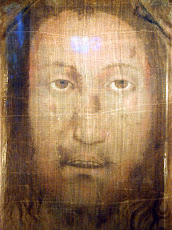
This cloth bears the image of the face of a bearded man with open eyes, a slightly opened mouth and a bruised left cheek. It was believed locally to be what was once known as the Veil of Veronica.
In St Peter’s Basilica in Rome, one of the four massive columns supporting the dome has long been known as the “Veronica pillar”. It features a statue of Veronica with a cloth bearing an image of the face of Christ and a bas-relief of an angel also displaying the image.
Within the pillar is a treasury in which is kept what is claimed to be the cloth with which a woman named Veronica wiped the face of Jesus on His way to Calvary.
This cloth, contained in a reliquary and shown to the people in St Peter’s on Passion Sunday each year, is black with brown areas and no visible image. It was placed in the pillar in 1625 by Pope Urban VIII.
Where did it come from?
Well, the existence of a portrait of Christ “not made by human hands” had been known since the sixth century, and from 705 it had been kept in its own chapel in the old St Peter’s, built by Constantine.
It became known as the “vera eikon”, or “true image”, and the name “Veronica” appears to have been applied in the Middle Ages to a woman whom Blessed Anna Catherine Emmerich names as Seraphia in her account of her visions of the Passion.
How did it get to Rome?
This question is discussed at length in a recent book by a German journalist, Paul Badde. He suggests that the cloth was, in fact, “the napkin which had been on His head, not lying with the linen cloths but rolled up in a place by itself” (Jn 20:7).
Badde recalls a tradition that a cloth with the face of Jesus was taken by the Apostle Jude after the Ascension to King Abgar of Edessa, a prominent city at the time, some 600 kilometres from Jerusalem and now known as Urfa, in Turkey. The king was immediately cured of an illness that had kept him bedridden. Another very old tradition says that the Greeks who came to Philip asking “to see Jesus” (Jn 12:21) had been sent by Abgar.
The cloth apparently remained in Edessa, and was hidden in the city wall when the city was under attack. It was rediscovered in 525 and taken to Constantinople, then to Genoa and finally to Rome.
So what is the cloth at Manoppello?
As already stated, the “image” now kept in the pillar in St Peter’s was placed there in 1625, after rebuilding work.
But it was – it seems – not the image that had been venerated there for centuries. It had disappeared, probably in 1506, stolen from the frame in which it was held by two sheets of glass. The frame, broken glass and all, is still to be seen in the treasury at St Peter’s. (There are fragments of glass in the cloth at Manoppello.)
Interestingly, Pope Urban VIII promptly issued a decree ordering the destruction of any copies of the “Veronica”, unwilling to admit that one of the most precious relics in Christendom had vanished.
Meanwhile, an anonymous pilgrim arrived in Manoppello in 1508 with the cloth wrapped in a package and gave it to a Dr Leonelli who was sitting on a bench in front of the church. He went into the church and unwrapped it, but on going out he could not find the person who had brought it. The cloth remained in the Leonelli family and then passed to another doctor who gave it to the Capuchins, who have held it ever since.
Badde points out in his book that the dimensions of the cloth at Manoppello mean it would not fit in the frame now used in St Peter’s to hold what certainly appears to be a forgery.
Perhaps because of the fact that St Peter’s still has what is purported to be the “Veil of Veronica”, little attention had been drawn to the image at Manoppello.
But Fr Domenico da Cese believed it should be better known, and in 1977 he took a large photograph of it to a Eucharistic congress in Pescara, the nearest large centre. Then things started moving.
A journalist from Switzerland wrote an article about it, which came to the attention of a Trappistine nun in Germany, Sister Blandina Schömer. Fascinated by the image, she obtained permission to move to Italy and devote herself to research on it, which she has continued up until the present.
Meanwhile, Fr Domenico had gone to Turin in 1978 for an exposition of the Shroud there, and was killed when he was struck by a car after leaving the cathedral. He was reputed to have the stigmata and cures have been attributed to his intercession, so that moves are now being made to begin the Cause of his beatification.
The principal findings of the research by Sister Blandina and others are that:
* the cloth is so thin and delicate it would be impossible to paint on it;
* the image is visible from both sides;
* when superimposed on the image of the face on the Shroud of Turin, the image of Manoppello matches exactly.
The conclusion is that the Holy Face of Manoppello is very likely the cloth “rolled up by itself”, found by Peter and John in the tomb on the first Easter morning.
The visit to Manoppello by Pope Benedict XVI in 2006 was the first journey of his pontificate inside Italy upon which he himself had decided. His homilies have increasingly contained references to the Face of Jesus.
And Padre Pio, canonised in 2002? Did he make one last visit to look upon the Face of the Man whose wounds he had borne for 50 years before entering into the eternal vision of his glorified Lord?

- Paul MacLeod

Wednesday, February 22, 2012

The Symposium Of European and African Bishops Concludes at Manoppello

The Symposium Of European and African Bishops Concludes at Manoppello

by Antonio Bini; photos by Antonio Bini and Paul Badde


Bishops on the Via Crucis leading to the Shrine of the Holy Face


Pescara - With a pilgrimage to the Shrine of the Holy Face the second Symposium of the Episcopal Conferences of Africa and Madagascar (SECAM) and the Council of Episcopal Conferences of Europe (CCEE)has drawn to a close.
"Evangelization today: communion and pastoral cooperation between Africa and Europe" was the theme of the Symposium which began on February 13, 2012 in Rome at the Pontifical Athenaeum Regina Apostolorum in Rome, with discourses by Cardinals Polycarp Pengo and Angelo Bagnasco, Chairman of the Symposium of Episcopal Conferences of Africa and Madagascar (SECAM) and Vice-President of the Council of European Episcopal Conferences (CCEE)respectively.


The days of study and discussion were intended to understand and reflect on the pressing problems of the Church on the two continents, in a climate of friendship that will be useful for better cooperation on issues of peace, immigration, religious freedom and combating prostitution. For the Hungarian Cardinal Peter Erdo, "European and African bishops want to face together the challenge of the new evangelization, living in a more intense way our brotherhood in mission. A collaboration that is based on mutual exchanges. While in the past many missionaries left Europe to go to Africa, now we are seeing an opposite movement, with priests, nuns and lay religious coming to Europe from Africa. We discovered many common concerns and we are committed to working together in the field of pastoral care, health, education, and social problems. Moreover, our continent needs an injection of ecclesial vitality and this vitality can come from the young Churches of Africa."


Along the same line, the Senegalese Cardinal Theodore-Adrien Sarr, who stated "The African immigrants will help Europe to discover for the future new youthfulness and freshness in the faith. Future exchanges between the bishops will address issues such as education, the fight against poverty, health, training of leadership teams, the dialogue between religions, the arms trade, human trafficking, external debt and the exploitation by the mining companies."


This path of commitment to communion and solidarity of people coming from so many different worlds comes from belonging to the same Church, united in Christ.


This is the deeper meaning to be found in the final pilgrimage to Manoppello.


It is the Pope himself who, the day before, while meeting with the bishops attending the Symposium who did not hide the complexity of the challenges facing the Church today, starting with that of religious indifference. Recalling the moral authority and credibility that must support them in their pastoral efforts, Benedict XVI said that the gaze of faith fixed on Jesus opens the mind and heart to the First Truth which is God. Benedict XVI sought to further strengthen this thought emphasizing that "a bishop must be in love with Christ."


The Shrine of the Holy Face was framed with an unusual amount of pure white snow which however did not prevent the Bishops from climbing Tarigni hill, walking along the Via Crucis. At each station the reflections were led by a different bishop. Arriving in the Basilica, Archbishop Bruno Forte of Chieti-Vasto, prior to the solemn celebration of Mass, welcomed his brother bishops from Europe and Africa and spoke regarding the extraordinary image of the Holy Face in Italian, English and French. Referring to studies of P. Heinrich Pfeiffer, Sr. Blandina Paschalis Schlomer, Andrew Resch, Paul Badde and Saverio Gaeta he said that one can "respond positively and with sufficient moral certainty to two questions put by the Holy Face: Is this the Veil of Veronica once venerated in St. Peter's? And 'Is this the precious relic of the sudarium laid in the tomb on the face of the dead Christ, as attested by the Gospel of John (20, 6-7)?" These reflections were also been drawn up in a letter From Archbishop Forte personally delivered to the bishops present.


These assessments are important, which also take into account, perhaps, that the Vatican last summer in a press release for the first time admitted (after 484 years), the disappearance of Veronica during the sack of Rome in 1527. The meeting was an opportunity to meditate and pray before the Holy Face, described in detail by the German writer and journalist Paul Badde. Many bishops did not hide their emotion. A feeling that has united distant worlds, from that of the bishop of Iceland to that of South Africa. At the end of the celebration Archbishop Charles Gabriel Palmer-Buckle of Ghana, expressing gratitude for the welcome they had received, asked Bruno Forte on behalf of all, that each time he returned to the Basilica of the Holy Face he might remember in his prayers the European and African bishops.


When I asked the same Archbishop Palmer-Buckle, who was part of the core group organizing the Symposium, what was the meaning which he and the other bishops would attribute to the pilgrimage to the Holy Face, he reflected deeply before replying that the impetus which comes from having known the Holy Face is to "proclaim the true Christ, a living Christ." The Archbishop Bruno Forte, to whom I had asked what impressions he had received from the participants, confirmed to me that "all were deeply affected by the pilgrimage to Manoppello".


Also present at the gathering was Petra-Maria Steiner, who in recent years has dedicated herself to studies on the Holy Face, and who is engaged in a constant effort of promotion of the Holy Face in the German speaking countries. Lastly there should be noted the greeting of the President of the Polish Bishops' Conference Jozef Michalik to Immaculata and Caterina, young nuns who arrived from Poland a few months ago and are now serving in Manoppello.


BISHOPS WHO TOOK PART IN THE PILGRIMAGE TO MANOPPELLO

EUROPE: Jozef Michalik, chairman of the Episcopal Conference of Poland; Ludwig Swartz, archbishop of Linz, Austria; François Garnier, Archbishop of Cambrai, France, Gerard de Foix, Archbishop of Lille, France; Senkiv Taras, Greek-Catholic church Bishop of Ukraine, Lucjan Avgustini, Albania, Duarte De Cunha, Portugal, Zef Gashi, Montenegro, Petru Gherghe, Romania, Pierre Bürcher, Iceland; Vjekoslav Huzjak, Croatia; Everard De Jong, Netherlands;

AFRICA: Buti Joseph Tlhagale, Archbishop of Johannesburg, South Africa, Jean Gabriel Djarra, Mali; Touabli Youlo Alexis, Ivory Coast, Jude Thaddeus Ruwa'ichi, Tanzania, Jean-Noël Diouf, Senegal, Denis Komivi Amuzu-Dzakpah, Togo; Gabriel Justice Anokye, Ghana; Maragde Mbonyintege, Rwanda, Frank Nubuasah, Botswana, Emmanuel Obbo, Uganda; Louis Portella Mbuyu, Congo, Benjamin Ramaroson, Madagascar, Joachim Tarounga, Chad, Charles Kasonde, Zambia, Gabriel Charles Palmer-Buckle, Ghana.


unosemper@libero.it

Friday, February 17, 2012

Pilgrims to the Holy Face of Manoppello -- Bishops Representing European and African Bishops Conferences

A historic day at Manoppello -- dozens of Bishops from the African and European continents together honor the Holy Face and seek help for their duties as successors to the apostles in the 21st century. Thanks to Paul Badde for this photo.