Sunday, January 31, 2016

Prayers Requested for Paul Badde's Speedy Recovery from Surgery

photo by Paul Badde


Prayers are requested for our friend the author and journalist Paul Badde who is recovering from  heart by pass surgery. Paul has been so faithful and untiring in witnessing to the Holy Face of Manoppello and making the Face of Jesus known throughout the world through his articles, books and photographs multiplied by his person to person ministry to so many of us. Paul was instrumental in bringing about the recent Pilgrimage Procession of the Holy Face from Manoppello to St. Peter's and Santo Spirito in Rome.
Ellen Badde, Fr. Heinrich Pfeiffer, S.J. and Paul Badde at Santo Spirito Church on January 17, 2016 (photo by Antonio Bini)

Paul Badde with Pope Benedict XVI in Manoppello on Sept. 1, 2006 surrounded by Archbishop Bruno Forte,
Fr. Andreas Resch, Fr. Heinrich Pfeiffer and Sr. Blandina Paschalis Schlomer


Tuesday, January 26, 2016

Archbishop Edmond Y. Farhat's Homily at Santo Spirito for the Concluding Mass of Holy Face Pilgrimage Procession


from left Fr. Carmine Cucinelli, O.F.M., Cap., Archbishop Edmond Y. Farhat, Mons. Americo Ciani (photo by Paul Badde)


Homily of His Excellency The Most Reverend

Edmond Y. Farhat

Apostolic Nuncio Emeritus to Austria


The Second Sunday in Ordinary Time – Cycle C
"Omnis Terra"
 

17 January 2016


Pilgrimage of the Holy Face from Manoppello to Rome

Church of Santo Spirito in Sassia


We have accompanied with hymns and songs, invocations and thanks, the icon of the Holy Face of Manoppello to venerate it and, through it, to praise the Lord Jesus Christ for his wonders. The Holy Mass was celebrated. The people of God prayed, the priests and ministers offered thanksgiving, prayers, and supplications.

from left Fr. Ted Lopez, Fr. Carmine Cucinelli, OFM, Cap., Archbishop Edmond Y. Farhat, Mons. Americo Ciani,
Fr. Heinrich Pfeiffer, S.J., Fr. Jess Marano and (behind) Mons. Jozef Bart, Rector of Santo Spirito (photo by Antonio Bini)


photo by Antonio Bini


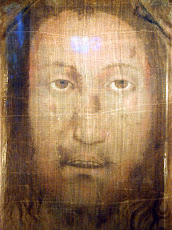
In the Face of Christ, impressed on the veil of Veronica, preserved in the sudarium of Manoppello, we venerate the Lord God of mercy, Savior of the world.
 
Archbishop Farhat gives a blessing with the Holy Face (photo by Paul Badde)
 

Today, brothers and sisters, right now, we return to the temple of the Holy Spirit to venerate the Holy Face and all it means. We celebrate the Eucharist, we confess our sins, and we announce the Good News.

The Good News of today is the invitation to the wedding at Cana. Jesus was invited, invited by his Mother because the guests were friends of his mom. She invited her Son, and at a certain point, said, “They have no wine.” “My hour,” responded the Son, “has not yet arrived.” “Do that which he says,” said his mom. Jesus, obedient to his Mother, saved face for the groom and his family.

The feast was beautiful and the joy was great. They drank and sang. The feast was transformed into a unique occasion. It was the occasion of the first sign of his manifestation, of the manifestation of his divinity. It was the beginning of the signs carried out by Jesus, because of which they believed in him. Better still, it is the first sign that reveals his personality. He came that they might have life, and have it in abundance. At Cana, Jesus manifested his authority. “Fill the jars,” and they filled them. Cana was the very first sign of the divine authority of Jesus, this authority that developed during his mission until it became known in the passion and in a true image, living, in the hands of Veronica.

Cana was the first visible sign of the divinity of Jesus. It is a provocative sign now, the icon of Manoppello that is a definitive sign. Cana was the first, and the face of the sudarium is the definitive sign. It is a provocative sign and insignificant, discrete and quiet, but most eloquent, always old and always new. Discussed and venerated, look at it with your eyes, accompany it, follow it, and let it guide your gaze. It is a concrete sign, but it is not made by man; it is created, but no one knows its origin, its formation.

It is not an object of another time; it is the icon of the eternal face, the face of goodness and of friendship, of mercy and of peace. The face that speaks, that examines, that asks, that awaits a response. It seems to say: “Look at me, you who are tired. Come to me and I will give you rest.” They have not seen, they did not have to suffer humiliation, the men of our time, as the friends of Mary did not have to suffer humiliation at Cana. He had to reach out.

They do not have faith, the men of our time, but, as at the wedding at Cana: “Have mercy on them,” Mary says [to her Son], “and contemplate the face bequeathed to you” [to the men of our time]. And we contemplate the face of Jesus. It speaks to us and nods to us, it is good, it is merciful. Therefore, we have brought it from Manoppello to here, because his expression [word missing] a wider goodness and mercy in this year of grace in which God reveals himself with the name of mercy, as the Holy Father Francis teaches. Therefore, we display it in the church of the Holy Spirit so that the Spirit may speak to the heart, and suggest intentions of wisdom and hope. Therefore we place it in the church looked after by Saint Faustina because she has been able to perceive the dimensions of his face.

There are moments in which, in an even stronger way, we are called to keep our look fixed on mercy to become effectively inserted into the action of the Father, as Pope Francis says in his exhortation.

This, dear brothers and sisters, is a privileged moment. We fix our gaze on the Holy Face and we will be transformed by God’s mercy. The sign is not an end in itself; the sign is a pointer on the way of the return, the return to the Father. The sudarium [word missing] of Christ. Christ is Jesus that has transformed the water into wine to participate in the joy of his friends and relations. The transformation requires a change. Our transformation and our conversion from pointless spectators to collaborators in the work of Jesus and Mary, who kept all these things in her heart, and no one knows the son and Lord like her. She guides us on the journey to encounter her Son, through his face that we can physically contemplate.

Yesterday we took it and venerated it to give thanks for so many benefits; today we greet it and honor it, asking him to accompany us on our new journey, the journey to the wedding of the Lamb, full of grace and mercy.

We hold impressed in our minds and in our heart his image that speaks to us and examines us. It is the image of the Word become Incarnate so that we might have life. It accompanies us on our way so that we might always remember that God is mercy. His mercy accompanies us. We remember that the people of God, going up to Jerusalem, in the Old Testament, always repeated during their pilgrimages: “God is good, he has given us goodness; he has given us faith because his mercy is eternal, because his mercy is eternal.”

We from this Eternal City, city of saints, of Faustina; city of John Paul II, of Paul VI, of John XXIII, of popes and saints; we turn our thoughts to the Jerusalem of Jesus, to the Jerusalem of Mary; and we ask peace for Jerusalem, peace to all the people of Palestine and of Jerusalem, of the Middle East and of the Mediterranean. There is room for everyone; mercy has no limits. ** Eternal is the mercy of God, because he is good; he is great, may his face guide us, accompany us, and we will not be lost.
**The final appeal for peace was repeated by Archbishop Edmond Y. Farhat also in Hebrew and Arabic
thanks to Paul Badde and Fr. Carmine Cucinelli, O.F.M,, Cap. for the transcript, Paul Badde and Antonio Bini for the photos and Fr. Daren J. Zehnle for the translation of Archbishop Farhat's homily

Thursday, January 21, 2016

Some Holy Face Pilgrimage Photos by Paul Badde


Entering St. Peter's Basilica


Entering Holy Door at St. Peter's


At Pieta in St Peter's

On the Way to Santo Spirito from St. Peter's


Archbishop Georg Ganswein at Mass at Santo Spirito


At Santo Spirito


Monday, January 18, 2016

Joan Lewis of EWTN "Visiting an Icon in Rome"

photo by Joan Lewis


Joan Lewis, EWTN Rome bureau chief, writes on her blog:
https://joansrome.wordpress.com/2016/01/17/visiting-an-icon-in-rome/

"Today I went to see the replica of the Holy Face of Manoppello during its presence this weekend in the Rome church of Santo Spirito, Holy Spirit. This church, just blocks from St. Peter’s Basilica, is principally dedicated to Divine Mercy and is crowded just about every day of the week, often at the 3 pm time of the Hour of Divine Mercy."

"I got to the church exactly at 4 pm (not that I had planned such a precise arrival) and I discovered that a Mass for Polish pilgrims had just begun. I was a lector at Mass last evening with the Santa Susanna community so this second Sunday Mass was a special joy, especially given the presence of the Holy Face (about which I wrote in my Friday, January 15 column).
Polish pilgrims come often to Santo Spirito because, as you know it was a Polish nun, St. Faustina Kowalska, who spread the devotion to Divine Mercy and a Polish Pope, John Paul II, who instituted Divine Mercy Sunday, the Sunday after Easter."
There are more photos of Santo Spirito in Joan's posting.


Edward Pentin of National Catholic Register on Holy Face Procession


Replica of the Holy Face close to its former home in St. Peter's basilica, in the former St. Mary's Chapel, where Michelangelo's Pietà stands today.
(Photo by Edward Pentin/NCRegister.Com)

Edward Pentin writing in his blog at National Catholic Register.com 

"Pilgrims from the Italian town of Manoppello, home of the Shrine of the Holy Face, retraced an ancient procession for the first time in 808 years in Rome on Saturday, carrying a replica of the sacred image which scholars believe to be the Veil of Veronica (vera icona "true icon")."

Read more: http://www.ncregister.com/blog/edward-pentin/historic-step-as-holy-face-procession-returns-to-rome/#ixzz3xcRjvySn


photo by Edward Pentin/NCRegister.com


Sunday, January 17, 2016

Rev. Daren J. Zehnle Reporting on Veronica Pilgrimage Procession

Fr. Carmine Cucinelli, O.F.M., Cap. holding replica of Holy Face in St. Peter's yesterday (photo by Fr. Daren J. Zehnle.)


 American priest Fr. Daren J.Zehnle, K.H.S.  wonderful reporting with great photos of the Pilgrimage Procession from St. Peter's to Santo Spirito    http://dzehnle.blogspot.it/2016/01/a-roman-pilgrimage-with-holy-face.html


Fr. Daren Zehnle (photo by Edward Pentin)

Archbishop Georg Gänswein's Homily at Santo Spirito

photo by Daniel Ibanez/CNA
Dear sisters and brothers!

Sunday today is called "Omnis Terra" in the words of Psalm 65 that we heard at the beginning of the Mass: "Omnis terra adoret te, Deus, et psallat tibi!" ("Let all the earth adore you, O God and sing psalms to you"). This Sunday was also called this eight hundred years ago ; and even then, as now, in all Catholic churches the Gospel of the wedding at Cana was proclaimed. Since then empires have fallen, swept away like autumn leaves; the Church has seen the succession of ninety popes; violent revolutions and wars have shaken Europe; fatal divisions have torn Christianity. So it seems almost a miracle the tranquility with which, in this Sunday's liturgy, we sing today as then: Praise the Lord, all you nations!

With this praise, however, today we also remember the fact that here 808 years ago, for the first time, Pope Innocent III  carried in procession the Holy Sudarium of Christ from St. Peter's to Santo Spirito. It was the holy veil that shows "the human face of God", which Pope Benedict XVI will never get tired of speaking about; and "the living face of the Father's mercy" to which Pope Francis has dedicated this Jubilee Year. And also back then, in January of 1208, the divine face of God here in this church, was connected to the concrete mercy of men; this church which much later, in 1994, St. John Paul II dedicated to the "Divine Mercy", in honor of Saint Faustina Kowalska, whose relics we venerate here. The Polish Pope was also a visionary and once more we experience that here today.

In fact, 808 years ago, in that very first procession, Pope Innocent III decreed that the holy image was not brought to the nobles of Rome, but to the sick pilgrims and the poor of the city, whose most important abode back then  was this hospital of  Santo Spirito. He also ordered that the papal chaplain, drawing from Peter's Pence, should distribute three coins to each of the three hundred sick and the thousand poor who were invited to attend the ceremony and who came from all over the city: one for bread, one for wine and the third for  meat. He also connected substantial indulgences to visiting the "true image" and for participating in its procession.

In fact it was an anticipation of the Holy Year, which only later, in 1300, was introduced to Rome by Boniface VIII. This all began right here!

From that time to the present modern age processions and expositions of the Holy veil have never ended. Soon there were countless pilgrims to Rome who wanted to contemplate the face of God. Later, it was in one of these processions that Dante learned to know the face of God. It is the face before which he ends the "cosmic excursion" of his Divine Comedy, as Pope Benedict XVI said ten years ago, when he presented his encyclical Deus Caritas Est. It is the face of the love that "moves the sun and the other stars", as Dante wrote in the best known passage in Italian literature.

It is the love of God who rejoices in us as "the bridegroom to the bride," as we have just heard in the words from the prophet Isaiah; and the strength of the Holy Spirit of whose various gifts St. Paul has once again made us aware in this church of Santo Spirito. And yet, nowhere else does this Spirit speaks more clearly and with more evidence as in the silent face of Christ, before whom we are gathered here today.

Because "this is the vocation and the joy of every baptized person: to bring and give Jesus to others", as Pope Francis said on January 3. And this is exactly what today is given to us - to become witnesses, in the moment when the good Capuchin friars of Manoppello here "bring and give Jesus", in whose face God himself shows his face.

In conclusion I would add just one thing on the Gospel of the wedding at Cana, about which so many instructive things have been said: who, in fact, could still wonder that Jesus worked his first public miracle exactly in favor of marriage and the family which are in such danger today that Pope Francis has dedicated synods to each of these! Indeed, in this time of Christmas in which we are still, we can understand perfectly that first miracle as a necessary extension of the mystery of the incarnation of God. For it is only within a family that we become human! With a mother and a father and - if we are lucky - with brothers and sisters. For this reason Christian artists have always portrayed the face of Jesus referring to his mother's, and vice versa. Because if God is the father of Jesus, his face should  and can only look like hers. And it is this most ancient face that today in an almost miraculous way has returned to  Santo Spirito in Sassia, that face which seems to be almost identical to the face of the Divine Mercy which has been venerated here for more than two decades.

It is a copy of that ancient original that Pope Innocent III showed the pilgrims and which for four hundred years has been kept in Abruzzo, on the Adriatic, in an outlying area of Italy, which today for the first time has been brought back to where its public worship began. From here, countless copies brought all over the world the true face of God that Christians knew. Precisely in this lies the deeper meaning of this moment. Before coming to Rome, the Holy Veil was kept in Constantinople, earlier in Edessa and even before in Jerusalem. It is not possible, in fact, that this face could be the property, could be the treasure of anyone, not even of the Pope. It is the signature of Christians. Only we know that God has a face - how and who he is. For this reason, the face of Christ is the first, the most noble and most precious treasure of all Christendom, even more: of all the earth. Omnis Terra! Before this face we ought to open ourselves again and again. Always as pilgrims; always to the outlying areas; and always having before our eyes one goal: that moment when we will be before him face to face.

translated from the original Italian