Monday, August 21, 2023

Conference on the Holy Veil of Manoppello at Mater Dolorosa Church in South San Francisco


Sister Petra-Maria Steiner


Several hundred people coming from all over the San Francisco Bay Area participated in the day long Conference on the Holy Veil of Manoppello held on August 5 at Mater Dolorosa Church in South San Francisco. Master of Ceremonies for the day was Reverend Deacon Christoph Sandoval of the Cathedral of St. Mary of the Assumption in San Francisco. Deacon Sandoval, who has a life long devotion to the Holy Face and has been a source of encouragement to very many in their devotion to the Holy Face of Manoppello, introduced each of the topics and lead the group in prayers to the Holy Face.


Reverend Deacon Ramon de la Rosa of the parish of Mater Dolorosa organized the logistics of the day with the help of a number of volunteers from the parish and beyond, including members of the Legion of Mary, Knights of Columbus and Singles for Christ. A simple lunch was provided for all.


The main speaker for the day was Sister Petra-Maria Steiner, of the Vita Communis Community, Mary, Mother of the Holy Family, who traveled from Germany for the conference. Sr. Petra-Maria is an expert on the Holy Veil of Manoppello, as well as on the life of Padre Domenico da Cese, having lived and worked for over ten years in Manoppello. The topics of her three talks were "An Introduction to the Holy Face of Manoppello and its connection to the Shroud of Turin and the Sudarium of Oviedo". "The Way of the Holy Face, from the Tomb to Manoppello via Rome." and "Why it the Holy Face so important to our faith?"

All of Sister's talks, accompanied by PowerPoint presentations, were very well received by those in attendance. Quite a few of the attendees already had some knowledge of the Holy Face of Manoppello but others were hearing about it for the first time. The conference was an opportunity for all to learn about this precious relic whose historical reality has in the 21st century come back into the consciousness of the people of God.

The editor of this blog, Raymond Frost, also gave a talk on "The Development of Devotion to the Holy Face of Manoppello on the West Coast" drawing on his experience of being in communication for over 15 years with many devotees of the Holy Face from Vancouver, British Columbia in the north to San Diego, California in the south. He dedicated his talk to the memory of the late Mrs. Daisy Neves, beloved pilgrim and missionary of the Holy Face, who was a true friend to so many and whose legacy of devotion to the Holy Face will never be forgotten.

The audience was delighted to hear of the many churches on the West Coast where the Holy Face is enthroned and of the future plans for enthronements in a number of other churches. Also highlighted was the personal devotion of Archbishop Salvatore Cordileone of San Francisco to the Holy Face of Manoppello, of his participation at the feast of Omnis Terra at the Basilica of the Holy Face of Manoppello in 2019, and his strong words of encouragement to the faithful "I encourage everyone who professes faith in Jesus Christ and love for him to cultivate a devotion to this holy image he has left us – a picture of the first instant of the Resurrection."

Many expressed the hope that this kind of conference can be held again, with devotees from other parts of the country who were not able to attend the conference attesting to this same desire.

The complete conference can be viewed here on YouTube


Wednesday, June 28, 2023

Sister Amalia Di Rella, Disciple of the Holy Face and Spiritual Daughter of Father Domenico da Cese


Sister Amalia Di Rella 


by Antonio Bini   
(Photos also courtesy of Antonio Bini)

website of the Association of the Holy Face in Ruvo di Puglia    https://www.associazionevoltosantoruvo.it/


The Association of the Holy Face of Ruvo di Puglia remembered Sister Amalia Di Rella at a conference in her native city 25 years after her death which took place in Genoa on June 16, 1988. After visiting the Shrine of the Holy Face and meeting Fr. Domenico da Cese during the annual celebration in May 1970, Sr. Amalia was moved to establish the Association. The gathering held at the historic Palazzo Caputi was moderated by the journalist Angela Ciciriello, who highlighted the nun's closeness to women who had difficulty in realizing their desire to become mothers. 


Speakers at the conference included Fr. Carmine Cucinelli, Fr. Peppino Lapenna, Fr. Mimmo Francavilla, director of Caritas of Andria, and myself.  . Fr. Carmine, the former rector of the Shrine of the Holy Face, not having personally known the nun, collected testimony from the Capuchins and other people of Manoppello who admired her in life for her devotion to the Holy Face, a model of faith for many people of the associations of the Holy Face of Ruvo di Puglia and Andria. Her willingness, along with that of those who accompanied her, to clean the church and the pilgrim's hotel with a spirit of joy was memorable. Everyone followed her with delight. "Sister Amalia said it," the devotees who accompanied her repeated to each other. The Capuchin then recalled a passage from the homily delivered by Mons. Calabro, bishop of Andria, on the occasion of the Mass celebrated to commemorate the thirtieth day following Sr. Amalia's death.

 Along the same lines was the talk by Don Peppino Lapenna, former parish priest of the church of San Michele Arcangelo in Andria, in which he underscored the impressive good works that Sister Amalia accomplished in favor of the sick and the elderly, as well as towards the church that was her reference in the years spent in Andria. Fr Mimmo Francavilla also wanted to remember how since he was a boy he had been struck by her extraordinary organizational skills and tireless work for the sick of UNITALSI (Italian organization to bring the sick on pilgrimage to Lourdes). 

Present at the meeting were Mons. Giuseppe Pischetti, vicar forane and Don Grazio Barile, chaplain of the Association of the Holy Face of Ruvo di Puglia. Many people followed the meeting with emotion, at the end of which coffee biscotti were distributed to those present in memory of the nun who loved to share simple convivial moments with those who joined her in her works and times of prayer.


But who was Sister Amalia Di Rella?

Many times I have met in Manoppello the Apulian devotees linked to Sister Amalia, especially on the occasion of their annual gatherings to remember Father Domenico, in particular after the proposal to start the process for his beatification proposed by the then Province of the Capuchins of Abruzzo. In 2014 I was in Ruvo, accompanying Father Carmine Cucinelli, afterwards writing about the Association and Sister Amalia in the Bulletin of the Shrine of the Holy Face.  

I would say that the spread of the cult of the Holy Face among so many people in Ruvo di Puglia and Andria, later constituted in Associations, represents a first significant result of the work of Sister Amalia, who in her simplicity and humility, was able to transmit her faith to a community, strengthened by the encounter with the Holy Face.

Faith is something personal and at the same time communal. Christianity in its reference to Christ inevitably has to do with the witness of other believers and it is to be believed that, also thanks to Father Domenico, Sister Amalia perceived in the Holy Face the divine character of Christ and at the same time the depth of his humanity.


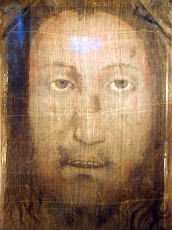
The Holy Face, in fact, is not only an inexplicable object, but above all the living and dynamic image of a man, identified with Christ from the title of the first document that attests to its presence in Manoppello (cf. "Relatione Historica d'una miracolosa immagine del volto di Christo" A Historical Report of a miraculous image of the face of Christ by Father Donato da Bomba – 1640),   a circumstance that finds more and more parallels with the history of Christianity.

Father Domenico ardently believed in this, and tirelessly devoted all his energies until his death  to spreading the devotion to the Holy Face, .

The friar did not want to be spoken about, foreseeing in a prophetic way that both he and the Holy Face would be spoken about especially after his death.  

This has indeed happened and is still happening. The Holy Face in that distant 1970 – when Sister Amalia arrived in Manoppello – had for centuries been at the center of a strong local devotion, but there were few beyond the circle of neighboring towns who knew about the extraordinary image preserved by the Capuchins in Manoppello, while those rare publications that dealt with it described it with fleeting hints, which indicated it to be a painting, as in so many reproductions that can be found in churches around the world.

Father Domenico openly supported the authenticity of the Holy Face, writing on holy cards which he had printed, that it was the "sudarium present in the tomb of Jesus" or that the image was "not producible by a human brush", considering it in other words an acheropite image.  ("acheropite" the Greek word for "not made by human hands")

In the run-up to the Great Jubilee of 2000, the studies on the identification of the Holy Face with the Veronica (true icon) carried out by Jesuit Fr. Heinrich Pfeiffer (Tübingen, 1939 – Berlin, 2021), authoritative professor of Christian art at the Gregorian University of Rome, gradually found the interest of the international press, to the point of convincing Pope Benedict XVI himself of the validity of his research. Here it is also necessary to recall the studies of Sister Blandina Paschalis Schlömer on the superimposition of the Holy Face with the Shroud. The German pontiff visited the Shrine on September 1, 2006. 

 Since then we have seen pilgrims come from all over the world to Manoppello, hundreds of bishops and cardinals, while the spread of the Holy Face has led to solemn enthronements of copies in a number of churches in various countries, also thanks to specific missions (in particular in the United States, the Philippines, Poland and Canada). In this regard, it should be remembered, that on March 31, 1979, six months after the death of Fr. Domenico, in the church of Purgatory in Ruvo there arguably took place the first enthronement of the Holy Face, during a solemn ceremony, presided over by the bishop pro-tempore mons. Aldo Garzia[1]. Today the enthronements are beyond number. 

Enthronement of the Holy Face at the Church of Purgatory in Ruvo.  Sister Amalia is at the right.


Twenty years before the Pope arrived in Manoppello, Don Tonino Bello, bishop of the diocese, recognized the "Pious Union of the Disciples of the Holy Face", approving its statutes on May 8, 1986. It was the bishop who by his act gave them this title, recognizing how Sister Amalia wanted to follow Christ by becoming his disciple.

The primary objective of the Pious Union was set in the "sanctification of its members through the practice of the evangelical counsels and the free service of assistance given to the least of the brothers and sisters in the persons of the sick", a service also corresponding to the demands of the Bishop's own pastoral mission. We could say that the Venerable Don Tonino already had his own idea about the horizons of holiness of Sister Amalia, whose holiness was the reference assumed as the basis of the statutes. Even before the approval of the statutes, Don Tonino Bello, a pastor who was always on the side of the least, had turned to their collaboration, assigning to it, among other duties, the care of the community for the assistance of drug addicts (today Casa Don Tonino Bello), which the bishop, in order to confront a rampant social emergency, had inaugurated in Ruvo on December 8, 1984.

The Pious Union depends directly on the bishop and is animated by an "elder sister" chosen by mutual agreement. The members of the group remain in the lay state, even after consecration through simple vows, and have no life in common except for periodic prayer meetings.

Article 5 of the Statutes states that "their spirituality is centered on devotion to the Holy Face of N.S.G.C. [our Lord Jesus Christ], lived in contemplation and assimilation of the Paschal Mystery."

Don Tonino, recognized as Venerable in 2021, came to know about the Holy Face through the strong devotional energy of Sister Amalia, and also personally as he would have gone once to Manoppello, together with the three Disciples of the Holy Face for their spiritual exercises. This is what Sister Maria Matera told me.

The reference to the Paschal Mystery suggests that Don Tonino had developed a personal idea of the Holy Face as the face of the Risen One. A thesis that will be amply developed several years later (see also the title of the book by Saverio Gaeta, Il Volto del Risorto, ed. Famiglia Cristiana, 2005). Even the subsequent updating of the statutes of the Association of the Holy Face, approved in 1989, reflects the imprint of Don Tonino Bello, so that the elaboration of the statutes of the Pious Union of the Disciples of the Holy Face must be considered entirely his.

Mons. Nicola Girasoli records in a significant testimony what Don Tonino told him about Sister Amalia whom he considered "a holy woman who does much for the sick and the poor". Among the sick there were a number of elderly priests.

The Bishop's testimony on the virtues of Sister Amalia Di Rella – dated June 16, 2009 – a date that is not accidental, as it coincides with the eleventh anniversary of the death of the "little Franciscan sister" – as many called her. I received a copy of this testimony from Br. Vincenzo D'Elpidio (Guardia Vomano, 1932 – Pescara, 2020), closely linked to Fr. Domenico, as well as to Sr. Amalia and to the devotees from Apulia. I have not been able to ascertain who were the recipients of Mons. Girasoli's testimony, although I have reason to think that among them there was the Bishop pro-tempore of Molfetta.

 
Brother Vincenzo with Sister Amalia


Msgr. Girasoli, also born in Ruvo di Puglia, currently the apostolic nuncio in Slovakia, knew Sister Amalia from the time of his early childhood, being struck "by her spirit of prayer and dedication to the poor and the sick".

Then the encounter with Domenico da Cese – in 1970 – which the apostolic nuncio defines as "a turning point on her path of holiness", guiding Sister Amalia on her spiritual journey, leading her to religious consecration and to the establishment of the Association of the Holy Face of Ruvo. The same apostolic nuncio, ordained in 1980, states he had taken part, as a young seminarian, in several pilgrimages to Manoppello, to the Shrine of the Holy Face, which he came to know about thanks to Sister Amalia and the Association of the Holy Face. Inevitable his meeting with Fr. Domenico da Cese. Msgr. Girasoli affirms that "his profound gaze and his lucid and effective words have remained impressed upon me exhorting me to go forward in my vocational journey".

 
Father Domenico da Cese at Ruvo.  Sister Amalia is at the right


A number of people have given their testimony about Sister Amalia, however the one released by Mgr. Girasoli, who affirms that the nun "certainly exercised the Christian virtues to a heroic degree", has the merit of combining a long and frequent personal acquaintance to the effort to understand the profile of holiness of Sister Amalia, in the hoped-for perspective - strongly affirmed- "that the canonical process begins to verify her exercise of the virtues to a heroic degree, hoping one day to see her, God willing, venerated on the altars." The Nuncio's considerations are also the result of continuous observation over time, as when as a young priest he accompanied a pilgrimage to Lourdes organized by Sister Amalia and the Association of the Holy Face in 1982.

Regarding the famous French shrine, we can only wonder what Sister Amalia would have thought about the fact that several years later, in 2010, Mons. Philippe Pherrier, bishop of the Diocese of Tarbes-Lourdes would come as a pilgrim to Manoppello, and was so strongly impressed by that visit, to the point of wanting to organize an exhibition on the Holy Face in Lourdes, actually realized in the years 2011 and 2012.

With regard to the reputation of holiness, it should be remembered that – according to the Church – it is a reputation which manifests itself spontaneously among a significant part of the people, and must not be aroused superficially through media propaganda. In the case of Sister Amalia the question does not arise, indeed the opposite problem seems to exist, with the strong memory of holiness restricted to the individual sphere of many people and members of the Association, who have personally handed down her memory, in the silence of a wider communication.

Only in recent days has the first biography of Sister Amalia been published, after having been filed away in a cabinet for a long time[2].

But an emerging communication phenomenon is taking place far from Puglia. I am referring to the growing dissemination of the Holy Face in the world, which began on the eve of the Great Jubilee of the Year 2000 and developed more and more after Benedict XVI's visit to Manoppello on September 1,  2006. The latter situation also is noted in the testimony of Mons. Girasoli.

Following in the wake of the Holy Face, the extraordinary figure of Fr. Domenico da Cese, who explicitly believed in the divine origin and authenticity of the Holy Face.

The human and religious story of the humble nun often appears together with that of Fr. Domenico, as in the "Illustrated Biography of Father Domenico da Cese, Capuchin", edited by Sister. Petra-Maria Steiner, Vita Communis, Waiblingen, 2018 (the book has been published in German, English and Italian) and the very recent work by Aleksandra Zapotoczny, published last February in Poland, with the title "Stygmatyk z Manoppello" (the Stigmatist of Manoppello), The life, miracles and mystical experiences of Father Domenico of the Holy Face of Jesus". [3]

Sister Amalia in prayer during the Vigil for Father Domenico


Returning to Mons. Girasoli, his testimony seems to be structured to correspond to the principles that govern the causes of beatification and canonization and I believe it can be interpreted in even greater terms with respect to the feeling of the wider community of people who knew and loved Sister Amalia.

It must also be said that the process of canonization represents a long and complex path, which responds to the need for caution on the part of the Church (or, better, of the ecclesiastical hierarchies) and at the same time presents wide discretionary spaces, as also demonstrated by the troubled path of Father Domenico da Cese, who is also supported by numerous testimonies, including those expressed by religious, and supported by extraordinary facts, such as the bilocation of the friar at the funeral of St. Padre Pio of Pietrelcina.

A cause of canonization involves considerable expense and requires constant commitment, a real organization, together with a dedication that can last many years.

It is not always easy for the laity to understand the application of the norms governing the matter, their interpretation and the choices made by the Church.

It is certainly no coincidence that the Augustinian Romualdo Rodrigo, author of an appreciated Manual of the Causes of Beatification and Canonization, admitted that "the holiest candidates before God are not always candidates for canonization."[4] It is relatively comforting that the final goal of canonizations is not the servants of God – since the saints certainly do not need to be declared as such – but it is the faithful, since they need the Church to propose new models of holiness.

And Sister Amalia was born and lived in poverty, wearing the Franciscan habit. She was a charismatic personality,certainly an example especially in consideration of her precarious health conditions which, despite her sufferings, did not prevent her from continuing to give herself totally to others.[5]

To the physical sufferings were added the moral ones. Mons. Girasoli alludes to this in his testimony as she was the victim of unjust "envy and jealousy", if not outright slander and humiliation, as also found in oral testimonies. Confirmations of these strong discomforts come from some letters written by Father Domenico in response to the nun, who must have made known to him the situations of which she was a victim.[6]

It is common to hear from those who knew her that the hospital wards and the homes of the sick were her convent.

A final hospitalization took place at the San Martino Hospital in Genoa where Sister Amalia died "in the concept of holiness"[7] on June 16, 1998. A coincidence: both  Fr. Domenico, who died on September 17, 1978 in Turin, as well as Sister Amalia herself died during an exposition of the Shroud. She was 64 years old. From the biography edited by Michele Ippedico, it would seem that her death had been foretold to her in a dream by St. Padre Pio of Pietrelcina thirty years after the death of the saint.

Suor Amalia's Grave


In conclusion, we recall a passage from the homily given by the then bishop of Andria, Mons. Raffaele Calabro, delivered on July 15, 1998, at the Mass commemorating the 30th day after the death of Sister Amalia and reported in full in no. 2/1998 of the Rivista del Volto Santo (Bulletin of the Shrine of the Holy Face of Manoppello), preceded by the heartfelt introduction of Fr. Germano Di Pietro, then rector in Manoppello, with the title "Sister Amalia has left us".

"The Eucharist we are celebrating allows us to gather our feelings of pain, gratitude and affection to remember a person who left an indelible mark on the lives of all of us and of many who knew her and benefited from her discreet and silent charity and there are truly many. For ourselves we ask at the Eucharistic Table that we might know how to continue the work she began with the same spirit, in humility and joy without scattering and forgetting her teaching".

The meeting in Ruvo di Puglia is undoubtedly in continuity with the wishes of the bishop.

[1] Tonina Cantatore, Da Ruvo di Puglia, in Rivista del Volto Santo, n. 1, June, 1979, p.32; In a photo accompanying the article, Sister Amalia appears alongside Mons. Garzia.


[2] Michele Ippedico, La pupazza di Dio, (The puppet, or rag doll of God) ed. Youcanprint, Tricase, 2023. a brief explanation of the title is a must. It seems that Sr. Amalia defined herself in this way, to indicate a worn rag doll in the hands of the Lord, a bit like Sister Teresa of Calcutta who said she was "a small pencil in His hands";


[3] The book was presented in Poland in the cities of Wadowice and Krakow where in recent years copies of the Holy Face were enthroned.

[4] Romualdo Rodrigo, Manuale delle cause di Beatificazione e canonizzazione, ed. Istitutum Historicum Augustinianorum Recollectorum, Roma, 2004, p.12;


[5] Precarious health characterized the life of Sister Amalia, with numerous hospital admissions and multiple surgeries (as many as 17, according to the testimony of Brother Vincenzo D'Elpidio on March 15, 2007). The pains manifested themselves mainly in her wrists, hands, and legs, during Lent, so much so that she was bedridden. In the last years of her life she wore gloves on her hands, leading many people to think that they were used to cover the stigmata. The statement issued on April 4, 2014 by Mrs. Maria Zagaria, in whose home Sister Amalia lived from November 1988 until her death, was also considered.

Unfortunately, medical documentation is very much lacking, limited to a certificate issued on April 23, 1979 by Dr. Vincenza Fracchiola of Ruvo di Puglia, a specialist in infectious diseases, which certifies that Sister Amalia suffered from many diseases ever since she was a young child and was repeatedly hospitalized towards the end of her life. It refers to stomach surgery, heart failure and regressive pulmonary edema.

[6] In a letter of June 1974, Fr. Dominic speaks of the "perversity of professions that have never believed in God." In another letter of March 1976 Fr. Domenico writes "Dear Amalia, we must pray a lot and have a lot of patience for so many adversities that come to us from bad people who are never lacking in any country. Remember that every day you must carry the cross that was assigned to you from heaven." The friar comforted her with his constant prayer to the Holy Face. On the other hand, the life of Fr. Dominic himself was not exempt from difficulties and misunderstandings, sometimes even from within the Capuchin Order;

[7] Eugenio Vittorio Di Giamberardino, Padre Domenico da Cese, Edizioni Frati Minori Cappuccini d'Abruzzo, L'Aquila, 2014, p. 35;

Tuesday, March 21, 2023

Biography of Padre Domenico da Cese Published in Poland


"The Stigmatist of Manoppello" ("Stygmatyk z Manoppello") is released in Poland.


The Life, Miracles and Mystical Experiences of Father Domenico of the Holy Face of Jesus


Reviewed by Antonio Bini

The book, authored by Aleksandra Zapotoczny, recounts the story of this mysterious Capuchin stigmatist and his supernatural gifts, emphasizing his connection to the Holy Face of Jesus preserved in Manoppello and his friendship with Padre Pio of Pietrelcina.  


Aleksandra Zapotoczny, has written several books on Pope John Paul II (in Italy Mondadori published in 2022 her book "Live inside us").   She has been interested for years in the Holy Face, which is known throughout Poland and has been venerated by thousands of Polish pilgrims.  Her interest in the Holy Face quite naturally extended to the figure of Father Domenico da Cese leading her to participate in several of the commemorative meetings in Manoppello, held annually around the anniversary of Father Domenico’s death, which took place on September 17, 1978, in Turin, where he had gone for the exposition of the Shroud.  Through these occasions she became a part of the group of devotees and propagators of the figure of the Servant of God, who have come to Manoppello from all over Italy.

During these gatherings she met the late Br. Vincenzo d'Elpidio, who was a long-time friend of Fr. Domenico and tireless supporter of his cause of beatification. The author manages to comprehend the friar’s extraordinary dedication to the Holy Face whose authenticity he always maintained.

Brother Vincenzo d'Elpidio, Antonio Bini and Aleksandra Zapotoczny


The volume narrates the most important facts of the life, the alleged miracles and the mystical experiences of Emidio Petracca, known to the world as Father Domenico, faithful propagator of the Holy Face. The author is convinced that Poland will also come to love Father Domenico and his work, helping to spread the extraordinary news that the world preserves a great gift: the image of the Face of Christ.

It is a cause for reflection that it was the Capuchin himself who, although despite the fact that he did not wish to be spoken about, prophesied on several occasions that after his death there would be an ever increasing amount of talk about his life at the service of the Holy Face.

Readers will also find many images of the places linked to the life of this priest from Abruzzo. There are testimonies and a number of interviews with people significantly present in the life of Father Domenico and those who frequent the Basilica of Manoppello. Space is given to the words of the vice postulator of the Cause of Beatification, Father Eugenio Vittorio Di Giamberardino and to Fr. Carmine Cucinelli, at the time of the interview rector of the Basilica of the Holy Face in Manoppello, who for many years, together with Sister Petra-Maria Steiner, collected many documents concerning the Servant of God.  Some family members of Father Domenico are also among those interviewed.

In her introduction to the book, the author Aleksandra Zapotoczny thanks in Italian one by one the people who contributed to the realization of this volume: "My most sincere thanks to Antonio Bini, to the editorial staff of 'La voce delle Cese', to Paul Badde, to the Capuchin Fathers of Manoppello and to the other witnesses of the holy life of Father Domenico da Cese".

Zapotoczny says that: "it is a great responsibility to introduce a person to those who do not yet know him. To date, publications have been published on the figure of Father Domenico in Italian, English, German and Portuguese, but this book of mine is the first in Polish. I paid great attention to describing the figure of Emidio Petracca, especially for those Poles who, not knowing languages, could not deepen the topic. I read about Father Domenico for the first time in the book by the German writer Paul Badde and this character intrigued me immediately, especially for the fact that he was "recommended" to the faithful by Padre Pio. So I decided to introduce Father Domenico to Polish readers, using for the cover of my book the first photo of Father Domenico that I saw published in Paul Badde's volume".

Zapotoczny recalls how "Poland is coming to know this incredible relic. In my book, I dedicate an entire chapter to the history of this Veil, mentioning all the people who have been working for years to make it known everywhere, as Father Domenico desired, including Renzo Allegri, Sister Blandina, Fr. Heinrich Pfeiffer, Saverio Gaeta and many others. An affectionate thought also goes to Pope Benedict XVI, who wished to visit Manoppello back in 2006, thus turning the spotlight on this relic.  Many Polish pilgrimages go to Manoppello and in our country there are already several churches that preserve copies of the Holy Face but, until today, the figure of Father Domenico has been known hardly at all.

We asked the author some questions to better understand her work.

1) What particular circumstance led you to write the book?

For years I have been dealing with the topic of the relics of the saints, regarding which I have published two books, with the third in preparation. Precisely because of this I approached the Veil of Manoppello. The first "eye to eye" encounter with Jesus was impressive. When you look at the Veil and the light that illuminates the reliquary changes, it is as if the face of Jesus comes to life. The fact that the Veil remained in the tomb of Jesus together with the Shroud of Turin inspires the faithful to deepen their knowledge of the life and death of Christ. During my research, I read for the first time the name of Father Domenico da Cese in the book written by the German writer Paul Badde, where a photograph of the Capuchin was also published. The figure of Father Domenico immediately inspired me and from that moment I knew that this photo would be published on the cover of the book I would write about him. I thank my publishing house Wydawnictwo AA for accepting my project.

2) You spoke of the bilocations of Padre Pio and Padre Domenico. How could you define or frame the relationship between these two Capuchins?

In Poland the Neapolitan priest Don Dolindo Ruotolo is known, also for being in the odor of sanctity. He too was recommended to the faithful by Padre Pio.  Don Dolindo did not receive the stigmata, but like Father Domenico he had the gift of bilocation. A curious fact, not well known in Poland, is that relating to the "double bilocation": first of all of the appearance of Padre Pio in Manoppello shortly before his death and then the presence of Father Domenico during the funeral of the friar of Pietrelcina. This is a curious and mysterious event, which deserved to be presented to the vast Polish public. Although, as we well know, supernatural events are not a sufficient measure to confirm the sanctity of a person. Being holy means something else.

3) You mentioned the process of canonization

The servant of God, Father Domenico da Cese is a figure to be presented to the Poles. In the book, of course, I report all the main biographical facts and I also recalled the information on the opening of the process of Beatification, as well as the prayer for the intercession of Father Domenico which was translated into Polish for the first time.

4) You also mentioned the figure of Brother Vincenzo.

My research to complete the book began before the pandemic and was interrupted by the lockdown period. This book was published on the 45th anniversary of Father Domenico's birth into heaven but, in the meantime, Brother Vincent has left us. It was very precious to me to have been able to know him and to receive a special blessing from him. In the book, I also published one of his testimonies about Father Domenico.

5) You also remembered Sister Amalia Di Rella, from Ruvo di Puglia, who was the spiritual daughter of Father Domenico

In my book, which contains 200 pages, I presented the life, the presumed miracles and the graces that would have been received through the prayers of Father Domenico da Cese when he was still alive. I introduced all the people who were close to him. Among these, the figure of Sister Amalia di Rella could not be missing. Puglia is much loved by Polish people and, presenting this spiritual daughter of Father Domenico, I wanted to invite the devotees to travel not only to Manoppello but also to Ruvo di Puglia (and in particular to the Church of Purgatory, spiritual home of Sr. Amalia and the Volto Santo Association, Editor’s note   )

°°°°

Aleksandra Zapotoczny, born in Wadowice, Poland, the birthplace of St. John Paul II, now lives in Rome. A Vatican expert, she collaborated with the Postulation for the process of Beatification and Canonization of the Polish Pope. A journalist accredited to the Holy See Press Office, she is the author of 26 books on saints and their relics.  Her book on Father Domenico is published by Wydawnictw AA of Krakow  - Stygmatyk z Manoppello - Aleksandra Zapotoczny | Wydawnictwo AA  - and can be purchased through the main web-stores. Future editions in other languages are desirable.


Thursday, January 26, 2023

Benedict XVI, the Pope Who Brought Christ's Gaze Back to the Church


Benedict XVI Commemorated in Manoppello to coincide with the ancient rite of Omnis Terra


By Antonio Bini

On the occasion of the re-enactment of the rite of Omnis Terra, named from the words of the Latin text of Psalm 65: Omnis terra adoret te, Deus (Let the whole earth adore you) Pope Benedict XVI was commemorated at the Shrine of the Holy Face of Manoppello.

Antonio Gentili, rector of the Shrine, recalled the origins of the ancient rite, inspired by the event established by Pope Innocent III in 1208, on the second Sunday following the Epiphany, when the Veronica from St. Peter's was carried in procession to the sick being care for in the nearby pilgrims' hospital of Santo Spirito in Sassia. That event, as Fr. Anthony underscored, is historically remembered as the beginning of the public worship of the sacred image. He then recalled that the tradition was resumed in 2016, on the occasion of the extraordinary Jubilee of Mercy, with a pilgrimage from Manoppello to Rome during which a reproduction of the Holy Face was carried in procession . In the following years the tradition  of the rite was renewed in Manoppello, thus becoming the third annual feast of the Holy Face.

Poster of the Association of Our Lady of the Holy Face announcing the Feast of Omnis Terra Commemorating Pope Benedict XVI


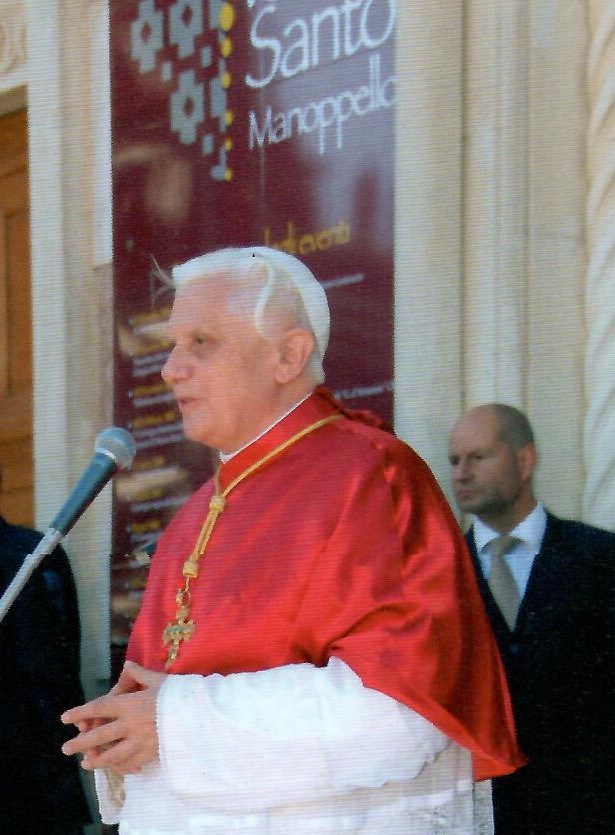
The rector then emphasized that the celebration intended to remember Pope Benedict XVI, recently deceased, who was a pilgrim to the Holy Face on September 1, 2006, the first Pope to visit this Shrine. Fr. Antonio highlighted that the television images and photos of that visit - which had returned to light in recent days - showed the pontiff deeply moved in meditation for a long time in prayer before the sacred image, and then as the pope encouraged the religious and the faithful in the search for the face of Christ.  Fr. Antonio concluded with the invitation to pray for Benedict XVI, thanking him for what he gave to the Church and to the Shrine.

In his homily, Archbishop Bruno Forte drew an appropriate link between Pope Innocent III, initiator of the cult of the Holy Face, and Benedict XVI, as the pontiff who "brought back" to the Church the forgotten sacred image, after centuries of oblivion and silence.

The archbishop, with an emotional voice, affirmed how the gaze of the dying pope rested on the reproduction of the Holy Face, as the pontiff gave a last invocation: "Lord, I love you."

From another testimony, published on the website of the German-speaking Catholic press agency Kath.net on January 2, 2023, we know that biographer Michael Hesemann visited Benedict XVI one last time on December 1, 2022, finding him weak, but mentally alert. Hesemann himself says that the pope had near him, on a small table, the reproduction of the Holy Face of Manoppello. It is likely that he had several, including the one, kept between two panes of glass in a silver frame, received as a gift from the Capuchins on September 1, 2006.


Photo courtesy of Paul Badde

Photo courtesy of Paul Badde


Archbishop Bruno Forte recalled, not without emotion, that visit, taking up and commenting on some passages of the prayer that the Pope dedicated to the Holy Face, relating them to sections of the discourse that the Holy Father gave on the occasion of his apostolic journey to Germany, to Freiburg im Breisgau, on September 24, 2011, during a prayer vigil with young people.

It was Archbishop Bruno Forte himself who welcomed Benedict XVI to Manoppello in 2006.

The pope's encounter with the Holy Face was very special. As he arrived at the Shrine, on a bright summer day, he was welcomed by thousands of people who filled every possible space near the Shrine of the Holy Face. The pope was visibly moved, without hiding his joy at being there, avoiding the attempts of those who tried to dissuade him from a trip to this place where no pope had ever gone before.

Pope Benedict with Archbishop Forte at the left and Fr. Cucinelli to the right


As soon as he arrived in the church plaza, he addressed a brief greeting to those present, and then entered the church which was crowded with bishops, Capuchins and priests.  He paused in prayer on his knees before the altar.  Then accompanied by Fr. Carmine Cucinelli, then rector of the Shrine and the archbishop of Chieti-Vasto Bruno Forte, the pontiff climbed the stairs behind the main altar leading to the other side of the Holy Face, and remained there for several minutes in deep recollection, staring intensely with shining eyes at the Holy Face, whispering, according to some, "... The Face of God".                                                                                              

Precisely these long and emotional moments of prayer represented the most significant moment of the visit. During his address to those present, carried on  giant screens to those outside the church, the Pope avoided expressing any official pronouncement on the nature of the veil, stressing however that he was in a place "where we can meditate on the mystery of divine love by contemplating the icon of the Holy Face".   Following this he addressed an invitation to religious: "Dear priests, if the holiness of his Face remains impressed on you, pastors of Christ's flock, do not be afraid, the faithful entrusted to your care will also be infected with it and transformed". He also urged the seminarians present not to be attracted by anything other than Jesus and the desire to serve His Church. At the exit of the church, he addressed a last greeting to the enthusiastic crowd that awaited him, renewing the encouragement, addressed above all to the many young people "to seek the Face of Christ" concluding his visit, exclaiming with joy: "It is good to be with the Lord."


Individual pilgrims and groups from various parts had reached the Shrine only on foot starting the night before, as security needs had led to traffic being blocked several kilometers away.

That day I was also in Manoppello. Indeed I was there since the previous night, as Fr.  Carmine, then rector of the Shrine, asked me to help him in the organizational phase of that extraordinary event that had no precedent for the town and for the Capuchins themselves, and also to set up a stage for journalists and television reporters and transformed the adjacent San Damiano hall into a press room.                                                                                         

That night we slept very little waiting for the next morning, between prayers and songs of groups of young people and new arrivals, including foreign journalists. The next morning, the arrival of the pontiff by helicopter, who landed in the nearby parking lot for the short walk to the Shrine, in the company of Archbishop Bruno Forte, of Mons. Georg Gänswein, Mons. James Harvey Prefect of the Apostolic Palace. Their passage was surrounded by the joy of the crowd that crowded near the barriers, moving Benedict XVI himself.

Already in February 2006, the hypothesis of a visit by Benedict XVI had leaked to some newspapers. The news caused a sensation, but was immediately denied by Mons. Bruno Forte, archbishop of the diocese of Chieti-Vasto, including the Shrine of the Holy Face. A circumstance that was to reveal little-known back stage maneuverings, or rather attempts made by members of the Vatican hierarchy to advise against that visit by citing possible consequences.

The announcement did not fail to generate expectations and hopes among the Capuchins themselves, who discreetly put their organizational machine into practice, preparing for the expected event. Only on August 19, 2006, the Vatican Press Office issued a simple notice confirming that the "pilgrimage of His Holiness Benedict XVI to the Shrine of the Holy Face in Manoppello" would be held on September 1. In short, a private pilgrimage and not a true and proper visit, which reaffirmed the pope's desire to meet the Holy Face.

In fact, at the beginning of 2005 it was Mons. Forte to have invited the then cardinal Joseph Ratzinger to Manoppello, from whom he had received episcopal ordination on September 8, 2004 in Naples, before assuming the leadership of the diocese of Chieti-Vasto. In a recent interview with the  newspaper "Avvenire" on January 6, 2023, Forte confirmed that the date of April 18, 2005, had already been set, but owing to the fact that two days before the appointed day the cardinal was elected pope the appointment could not be kept. But it was only postponed.

In the autumn of 2004 it was the journalist and writer Paul Badde who informed the future pope, living at that time close to the Vatican in the very same apartment building as Badde, of the research he was conducting on the Holy Face, and gave the cardinal a copy of his first book on the Holy Face published in Germany (Das Muschelseindentuch, Ullstein, Berlin).

Heinrich Pfeiffer, the authoritative scholar of the image of Christ, after presenting his theses on Veronica at a conference with the foreign press in Rome on May 31, 1999,delivered a memorandum to Cardinal Ratzinger hoping for a visit by Pope John Paul II.   In those same years, Cardinal Fiorenzo Angelini had also informed the Polish pope of the results of the research by Fr. Pfeiffer, professor of Christian art history at the Gregorian University of Rome and scientific consultant of the International Research Institute on the Face of Christ, created in 1997 by Cardinal Angelini himself, precisely in view of the great Jubilee of the Year 2000.

The visit was a great international media event, as documented by the booklet in which I collected the main comments expressed by the reporting which appeared on television, in newspapers and magazines, or was disseminated by press agencies. The Capuchins of the shrine wanted to publish this booklet as a supplement to their magazine Il Volto Santo di Manoppello.

It seems appropriate to me to point out some of these comments in order to understand what happened in the years that followed and also to grasp the meaning of the papal pilgrimage that raised questions among the many journalists and commentators. For example, Jerry O'Connell, in the British newspaper The Universe, wondered "how a visit accompanied by over 300 journalists could be considered private". Paul Kreiner in "Der Tagesspiegel" also recalled the irony with which the pope himself spoke of the "private" character of his visit.

Saverio Gaeta is quite explicit in his article "This is the Face that we will see again", published in the weekly Famiglia Cristiana, n. 37/2006, p. 57. For the most widely circulated Catholic weekly in Italy, with unusual frankness, he wrote that "his coming, despite the objections raised by some leaders of the Vatican Curia regarding the appropriateness of such a trip (for fear that in fact it would contradict what has been claimed for centuries by the Vatican Chapter, which has always claimed to possess the original), makes legitimate the idea that the Pontiff is convinced of the authenticity of this image." Paul Badde, in the newspapers Die Welt and Berliner Morgen Post, also dwelt "on the resistance of the Vatican hierarchy" that characterized Benedict XVI's trip to Abruzzo. Others also spoke of  a"detective story".  Circumstances that can also give an idea of the difficulties that have characterized Benedict's pontificate.

The popular German newspaper Bild, in an article by Andreas English, wrote "the pope prays before the Holy Face, elevating the image to the most important relic of Catholics." Joachim Fischer in the Frankfurter Allgmeine Zeitung recalled the Gospel of John which speaks of the cloth that covered the face of Jesus (sudarium) as well as the burial cloths, also claiming that "more than his prudent words, the Pope impressed by remaining in silent devotion before the Icon". From this behavior the journalist notes the possibility of historical changes in the sense that "for the Catholic Church the period in which it distanced itself from images is over."  Guido Horst, in the German newspaper Die Tagespost, argued that the pope "with not a word expressed the thesis that the veil of Manoppello is what in the tomb was on the Face of Jesus." The BBC and Reuters also spoke specifically of visiting the Veronica. Others recalled the studies of Sister Blandina Paschalis Schlòmer regarding the overlapping of the Holy Face with the Shroud.                                                                                                                                                                                 

With respect to a variety of comments and questions in the press around the world, I recall that L'Osservatore Romano dedicated its front page to the papal visit, with the complete text of Benedict XVI's words delivered at the Shrine on an internal page, without further comment. After almost 150 years of history, the Vatican newspaper was still and all taking an interest in the Shrine of Abruzzo for the very first time.


The meaning of the visit must also be understood in the light of the cordial meeting with the most famous scholars of the Holy Face, which took place inside the Friary, during a break in the visit, as documented by the images that show the pontiff with Fr. Heinrich Pfeiffer, Paul Badde, Sr. Blandina, Fr. Andreas Resch and Saverio Gaeta, all convinced supporters of the authenticity of the veil and its identification with the Veronica (true icon).

Pope Benedict with Paul Badde.  In the middle Archbishop Forte, Fr. Resch and Fr. Pfeiffer
To the right Sr. Blandina


Sr. Blandina greeting Pope Benedict

Fr. Pfeiffer greeting Pope Benedict.  Archbishop Forte looks on


Fr. Pfeiffer, in his article which appeared in the special edition of the Shrine's magazine dedicated to the visit, published by the Capuchins, argued that it was important that the pope, "well beyond any type of pressuring" had seen with his own eyes "the image of Christ who was venerated over the centuries as the most important relic of Christianity. Perhaps it would never have been known to the general public if the now deceased Fr. Domenico da Cese had not wanted to exhibit it during the Eucharistic Congress held in Pescara", alluding to the exhibition on the Holy Face that the Capuchin, deeply convinced of the authenticity of the image, wanted to organize on the occasion of that event (September 1977), during which  Pope Paul VI was present.

Padre Domenico and the Holy Face


Pfeiffer, the first to support after years of research the identification of Veronica with the veil of Manoppello took the opportunity to admit "that he never wanted to create difficulties for the Canons of St. Peter's, but it is known that one of them exhibits on the eve of Passion Sunday, what is a copy that replaced the true relic". In previous years, a lively debate regarding the Veronica's disappearance also ended up on the pages of the monthly 30 Days, between the German Jesuit and Mons. Dario Rezza, canon of Saint Peter's Basilica. We also know that two canons of St. Peter's went to Manoppello in the early years of the new millennium and, while venerating the sacred image, verbally recommended to Fr. Germano Di Pietro, then rector, to avoid talking about the Veronica, of which they had also begun to write about in the magazine of the Shrine. For a long time the Capuchins had been afraid to do so.

Pfeiffer, who died on November 15, 2021, suffered greatly from the consequences of his studies, which he tenaciously continued to carry out. After the pope's visit to Manoppello, he wrote that "every research is a debtor to only one thing: the truth." And Benedict's presence in Manoppello should also be understood as a response to his studies.

In reality, from that visit, immediate effects emerged, such as the Shrine's elevation to the status of basilica only three weeks after the visit. The granting of the title was intended to "intensify the attachment and devotion of the chair of St. Peter to this important church and at the same time make it the center of particular liturgical and pastoral action."

One year after the pilgrimage, the Pope sent to the Shrine, through the bishop, the prayer dedicated to the Holy Face, the text of which expresses a long reflection directed to the "human face of God who entered history to reveal the horizons of eternity. Silent face of Jesus suffering and risen ..".  A true and proper testimony that came from the theologian pope, who has shaped his entire religious and academic life on the dialogue between faith and reason, between science and faith.

The consequences of the encounter with the Holy Face emerged from other voices, such as that of Alessandra Borghese, a Roman noblewoman very close to Vatican circles, who published an article in the newspaper Il Resto del Carlino on December 20, 2007 – entitled "The Mystery of the Holy Face" – in which she wrote that  some friends had heard that the pope was deeply moved by that sacred image.

Even the centuries-old silence on Veronica began to fade. In a statement from the Holy See Press Office of July 14, 2011, coinciding with the presentation of the exhibition "The Man, the Face, the Mystery," to be held in San Marino, with works from the Vatican museums, it became known that Veronica had disappeared in 1527. A thesis confirmed by Antonio Paolucci, then director of the Vatican museums, in an interview with the newspaper Il Resto del Carlino on August 18, again about the San Marino exhibition. But these belated admissions, although relevant, seemed to produce little reaction, persisting towards the "rediscovered Face " an attitude of little attention.

Other signs and events followed in this direction in the following years, also after the resignation of Benedict XVI (February 28, 2013), which he followed by almost a decade of secluded silence, until his death.

Among these signs and events, it is worth remembering how,  coinciding with the extraordinary Jubilee of Mercy, instituted by Pope Francis in 2016, the idea of resuming the ancient tradition established by Pope Innocent III took shape.

On January 16, 2016, a pilgrimage of 400 people, led by Fr. Carmine Cucinelli, with the reproduction of the Holy Face, enclosed in an ancient silver reliquary, traveled from Manoppello to converge on St. Peter's Square. The procession was able to enter St. Peter's under the statue of Mochi and then in procession, led by the choir, headed to the nearby basilica of Santo Spirito in Sassia, packed to the hilt. The Mass was celebrated by Archbishop Mons. Gänswein, prefect of the Papal Household and, above all, Benedict XVI's trusted secretary, who had already accompanied the pope to Manoppello.   see https://holyfaceofmanoppello.blogspot.com/2016/01/the-veronica-at-st-peters-today-toward.html   and    https://holyfaceofmanoppello.blogspot.com/2016/01/archbishop-georg-gansweins-homily-at.html

In the course of the homily he clearly stated that it was "a copy of the ancient original that Pope Innocent III showed to pilgrims and that for four hundred years has been kept in Abruzzo, on the Adriatic, in an outlying area of Italy, from where today for the first time it has been brought back to the place where its public worship began." Among the concelebrants were two canons of St. Peter's, Lebanese Archbishop Edmond Y.  Farhat and Mons. Americo Ciani.

Since then the ancient rite is repeated each year in Manoppello and ends with a short procession in front of the church plaza. On January 17, 2021, Mons. Gänswein returned to preside over the celebration, reiterating, among other things, that "On the first of September 2006 Pope Benedict brought back to the Church and throughout the earth the 'face of God' human and personal". He added  the reference to when on May 15, 2009, "Benedict visited the Holy Sepulchre in Jerusalem, from which both the veil of the Holy Face and the Turin Shroud come as an incomparable message of the Resurrection of Christ from the dead."  Relevant statements, which can be traced back to the thought of the pope, and of course to that of Mons. Gänswein and that make us think back to the humble prophecy of Fr. Domenico da Cese, who came to the same conclusions in the 1970's, courageously expressing them in the notes that accompanied a holy card that reproduced the Holy Face.   see     https://holyfaceofmanoppello.blogspot.com/2021/01/homily-of-archbishop-george-ganswein-at.html                                                                                                                                                                                   

In the book "Nothing but the truth" (ed. Piemme, Milan, 2023), written by Mons. Gänswein, with the collaboration of the journalist Saverio Gaeta, there are references to the Holy Face. The book, released a few days after the death of Benedict XVI, is causing an uproar for some details that emerged especially during the period following the resignation, which perhaps would have required greater confidentiality, while understanding the human desire to clarify some episodes,  after almost ten years of silence, also to protect the memory of the deceased pope.

The book represents, in any case, an opportunity to learn more about the vision of the recently deceased pope.  It is argued, among other things, that for pope Ratzinger at the base of the trilogy "Jesus of Nazareth," there was the conviction of Jesus' saving message, "which is not simply a doctrine, but the concrete encounter with his person, with the God who truly became man and who continues to be present in every age." In this regard, Mons. Georg recalls the words that the pope pronounced in Manoppello before the Holy Face: "To see God we must know Christ...".  In addition, the invitation of Mons. Forte, to the then Cardinal Ratzinger, to whom he donated a copy of the book on the Holy Face, edited by Saverio Gaeta, printed by Famiglia Cristiana in March 2005.   In the appendix of Mons. Georg's book, the papal testament is published, written on August 29, 2006, that is, while he was preparing for his pilgrimage to the Holy Face, of which he knew everything (even beyond the books that had been given to him), including his spiritual legacy: "Remain firm in the faith! Don't let yourself be confounded!... Jesus Christ is truly the way, the truth, and the life—and the Church, with all her shortcomings, is truly His body."

The papacy of Benedict XVI will be discussed at length, as well as his resignation, which seemed inspired by the gesture made in 1294 by Celestine V, on whose mortal remains kept in the Basilica of Collemaggio in L'Aquila he went to pray in the days following the earthquake that struck Abruzzo on April 6, 2009 and again, on a pastoral visit to Sulmona on July 4, 2010. But to have brought back to the Church the gaze on the face of Christ will remain an act historically attributable to his pontificate.

(all photos except as noted courtesy of Antonio Bini)