 |
| At the left a copy of a page from the Mirabilia Urbis from the 1400's and at the right the Veronica image from the 1800's |
 |
| Russian Icon from the 1800's |
 |
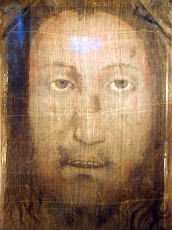
| Holy Face of Manoppello (photo by Paul Badde) |
Five centuries after the Sack of Rome, new hypotheses emerge, but also doubts and contradictions
by Antonio
Bini
After
centuries of oblivion, with the five hundredth anniversary of the Sack of Rome
now imminent , a certain curiosity seems to be rekindled around the Veronica, once highly venerated, the dream and mirage
of the Romei, the medieval pilgrims who journeyed to Rome anticipating the
future contemplation of God in the afterlife, then starting off again from the
eternal city wearing the emblem of the Veronica on their hat or through a
plaque sewn on their cloak.
The Veronica
was considered the most important relic of Christianity, so much so that Pope
Nicholas IV placed it at the head of the prerogatives of the Basilica, even before
the relics of St. Peter himself.
The
public cult of the Veronica dates back to 1208, the year in which Pope Innocent
III wished to carry it in procession to the nearby hospital of Santo Spirito in
Sassia an ancient structure for the hospitality of pilgrims whose
reconstruction he had personally supported.
Cardinal
Stefaneschi, chronicler of the first Jubilee in history, instituted by Boniface
VIII in 1300, wrote that "many flocked in large numbers and in more
packed crowds than usual on the day when the venerable effigy, commonly called
the Sudarium or the Veronica, was exposed to the whole world "
(cf. De centesimo seu jubileo anno liber).

For many historians, including the distinguished medievalist Arsenio Frugoni[1],
the term the Veronica refers to the image, a true icon, from which the
name of the woman would have been derived, which would have led to the
construction over time of the devout legend, spread by the Stations of the
Cross (Via Crucis), created in the current version by Saint Lawrence of Port
Maurice, a Franciscan (1646-1751),
through the institution of the sixth station.
Yet
Frugoni himself, like other scholars, observed that there is no trace of Veronica
in the Gospels, while her name was erased from the Martyrology in 1582 during
the papacy of Gregory XIII, similarly Charles Borromeo eliminated her name from
the Missal for the Ambrosian rite.
The Veronica
disappeared during the Sack of Rome in 1527, being "on that occasion
one of the main targets of the looters."[2]
 |
| The Sack of Rome as depicted in a German illustration of the 1800's |
The
construction of the new basilica had been underway since 1506, and the Vatican
did not make its disappearance public: "Faced with the serious loss of the
Veronica," noted the theologian Mario Imperatori, "the popes
maintain an embarrassed silence, and according to a reliable historical
reconstruction[3],
they will proceed to replace the relic with a simple icon, which will then be reproduced several times
until the strict prohibition imposed by Urban VIII in 1628".
Oblivion gradually fell on the venerated image.
There
was not even a mention, for example, in the Pilgrim's Book, published by the
Central Committee for the Holy Year of 1950, unlike the medieval guides known
as Mirabiliae Romae or Mirabiliae Urbis, in which the description of the Veronica,
often also illustrated, was never missing.
The
French traveler Michel de Montaigne, who saw the Veronica in St. Peter's during
Easter 1581[1], a
little more than half a century after the Sack of Rome, described it as "a
tormented face, of a gloomy and dark color".
Only
the pope and the canons of St. Peter's were allowed to see the Veronica up
close.
A few
years ago the writer Paul Badde had the privilege, after insistent
requests, of being admitted to the internal treasure chamber in the Veronica
pillar of St. Peter's and then wrote that: "the icon was covered with
glass. Underneath some object, which seemed to dissolve. A patchy dark, dirty grayish material with no
outline. Without any drawing or color.
No trace of a picture was there to be seen, nothing”, and above all “this was
in no way compatible with the old reproductions of the Veronica".[2]

If this had been the image seen by Dante, the poet could
never have written that:
"Jesus Christ left to us as example of his beautiful figure".
For
some years now, thanks to powerful telephoto lenses - it has been possible to
photograph it - when once a year, for a few moments, after a procession inside
the basilica, it is exposed to the faithful on the fifth Sunday of Lent, by
some canons, on the other side of the loggia located above the large statue of Veronica[3],
the woman who, according to tradition, wiped the face of Jesus. This statue, sculpted by Francesco Mochi, was
installed around 1640, i.e. after the Sack of Rome and placed to the left of
the main altar.
 |
| Fr. Carmine Cucinelli, OFM, Cap., then rector of the Shrine of the Holy Face at St. Peter's Basilica facing the Veronica statue in January 2016 holding a copy of the Holy Face as part of the pilgrimage from the Shrine to St. Peter's and the Church of Santo Spirito in Sassia |
The exposition
that took place in 2026 was preceded by a statement from the Communication
Office of the Fabric of St. Peter's in the Vatican announcing the repetition of
the "very ancient tradition" of the exposition of the major relic
of the Holy Face (Veil of Veronica)", which would be followed by the
Eucharistic celebration presided over by Cardinal Mauro Gambetti,
archpriest of the Basilica.

The statement, which has aroused the curiosity of the media, uses the term Veil of Veronica together with that of Holy Face, according to a terminology that often associates the face of Christ with the concept of sudarium, as we have already seen in the reference to the chronicles of the Jubilee of 1300.
This
communicative approach perhaps seems to follow a recent line of interpretation consequent
to the publication of an essay by the theologian Veronika Maria Seifert[4],
reviewed by Gabriele Nicolò in L'Osservatore Romano[5],
in which it is maintained that there were two acheropite images in the past in
Rome, the sudarium of Veronica, "or the suffering face of Christ along the
Via Crucis", and the Holy Face of Manoppello, "the glorious one of the
resurrection", which would have been kept from the
eighth century in the Pontifical Lateran Chapel, then moved later to St.
Peter's, perhaps in relation to the abandonment of the Papal Palace by its
owner, exiled to Avignon.
In a
subsequent interview with Seifert by Paolo Odarza, released by the Vatican News
website on April 4, 2025 - The face of Christ, between history and devotion - Vatican
News - the
scholar, while aware of the theses of scholars who support the disappearance of
Veronica during the Sack of Rome, expresses her conviction in favor of its
having stayed in St. Peter's, advancing
the hypothesis that it was not the Veronica that disappeared in 1527 but
rather the Holy Face, believed to be the sudarium placed on Christ's head in
the tomb, as narrated by the Evangelist John, verse 7 of chapter 20 and
identified with the Veil of Manoppello.
 |
| Father Domenico da Cese |
This
hypothesis was openly supported in the seventies by the prophetic Father Domenico
da Cese, a Capuchin, through simple holy cards of the Holy Face that he
distributed free of charge among visitors to the Sanctuary of Manoppello. The
approach of the friar, a pioneer in the dissemination of the Holy Face, broke with the
traditional prudence maintained by generations of Capuchins, who in previous
centuries had lived the constant concern to guard the veil, with respect to the
danger, not only of possible excommunications, but fearing that the sacred
image could even be destroyed, in implementation of the provisions of Urban
VIII, even more severe than those
adopted by previous popes[6],
where it had been considered a copy.[7]
Following the prohibitions of Urban VIII, an entire category
of Roman artists and artisans disappeared, that of the Pictores Veronicarum,
who specialized in the reproduction of the holy face of Christ or the Veronica,
which they sold to pilgrims.
"These strange measures," observed Fr.
Heinrich Pfeiffer, "find an explanation in the disappearance of the
original Veronica."[8]
Seifert
also asserts that the dark surface of the Veronica would depend on the fact
that it is "a relic of blood and the blood becomes dark",
neglecting to consider that the veil of Manoppello also has blood stains,
without having lost its extraordinary transparency and brightness over time.
In this
regard, it should be remembered that Fr. Heinrich Pfeiffer considered "the
piece of cloth in the reliquary of Rome as a false substitute".[9]
Very rare were the copies made in the following years and
only by canons of St. Peter's, who reproduced the Veronica with its eyes
closed. Overcoming the prohibitions of Urban VIII, Pope Pius IX during
his pontificate (1846-1878) favored a wide diffusion of printed copies of
images, with a distinguishable dark face with closed eyes, however different
from the imperceptible dark veil currently exhibited in St. Peter's. To
increase the credibility of the reproductions, which did not fail (and do not
fail) to exert a certain influence among different religious and believers, the
individual copies were accompanied by the prevailing formula "Vera
Effigies Sacri vultus Domini Nostri Jesu Christi", (True effigy of the
Holy Face of Our Lord Jesus Christ) with special stamping.
 |

The original of one of these copies was also exhibited until
a few years ago in the Shrine of the
Holy Face, in the corridor that precedes the room of sacred furnishings placed
next to the reproduction of the Veronica with open eyes datable to about
1450.
As for
the Sack of Rome, well-founded evidence has recently emerged that leads to
identify the Spanish military leader Hernando Alarcon, who guarded Pope
Clement VII in Castel Sant'Angelo during those terrible months of devastation,
as the person who saved the Holy Face, bringing it to Abruzzo, in his palace in
Tossicia, the ancient capital of the Valle Siciliana, fiefdom received the previous year from
Charles V for his actions during the battle of Pavia in 1525.[10]
 |
| Hernando Alarcon's Palace in Tossicia |
 |
| Hernando Alarcon |
The
reference to the Sack of Rome is also surprising, considering that previously
it was the Holy See Press Office, on July 11, 2011, after almost five
centuries, to admit, on the sidelines of the presentation of the exhibition
"The Man, the Face, the Mystery", which would be inaugurated in the coming
weeks at the Republic of San Marino, to be set up with works from the Vatican
Museums, that the Veronica had "disappeared
following the Sack of Rome in 1527",[11]
as many scholars had long claimed.

Unique connections have led Father Federico Lombardi to provide
the introduction for Veronika Maria Seifert's book, considering that Fr.
Lombardi was director of the Holy See Press Office from 2006 to 2016, and
therefore in the year 2011 in which the statement on Veronica's disappearance
was released. Perhaps it is because of these circumstances that the cautions
expressed in the introduction are due: "We know
well, and the author is perfectly aware of it, that we will never arrive at
definitive certainties of a historical or scientific nature about the origin of
these Icons, but their importance and their significance in the history of
faith and spirituality is such," Lombardi writes, "that the desire to talk about it and
to study its nature and events has not been exhausted for centuries, on the
contrary it is enriched with ever new hypotheses".
The
absence of Veronica from St. Peter's was confirmed in a subsequent interview
that Prof. Antonio Paolucci[12],
director of the Vatican Museums, granted to the journalist Letizia Cini, then
published in the newspaper "Il Resto del Carlino", on August 18,
2011, with the title "In the face of man, the image of God", on the
eve of the opening of the Exhibition, which was held from August 20 to November
6 of that year.

Already
during a previous and even more important exhibition – having as its theme
"The Face of Christ" – set up at the Palazzo delle Esposizioni in
Rome from 9 December 2000 to 16 April 2001 and conceived to solemnly close the
Great Jubilee of 2000 – the theme of the absence of the Veronica had emerged,
of which only the ancient empty reliquary was exhibited, donated for the Jubilee of 1350 by three
Venetian nobles, Nicolò Valentini, Bandino de' Garzonibus and Franceschino
Glastro. [13]
 |
| Ancient Reliquary from the Treasury of St. Peter's Basilica showing two shattered panes of glass which formerly enclosed the Veronica |
Gerhard Wolf, one of the curators of the exhibition, an academic and prestigious director of the Kunsthistorisches Institut in Florence, beginning with the introduction of the catalog, did not fail to raise the question, overcoming the veil of secrecy surrounding the Veronica, wondering if "the Veronica had disappeared from Rome at the beginning of the sixteenth century or sold at auction by the soldiers of Charles V after the Sack of Rome in 1527? Is it preserved somewhere in the Abruzzi or is it still hidden in the south-western pillar of the quadrant of the new St. Peter's Basilica ?"[14]
Even the then rector of the Shrine, Father Germano Di Pietro, posed a similar question, asking "Is the Veronica in Rome?", referring precisely to the doubts that emerged on the occasion of the aforementioned Roman exhibition,[15] which moreover confirmed the uncertainties already manifested in the exhibition "Romei and jubilees. The medieval pilgrimage to St. Peter's (350-1350)" - which was held in Rome - Palazzo Venezia in the imminence of the opening of the Great Jubilee - from 28 October 1999 to 26 February 2000 - and organized by the Ministry of Culture together with the Vatican Museums, the Vatican Apostolic Library and the Fabric of St. Peter's.

On that occasion, objects and works on
display were accompanied by explanatory panels. In one of these, the absence of
the Veronica was recalled: "Arriving at St. Peter's Basilica in the Vatican,
pilgrims used to be able to have access to the relics kept there. Among these, the image of Veronica
was of great importance".
.jpg) |
| Explanatory panel at the Exhibition "Romei and Jubilees" |
The
thesis of the identification of Veronica in the Face of Manoppello had been
widely circulated only the year before in Rome, following an international
press conference held by Father Heinrich Pfeiffer, professor of Christian art
at the Gregorian University, together with Prof. Donato Vittore of the
University of Bari, who illustrated the unique characteristics of the veil and
the absence of color.
Before
then, few people knew about the existence of the Shrine, hidden at the foot of
the Maiella, where only in 1966, after the expansion of the small church, was work
started to enlarge and asphalt the road leading to it.
Professor
Wolf's questioning opened up an issue that was certainly not secondary,
considering that the Veronica over the centuries had effectively become the image of Christ
for the universal Church[16],
at least until the first decades of the sixteenth century, while there was no reference to the
"Holy Face", except for the in-depth study concerning the Holy Face
of Lucca, which, as is known, is a wooden crucifix, and arrived in the Tuscan city in the year
742.
On the other hand, in that exhibition the works, engravings and illustrations on display, also from various European museums, widely recalled the very different characteristics, once expressed by the Veronica, starting from the open eyes.[17]
In this regard, it seems appropriate to recall the further observations of the English historian Ian Wilson, who wonders why the Veronica is not shown openly, hazarding the hypothesis:
"What if, as someone has said, there had been some clandestine change during the sixteenth century, so that the original is that cloth similar to the Veronica – still existing – that appeared at that time in Manoppello, and only a nondescript fabric had been left in the Veronica's case?"[18]
Among the works on display, it is worth
mentioning the precious miniature present in the Regula Sancti Spiritus,
a codex of the mid-fourteenth century, containing the Statutes of the
Hospitallers of Santo Spirito in Sassia, where Veronica, held upright by Pope Innocent III’s right arm, appears with long light colored hair, and beard parted at chin height
with eyes open.[19]

Even
more evident is the altarpiece by Ugo da Carpi, made in 1524 and intended to be placed in the section on
the ciborium of the ancient basilica of St. Peter. The ciborium, depicted by
Canon Jacopo Grimaldi, in the upper section kept the Veronica, enclosed in a
special chest, with a number of locks controlled by the canons of St. Peter's,
while the final key was kept by the pope. A work inspired by the Veronica and
"made without a brush", as the artist wrote, made with a unique
technique to respect the acheropite nature of the image, which shows the face
of Christ clearly visible and with its eyes open[20].

With
regard to the acheropite nature of the Holy Face, it should be emphasized that
in a study by the theologian Mario Imperatori[21],
reference is made to the results of a "conference organized by ENEA
(The Italian National Agency for New Technologies, Energy and Sustainable
Development), from May 4-6, 2010, in which for the first time the hypothesis
pioneered for years by Fr. Pfeiffer and Sister Blandina Paschalis Scloemer had
a wider scientific echo”. On May 4, 2010, in the press release for the opening
of the International Workshop on the Scientific Approach to the Acheiropoietos,
ENEA argued that "the characteristics of the veil pose the problem of
the formation of the image, which although it seems at first glance a painting,
in reality shows various peculiarities largely incompatible with this
hypothesis".
Already
in the year 2000, the most authoritative scholar of the Shroud, Prof. Pierluigi
Baima Bollone, had confirmed the validity of Sister Blandina's research[22],
stating that, compared to the Shroud, the face of Manoppello "has an
identical general layout, overlapping dimensions and ten points of congruity",[23]
circumstances that suggest the two veils came into contact.
And
most importantly it is probable that these spheres of investigation, which have
developed in recent years, especially after the visit of Benedict XVI on
September 1, 2006, have led to a more careful reconsideration of the divine
nature of the Holy Face.
Countless
references could be made regarding its traceability to the Veronica, while
admitting the frequent possibility of using different terms, such as Sudarium
and Holy Face (Volto Santo o Santo Volto), to name the same image, but we limit
ourselves to the thought of Cardinal Francesco Angelini, at that time president
of the International Institute for Research on the Face of Christ, who in the
preface to the book by Fr. Heinrich Pfeiffer defined it without uncertainty as
"a publication that contributes decisively to shedding light on the
"mystery" of the Roman Veronica".[24]
Before the pilgrimage of Pope Benedict XVI, the hypothesis of the Veronica was also supported by the authoritative Cardinal Carlo Maria Martini, who visiting the shrine was struck by the encounter with the Holy Face, leaving written on the guest register "The Face that we will contemplate eternally", recalling that visit in the preface in one of his books[25] , "pointing out that "in the Shrine there is a cloth that seems to be that of the Veronica. It is certainly an extraordinary image because it is not painted and, seen in the light from all sides, reflects the sweet face of the Lord." Cardinal Louis Antonio Tagle called him "the face of truth" in an interview he granted me in May 2017 in Manoppello, where he had presided over the celebrations of the May festivities.[26]
Among the cardinals we also remember the visit to the Holy Face on
September 18, 2021, by Cardinal Mauro Gambetti, archpriest of St. Peter's, who
left the following message in the guest book "Deep within, painted in a shade of the same
color, appeared to me our likeness --
and through this I discovered my own face" (Dante). I cannot find more
appropriate words to express the wonder and gratitude that I have in my heart
for the encounter with the Holy Face and the fraternity that venerates and
guards it." The message makes his own Dante's thought taken from the
verses of Canto XXXIII of
Paradise, in
which Alighieri describes the final vision of God, not as an abstract and
distant entity, but as a reality that includes his own humanity. The verses
follow the reference to "our Veronica".
For the
theologian Emanuela Fogliadini "there are many reasons that give us the
historical certainty that the Face of Manoppello is none other than the Roman Veronica"
(The Face of Christ. The
Archetypes of the Savior in the Tradition of the Christian East, Jaca Book,
2011).
"The
Holy Face and the Veronica are the same thing," concludes Mons. Walter
Amaducci, recently drawn close to the devotion and study of the Face of
Manoppello.[27]
In a
recent television report, produced by journalist Mario Prignano for
Rai 1 and aired on March 28, 2026, during the Easter period, RAI VIdeo the veil displayed
in St. Peter's was placed, perhaps for the first time, in direct comparison with
the Holy Face of Manoppello , offering an extraordinary opportunity to realize
the mystery of the two images, the first
dark and imperceptible, in which there is no trace of any image, the second
represented by the luminous Face of Manoppello, with eyes and a living gaze
"that does not cease to rest on men and peoples", as Benedict
XVI wrote, in his revealing prayer dedicated to the Holy Face, exactly one year
after his pilgrimage to the Abruzzo town.
The historical events that accompany the face
of Christ sometimes seem to take on the character of a detective story, with an
aura of mystery, between discoveries and silences, even of centuries, between
pronouncements, amnesia and contradictions, sometimes with actions that
disorient believers because of the disappointment of acquired historical
certainties or how the prevailing characteristics were derived from the long
theory of images handed down over the centuries.
Despite everything, it can be reasonably argued
that the veil displayed in St. Peter's until 1527 is the sudarium preserved in Manoppello,
regardless of the different names assumed over time.
The
image of Jesus, for centuries a dominant figure in the history of Western
culture, continues to attract believers in search of his face even in the third
millennium.
Concluding
these brief reflections, it seems appropriate to recall the prophetic message
of John Paul II, who at the end of the Great Jubilee of the Year 2000, with his
gaze turned to the approaching millennium, highlighted in the encounter with Christ the great heritage
of the Jubilee, observing that "Like those pilgrims of two thousand
years ago, the people of our time, perhaps not always consciously, they ask today's believers not only to
"speak" of Christ, but in a certain sense to make him
"seen" to them. And is it not
the Church's task to reflect the light of Christ in every age of history, to
make his face shine also before the generations of the new millennium?"[28]
[1]
Montaigne, Viaggio in Italia, Editori Laterza, Bari, 1972, p. 204;
[2]
Paul Badde, The Face of God, Ignatius Press, San Francisco, 2010, p. 282-283;
[3]
Often presented as Saint Veronica, she does not actually appear in the Roman
Martyrology;
[4] Il
sudario della Veronica e il Volto Santo, Editrice Velar, Bergamo, 2023;
[6] In
this context, the behavior of Father Domenico da Bomba, author of the
"Relatione Historica d'una miracolosa immagine del Volto di Cristo",
a fundamental document that narrates the arrival of the Holy Face in
Manoppello, should also be interpreted. The friar arrived in Manoppello only in
1640, indicating 1506 as the presumable year of arrival of the sacred image,
assuming a dating prior to the Sack of Rome to avoid possible
consequences;
[7]
With regard to the measures of Urban VIII, it is significant to consult the
documentation concerning the request for the delivery of the icon of Chiusa
Sclafani, made in 1617, attached in the appendix of the essay "Christ at
Chiusa Sclafani" by Antonino Giuseppe Marchese, Plumelia, Bagheria, 2009,
where the cardinal of Palermo Giannettino Doria, on June 12, 1628, ordered
Sicilian parish priests to deliver copies "representing the true sacred
image of the Holy Face to give an opportune remedy to this disorder",
under penalty of requisition and excommunication. After various interventions
in defense of the copy, Cardinal Mellino, from the Vatican, with a letter dated
August 23, 1628 authorized the maintenance of the "image of the Holy
Face", as it had been made with the permission of Pope Paul V at the
request of the venerable Innocent of Chiusa who at the time worked in the
Vatican;
[8]
Heinrich Pfeiffer, Il Velo dei segreti: l’enigma di Manoppello, in Luoghi
dell’Infinito, October, 2028, p. 34. In the article referred to, the
disappearance of Veronica on the occasion of the Sack of Rome is
reiterated;
[9]
Heinrich Pfeiffer, Il Volto Santo di Manoppello, ed. Carsa, Pescara, 2000, p.
13;
[10]
Antonio Bini, Heinrich Pfeiffer, lo studioso che identificò la Veronica,
Teaternum Edizioni, San Giovanni Teatino, 2024, p. 43 ff.;
[11]
Antonio Bini, La Veronica non è in San Pietro. Un comunicato stampa pone fine
ad un silenzio durato cinque secoli, in Il Volto Santo di Manoppello, n. 2,
2011, p. 46;
[12]
Prof. Antonio Paolucci (Rimini 1939 - Florence 2024), in 2007 had been
appointed director of the Vatican Museums by Benedict XVI. An art historian of
recognized international competence and essayist, he was for a short time
Minister for Cultural Heritage;
[13]
Unlike the current reliquary, the fourteenth-century one was between two panes,
which were supposed to allow viewing from both sides. Paul Badde, admitted to
the visit of the Veronica as it is presented today, was not allowed to take
photos, but he was nevertheless able to find that the surface of the image
exceeded that of the original reliquary;
[14]
Gerhard Wolf, , Dal volto all’immagine, dall’immagine al volto, in Il Volto di
Cristo, ed. Electa, Milan, 2000, p. 20. The question is raised again later on
p. 114. The exhibition was organized by
the Ministry of Cultural Heritage and Activities together with the Vatican
Museums, the Vatican Apostolic Library, the Fabric of St. Peter's and other
institutions.
[15]
Germano Di Pietro, E' a Roma la Veronica?, in Il Volto Santo di Manoppello, n.
2, 2002, p. 2 ss.;
[16]
According to Flavio Caroli, starting with Innocent III, "the Veronica
acquires a stable role in the religious imagination, to the point that not even
during the Sack of Rome in 1527 were copies of an original destroyed that
perhaps no longer exists", in Il Volto di Gesù, ed. Mondadori, Milan,
2008, p. 74;
[17] An extraordinary online "catalog" with
about 5000 artistic and literary works related to the Roman Veronica, the
result of a laudable collective action, was promoted by the Il Volto Ritrovato
Association of Milan, through the creation of the VeronicaRoute.com site,
created with the intention of rediscovering the lost features of the medieval
relic once kept in St. Peter's;
[18] Ian Wilson, La Veronica e la Sindone, in Il Telo, rivista di sindonologia, n. 1, January-April, 2000, p. 16;
[19]
AA.VV., Il Volto di Cristo, ed. Electa, Milan, 2000, p. 126;
[20]
Antonio Bini, La Veronica com'era nella Tavola di Ugo da Carpi, in Il Volto
Santo di Manoppello, n. 1, June, 2024, p. 30 ff.;
[21]
Mario Imperatori, Sindone e Velo di Manoppello, in Rassegna di Teologia,
Aloisiana Libri, n.1, January-March 2012, p. 64;
[22]
After publications in various languages, Sister Blandina edited a voluminous
essay, for the first time in Italian, the result of almost fifty years of
research, entitled “Salì sul tramonto”, Ars Grafica Vivarelli Edizioni, Pratola
Peligna, 2025, in which the scholar wants to demonstrate that the Shroud and
the Holy Face were formed in the tomb of Jesus at the moment of resurrection;
[23]
Pierluigi Baima Bollone, Shroud, 101 questions and answers, Edizioni San Paolo,
Alba, 2000, p. 34;
[24]
Heinrich Pfeiffer, Il Volto Santo di Manoppello, Carsa Edizioni, Pescara, 2000,
p. 9;
[25]
Carlo Maria Martini, La trasformazione di Cristo e del cristiano alla luce di
Tabor ", Rizzoli, Milan, 2004;
[26]
Antonio Bini, Il Volto della Verità, in Abruzzo nel Mondo, n. 3, June-July,
2017, p. 3;
[27]
Walter Amaducci, Il Volto Santo, Editrice Stilgraf, Cesena, 2023, p. 30. The book
has also been published in English, French and German. Vietnamese and
Portuguese editions are imminent.
[28]
John Paul II, Apostolic Letter "Novo Millennio Ineunte" at the end of
the Great Jubilee of the Year 2000, Rome, 6 January 2001;




No comments:
Post a Comment