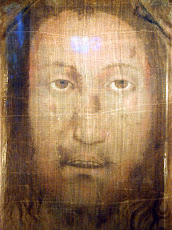
Padre Pio of Pietrelcina and the Phenomena of Bilocation Related to his Death. The Parallel Lives of Padre Pio and Padre Domenico of the Holy Face
Padre Domenico captured on film at the funeral procession for Padre Pio while still remaining at Manoppello
by Antonio Bini -- translated by Raymond Frost
The life of Padre Pio of Pietrelcina, marked by so many extraordinary episodes, attracted masses of devotees, from Italy and abroad, to the shrine of the Capuchins of San Giovanni Rotondo. I had the privilege of being baptized by him on January 6, 1952. Padre Pio -- it's hard for me to call him anything else even though he has been declared a saint-- also married my parents 28 October 1950, at 5 am as documents show, to avoid the crowds of pilgrims who from the early hours of the day were waiting to meet him or even just to see him. Only after the death of my parents did I gradually discover the value of that gift which I had kept hidden until a few years ago maybe even from myself. In those days my father did not own a car but had hired one to reach San Giovanni Rotondo from Abruzzo. There was no autostrada yet and the journey required quite a few hours due to the poor condition of the roads. But such difficulties were nothing compared to the challenges which were overcome to obtain the availability of the holy Capuchin.

Padre Pio celebrates the matrimony of Fernanda and Vitantonio Bini, San Giovanni Rotondo October 28, 1950
I remember the strong charisma of Padre Pio, the presence of so many pilgrims waiting for hours for him to appear from one of the two lateral openings at the altar of the old church which was connected to the convent -- and then the lines at his confessional. Even children remained rapt and silent, almost afraid of his presence. The last time I saw him, a few months before his death, he followed the Mass from above the new church and was visibly suffering. So many were there sharing in the concern for his health.
Yet only six years earlier he had been the subject of persecutory measures restricting his priestly action, which were the result of doubts, suspicions and rumors that discredited his work.
As time went on, I was able to become aware of what had happened, especially due to the reappearance of eye witness testimony, such as that of the then provincial minister Padre Amedeo from San Giovanni Rotondo, dear friend of my father, who was also caught up in the Vatican decisions, which led to his removal from office and to his exile to Campobasso, outside the territorial region. In a letter of his from March 1961 one can grasp the profound bitterness from the lies and slanders he suffered which the press reported in news stories as if they were true.
These are painful facts that still today ought to make us reflect on how religious communities can also become places where human weaknesses are certainly not foreign, breeding negativity such as envy, slander, greed and dishonesty, even at the expense of brethren who, without bombast, have dedicated their lives to others and are examples of sacrifice and selflessness. Only the direct intervention of Pope John Paul II would unblock, years later, the process for the beatification of Padre Pio. This process had virtually stood still due to these old persecutions, despite the veneration of the crowds, the documented miracles and the increasingly popular cult dedicated to the Capuchin stigmatist.
Some years later, I “rediscovered” Padre Pio while coming to learn more about the Holy Face. When in December 1998, as manager of a communication project for the Jubilee of 2000, I was called to attend a conference on this singular image of Christ, I did not yet know much about it because, even though having heard about it, I did not think it particularly interesting in as much as publications and guides, when they referred to it at all, classified it as if it were a normal painting.
On this occasion I listened with interest to the report of Father Heinrich Pfeiffer, professor of Christian art at the Gregorian University in Rome, who after years of study outlined his hypothesis regarding the veil, which he considered the true face of Christ, the Veronica (vera icon). A few days later I returned to the Shrine of Manoppello to gather what had been written on the Holy Face, wanting to study in depth the history of the veil. The then Father Guardian, Padre Germano, told me I could take all of the duplicate copies of the magazines and publications from the archives. Among the documentation which I had excluded was testimony on the life of a member of the Capuchin monastery – Padre Domenico da Cese – who had died on September 17, 1978 as a result of a traffic accident in Turin, where he had gone to visit the Shroud. Nevertheless I found this testimony among the papers at hand when I returned home.
I got to know the close spiritual relationship between Padre Pio and Padre Domenico. They had met in 1940, in San Giovanni Rotondo, when the Capuchin from Abruzzo was on leave from his duties as military chaplain in Albania during the Second World War. From that time on, the life of Fr. Domenico became in fact parallel to that of Padre Pio, even in the stigmata.
Padre Domenico, born March 27, 1905 at Cese, near to Avezzano, had a childhood marked by singular events, such as his prediction of the earthquake that devastated Abruzzo January 13, 1915, with thirty thousand dead. He himself had been saved by a man whose face he recognized many years later in Manoppello. It was the Holy Face. But other testimony emerged regarding the case of the bilocation of Padre Pio before the relic of Manoppello, September 22, 1968, at the dawn of the last day of his earthly life. It would have been the same Padre Domenico, having opened early in the morning the doors of the church to meet the famous Capuchin in prayer in the choir behind the altar, whose suffering was addressed to Jesus "I’m coming to the end. Pray for me. See you in heaven." It was the same Padre Domenico who related how years prior while telling Padre Pio of his encounter with the Holy Face the saint of Pietrelcina had observed: "It’s the greatest miracle that we have."
The testimonies and rumors regarding the episode were confirmed to me with ease and simplicity by Brother Vincenzo D'Elpidio, for years his devoted friend, still sought by many people connected to Padre Domenico, many of whom have testified- through a recent book - their memories and the experiences of faith, which give rise to stories of ordinary and extraordinary humanity, an expression not only of the widespread rural culture of Italy from the nineteen-fifties to the nineteen-seventies, but also of the world of business and professionals and of many religious men and women as well, all united by the search for encouragement and hope that the Capuchin with the powerful physical appearance and bushy white beard was able to provide. There were so many people who turned to him, including those sent by Padre Pio himself, also "to save them the trip to San Giovanni Rotondo." Another Capuchin, Padre Guglielmo Alimonti, a disciple of Padre Pio and known for founding more than 400 Padre Pio prayer groups, writes Padre Domenico was “a worthy son of St. Francis and a holy priest," declaring that he intended to abstain from testifying of "the charismatic signs, which were under the eyes of all and yet caused him suffering and humiliation." Also in the testimony of another Capuchin, Padre Leone Campana, one speaks of a friar gossiped about by some of the Capuchins, even though he was widely regarded as an exemplary religious, if not also a saint.
Padre Domenico experienced sufferings and humiliations as did Padre Pio, even if they did not reach the levels of persecution by the Holy Office and did not rouse the attention of the media. Also in the case of Padre Dominic, suspicions were aroused among some envious brothers due to the constant influx of pilgrims directed solely to the patient Capuchin, who heard confessions tirelessly from morning to night, who comforted and strengthened in the faith so many people in need of a word of encouragement and hope, who received and wrote every day dozens of letters to those who sought his help. He presented their request for prayer to the prodigious Holy Face. And there are many to tell of his fervor to convey the uniqueness of that image. For many he was simply "Padre Domenico of the Holy Face.”
The published collection of testimony begins with the prayer for the beatification of Padre Domenico Cese written by the bishop of Sora, Luca Brandolini who with deep devotion writes "the humble Capuchin who had the privilege of sharing visibly the passion of Jesus and the gift of being able to read the depths of souls to alleviate their pain and reconcile them with God." The prayer is dated February 18, 2006.
In August 2012, the name of Fr. Domenico was listed among the "venerable and / or ‘servants of God’” in the book “Sulle Orme dei santi: Santorale cappuccino” (In the footsteps of the saints: the Capuchin list of saints), published in San Giovanni Rotondo, with a foreword by the Minister General OFM Cap. Mauro Johri. But this is only a bitter error, as the process for beatification is not active yet, despite the relevant documentation gathered about the extraordinary life of this humble Capuchin lover of the Holy Face.
Padre Domenico was a simple friar not a scholar. In a book by Enrico Sammarco, entitled "Ricordando il Volto Santo” (Remembering the Holy Face), ed. Porziuncula, Assisi, 1972, the author describes the Capuchin’s homily highlighting the emphasis with which he would recall "over and over again the listeners' attention to the Holy Face." In a later passage Sammarco then speaks of the debate which had begun regarding the Holy Face stating that the arguments of Padre Domenico were based on "only pious speculation," while the author’s rationalist approach "took its cues from historical realities."
Sammarco, having overcome the initial uncertainties, confesses to having been conquered by the Holy Face, which he called a "living miracle". His essay is also interesting because for the first time there is revealed a field of conflict and controversy on the part of sindonologists- Sammarco was among the first of these to know and study the Holy Face – in relation to the relic of Manoppello. These positions, which with the wider diffusion of knowledge of the Holy Face would become increasingly difficult, were evidently known to Padre Domenico, who wanted to go to Turin for the scheduled exposition of the Shroud from August 27 to October 8, 1978. And it was precisely in Turin that Padre Domenico met his death on September 17 as a result of a traffic accident, which according to the testimony of a Roman priest, Don Aldo Bollini, he had predicted, down to the date.
In this context the statement given by Mr. Francesco Chionni of Rieti, who had driven the Capuchin in his own automobile to Turin, gives us much food for thought.
Chionni, now deceased, was there to assist Padre Domenico in his last hours of life. He wrote that the friar, lying sick on his hospital bed, forgave and comforted the young man who had struck him with his car and offered "this sacrifice for the Shroud of Turin". It is suprising how he thought to be responsible for this extreme act of love in return for that kind of exclusion which even then was being perpetrated by the vast array of sindonologists against the Holy Face of which he was the humble and tenacious defender in the small sanctuary at the foot of Maiella, at that time almost unknown.
In the light of what has happened in the extraordinary diffusion of knowledge of the Holy Face in the last 10-15 years, and after the pilgrimage to Manoppello made by Benedict XVI that sacrifice should make us think even today of those who, unfortunately also among religious men and women, take positions that sometimes go beyond simple criticism of those who believe and study the Holy Face (and therefore of the Holy Face itself), an extraordinary phenomenon just as is the Shroud, representing together different aspects of a single reality.
In June 2011, the magazine Il Volto Santo di Manoppello describes in an article of mine the meeting in Manoppello attended by about two hundred devotees of Padre Domenico to start the investigation for the diocesan process for the beatification of the Capuchin, inviting all those who could not be present at the meeting to send their testimonies, letters and documents.
Among the people who responded to the invitation, Mr. Francesco Bernardino Farchioni, resident in Rieti, related on August 29, 2011 an unusual episode which occurred during the funeral of Padre Pio. Mr. Farchioni on the day of the funeral had come with his friend Francesco Chionni to Manoppello and the two of them were about to leave for S. Giovanni Rotondo together with Padre Domenico, who did not accept their invitation. At that point Farchioni and his friend Francesco Chionni gave up the idea of continuing their journey, staying in Manoppello. A few weeks later the two friends returned to visit Padre Domenico. During their stay, several busloads of pilgrims arrived. Some women came to Padre Domenico, who was chatting with the two young men from Rieti in front of the sanctuary, to ask him why he had not responded to their greeting when he attended the funeral of Padre Pio. Padre Domenico said at that time he had to excuse himself to hear some confessions and bless the groups of pilgrims and to the young men he said he would have to leave for the usual rituals, confessions and blessing of the pilgrims. Upon his return, Mr. Farchioni asked, "Padre Domenico, but the day of the funeral we were here. Now you have to explain this to me. “The Capuchin was silent. Upon further insistence, Padre Domenico replied evasively, "Francesco, you want to know so very many things." Farchioni refrained from trying to get to the bottom of the question, also at the suggestion of his friend Chionni who, ten years after that, accompanied Padre Domenico on the tragic pilgrimage to the Shroud of Turin.
This testimony could certainly be classified among the many unusual episodes that are ascribed to the life of Padre Domenico. Then in the past few weeks I heard rumors on the fact that Padre Domenico would have been seen and recognized in a recent documentary film on the life of Padre Pio.
Thanks to Padre Domenico's niece Caterina and her husband I managed to obtain excerpts of a video. But the quality was very poor and I did not have certain elements regarding the television network, the title of the same, the director, etc. After much research, I managed to learn that this is a documentary film by Nicola Vicenti "Padre Pio: La Storia di un santo” (The Story of a saint), which aired on June 11, 2010 on the television network RAI 3. The documentary is the result of an extraordinary work of research and gathering of documentary materials, photographic and videographic, coming from various archives and collections.
The viewing of the individual sequences of images allows one to confirm the presence of the Capuchin in the funeral procession, as it moves slowly from the Sanctuary to the town center, between two rows of huge crowds, with over one hundred thousand people coming from all over Italy and also abroad to San Giovanni Rotondo. A few still shots of film taken by the Luce Institute the are sufficient to capture the Capuchin, who follows the procession with great attention, almost surrounded by the Carabinieri, while in a later sequence, you can see the same friar just as he is leaving the procession of the Capuchins.
I had already taken the testimony of the Capuchin’s niece, Caterina Petracca, who had a constant interest in her uncle, who confirmed that it was Padre Domenico, "who should not have been found at San Giovanni Rotondo."
But I felt it necessary to have other confirmation from other people who knew Padre Domenico very well. Especially significant in my opinion is the testimony of the photographer Gianni Cati, who was associated for a long time with the Sanctuary and with Padre Domenico for years, and who started in 1965 to document the Holy Face, even in an exhibition held in Pescara in September 1977 on the occasion of the Eucharistic Congress, which was attended by Pope Paul VI. Without stating the reason for the request, I met the former photographer on February 1, 2013. At the appearance of the images of the funeral procession of Padre Pio he immediately and without hesitation said that it was Padre Domenico. Yet the Capuchin had not moved from Manoppello, while living deeply the painful end of the human story of the beloved Padre Pio, with whom he had lived in communion his priestly life. After further research I was able to ascertain that the only surviving member of the community of Capuchins who was in Manoppello in September 1968, Padre Enrico Carusi, is now part of the friary of Our Lady of the Seven Sorrows of Pescara.
The day of January 13, 2013 I was finally able to meet Padre Enrico. Despite his advanced age and health problems, the Capuchin remembers the time he was guardian of the community, denying that Father Dominic had traveled to San Giovanni Rotondo to attend the funeral of Padre Pio. He stated, however, that the funeral was attended by another Capuchin belonging to the fraternity of Manoppello, Padre Constantino Puglielli, who as pastor of the parish of San Callisto in the nearby village of Ripa Corbaria organized the pilgrimage of a group of parishioners.
The magazine of Il Volto Santo(no. 2/1968), released in December, reported an article on the death of Padre Pio without any reference to the participation of the sanctuary, or simply to Padre Domenico at the funeral of the saint of Pietrelcina.
My thoughts turn finally to September a decade later, at the funeral of Padre Domenico, which took place in his sanctuary and was celebrated by the Bishop of Chieti together with sixty priests, in the presence of so many devotees and spiritual children. On that occasion the then Superior of the Sanctuary, Padre Luciano Antonelli, expressing "dismay, anguish and bewilderment", for the sudden loss pointed to “those secret reflections of the signs of providence, which we are not always willing to recognize and understand," alluding to dimensions of human life and of faith which are not always explained by the usual parameters that are used to measure our everyday life.
By means of testimonies, confirmations and documents I have limited myself to investigate and reconstruct the phenomena of bilocation of Padre Pio before the Holy Face at the end of his earthly life as well as that of his brother Padre Domenico da Cese in San Giovanni Rotondo which I have described leaving the interpretation of these episodes to the sensibilities of the individual readers.
ex voto “for graces received”, that is found at the chapel of the cemetery of the little town of Cese where Padre Domenico is buried. (Apparition of Padre Domenico among the angels). On the painting is written “the holy Friar Domenico da Cese appeared to Budano Lelia in this way with the angels - 28-5-1994.